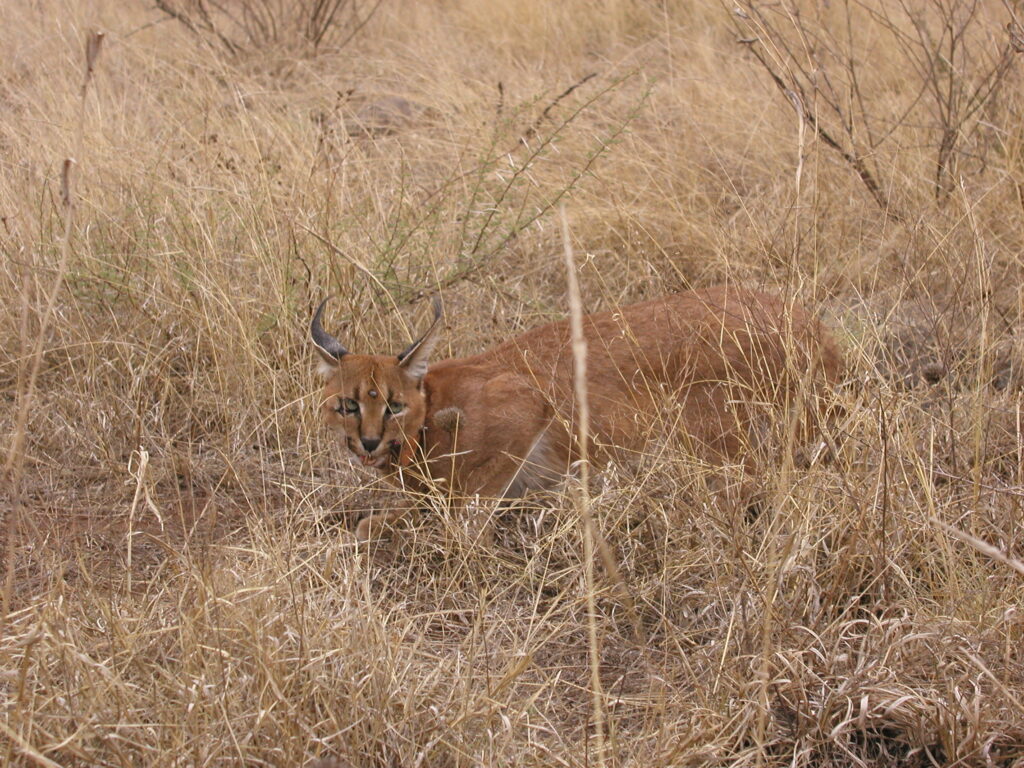
Caracal
Photo © Shaun MItchem
Photo © Shaun MItchem — CC BY 4.0 — Source: Wikimedia CommonsIdentification
The caracal is a slender, moderately sized wild cat with a distinctive appearance that sets it apart from other felines. It reaches 40–50 cm at the shoulder and weighs 8–19 kg, with males noticeably larger than females. The most striking features are its long, tufted ears bearing prominent 4.5 cm black tufts, which inspired its name—derived from the Turkish words meaning "black ear." The face is short with distinctive black facial markings, including two stripes running from the forehead to the nose and a black outline around the mouth, contrasted by white patches surrounding the eyes and mouth.
The caracal's coat is uniformly reddish tan or sandy, with lighter coloring on the underbelly and inner legs, often marked with small reddish spots. A notable distinction from the lynx, which it resembles, is that caracals lack the spotted or blotched pattern found on lynx coats. The body slopes downward from the rump due to hind legs being longer than forelegs, and the tan, bushy tail extends to the hocks. Long canine teeth and a robust build complete the caracal's formidable predatory profile.
Range & Habitat
The caracal is native to Africa, the Middle East, Central Asia, and arid areas of Pakistan and northwestern India. Three subspecies are recognized: the southern caracal, found in Southern and East Africa; the northern caracal in North and West Africa; and the Asiatic caracal across Asian regions. This wide distribution reflects the species' remarkable adaptability to diverse environments.
Caracals inhabit arid and semi-arid regions, thriving in landscapes where many other predators struggle. Their presence across such varied geography demonstrates their ability to survive in harsh, dry conditions where prey may be scarce and competition fierce.
Behaviour & Diet
The caracal is typically nocturnal and highly secretive, making it difficult to observe in the wild. It is territorial and lives mainly alone or in pairs. As a carnivore, it primarily preys upon birds, rodents, and other small mammals, employing remarkable hunting techniques honed by evolution. The caracal can leap higher than 3.0 m and possesses the extraordinary ability to catch birds in midair—a skill few terrestrial predators can match. Its hunting strategy involves stalking prey until within 5 m, then sprinting to deliver a killing bite to the throat or back of the neck.
Caracals become sexually mature by one year of age and breed throughout the year. Gestation lasts two to three months, resulting in litters of one to six kittens. Young caracals remain with their mothers for nine to ten months before becoming independent, though some females may stay longer. In captivity, caracals have an average lifespan of nearly 16 years.
Best Time & Places to See It
Observing caracals in the wild presents a significant challenge due to their nocturnal habits and secretive nature. Your best opportunities occur during dawn and dusk hours when caracals may be active. Patience and stillness are essential virtues for caracal-watchers. Arid and semi-arid regions across their range in Africa, the Middle East, and Asia offer the most promising prospects, though sightings remain rare for casual observers.
Wildlife reserves and protected areas within caracal range increase your chances of encounter, particularly in regions of East and Southern Africa where the southern subspecies is found. Local guides familiar with caracal sign and behavior patterns significantly improve the likelihood of a sighting, though even experienced trackers often go long periods without observing this elusive cat.
Photography Tips
Photographing caracals requires preparation for low-light conditions, as these cats are primarily nocturnal. A fast lens with good low-light performance and high ISO capability is essential. The caracal's distinctive facial features—particularly the ear tufts and facial markings—provide excellent photographic subjects when a sighting occurs. Frame shots to capture the characteristic black ear tufts and the striking white eye patches and mouth outline against the reddish-tan coat.
The caracal's long legs and sloping body posture offer dynamic compositional opportunities. If fortunate enough to witness a hunt or a leap, fast shutter speeds and burst mode will help capture this remarkable athleticism. The animal's solitary and pair-based lifestyle means you may encounter individuals in isolation, allowing for intimate portrait photography. Given the rarity of sightings, approach any encounter with respect for distance and the animal's comfort, using telephoto lenses to minimize disturbance while maximizing your ability to document this magnificent desert predator.
Serengeti National Park
Tanzania
+558 birds+57 mammals
Across Tanzania's northern plateau, where volcanic soils meet acacia woodland and open grassland, unfolds one of Earth's most dynamic ecosystems. The Serengeti National Park sprawls across…
VIEW NATIONAL PARKTsavo West National Park
Mwatate, Kenya
+513 birds+49 mammals
Where volcanic ridges and weathered lava flows meet the semi-arid lowlands of south-central Kenya, Tsavo West National Park unfolds across a landscape sculpted by fire and…
VIEW NATIONAL PARKNgorongoro Conservation Area
Tanzania
+626 birds+55 mammals
Volcanic calderas and open grassland dominate this high plateau in northern Tanzania, where the landscape rises above 2,000 metres and ancient geological forces have shaped both…
VIEW WILDLIFE MANAGEMENT AREAGarden Route National Park
George, South Africa
+353 birds+54 mammals
Sweeping across the Western Cape's coastal and mountainous terrain, this sprawling national park encompasses over five thousand square kilometers of extraordinarily diverse landscape—from coastal limestone cliffs…
VIEW NATIONAL PARKPilanesberg National Park
Moses Kotane Local Municipality, South Africa
+364 birds+49 mammals
Granite peaks and volcanic ridges rise unexpectedly from the savanna floor across this 734-square-kilometre expanse in the North West province, creating a landscape of profound ecological…
VIEW NATIONAL PARKKruger National Park
Ba-Phalaborwa Local Municipality, South Africa
+540 birds+91 mammals
Across the low-lying savanna of northeastern South Africa unfolds one of Africa's largest and most ecologically intact protected areas, where acacia woodlands merge into mopane scrub…
VIEW NATIONAL PARKAgulhas National Park
Cape Agulhas Local Municipality, South Africa
+224 birds+13 mammals
Where the Atlantic and Indian Oceans meet at Africa's southernmost tip, Agulhas National Park stretches across 892 square kilometres of windswept coastal landscape and rugged limestone…
VIEW NATIONAL PARKMountain Zebra National Park
Inxuba Yethemba Local Municipality, South Africa
+265 birds+35 mammals
Across the windswept plateaus and deeply incised valleys of the Eastern Cape's interior, Mountain Zebra National Park unfolds as a landscape of geological drama and ecological…
VIEW NATIONAL PARKAddo Elephant National Park
Sundays River Valley Local Municipality, South Africa
+388 birds+55 mammals
Where the Eastern Cape's semi-arid scrublands meet transitional woodland, Addo sprawls across 13,478 square kilometres of one of southern Africa's most biodiverse landscapes. The terrain rises…
VIEW NATIONAL PARKCamdeboo National Park
Camdeboo Local Municipality, South Africa
+272 birds+24 mammals
Granite ridges and weathered sandstone cliffs rise across a semi-arid landscape where the Karoo transitions into the eastern escarpment of South Africa, creating Camdeboo National Park's…
VIEW NATIONAL PARKEtosha National Park
Namibia
+356 birds+58 mammals
Across northern Namibia's stark semi-arid plateau, a vast shallow depression transforms seasonally into one of Africa's most dramatic wildlife theaters. Etosha National Park, encompassing more than…
VIEW NATIONAL PARKArabuko Sokoke Forest Reserve
Kilifi, Kenya
+383 birds+29 mammals
Coastal forest rises from the Indian Ocean plains of Kilifi County, where sandy soils and seasonal rainfall have sculpted a woodland ecosystem unlike anywhere else on…
VIEW NATURE RESERVENo community photos yet. Log in to add the first one.
No community observations of this species yet.