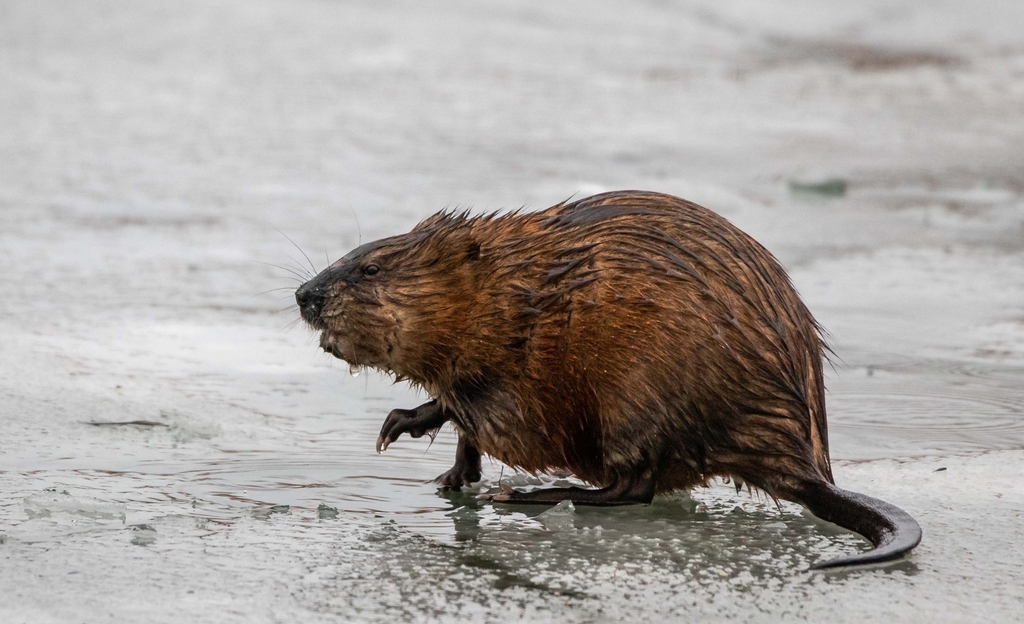
Common Muskrat
Photo © Derek Spencer
Photo © Derek Spencer — CC BY 4.0 — Source: iNaturalist photo #434580431Identification
The common muskrat is a medium-sized semiaquatic rodent weighing 0.6–2 kg, making it roughly four times heavier than a brown rat despite being only slightly longer. Adults measure about 40–70 cm in total length, with half of this being the distinctive tail. They are covered in short, thick fur that is medium to dark brown or black, with a lighter-coloured belly, and the fur gradually turns partly gray with age. The fur comprises two protective layers that insulate the animal in cold water.
The most distinctive feature is the long, scale-covered tail that is uniquely flattened vertically—quite different from the hair-covered tails of most rodents. When muskrats walk on land, their tails drag on the ground, creating easily recognizable tracks. These rodents are the largest members of the subfamily Arvicolinae, which includes voles and lemmings, and are considerably smaller than beavers, with which they often share habitats.
Range & Habitat
The muskrat is native to North America and has been introduced to parts of Eurasia and South America. The species is found in various wetland environments, where it plays a crucial ecological role. Muskrats inhabit streams, ponds, lakes, and marshes, constructing their homes according to the terrain and climate of their surroundings.
Behaviour & Diet
Muskrats are primarily nocturnal or crepuscular, most active at night or near dawn and dusk. They live in family groups consisting of a male, female, and their young, and often engage in territorial fights during spring. These animals are exceptional swimmers, capable of remaining underwater for 12 to 17 minutes. Their hind feet are partially webbed and provide the main propulsion for swimming, while their flattened tail functions as a rudder for directional control.
Muskrats construct elaborate nests for protection from cold and predators. In streams and ponds, they burrow into banks with underwater entrances 15–20 cm wide. In marshes, they build "push-ups"—structures made from vegetation and mud that can reach up to 90 cm in height. They also construct feeding platforms in the water from cut vegetation. Plant materials compose approximately 95% of their diet, primarily cattails and other aquatic vegetation, though they also consume small animals including freshwater mussels, frogs, crayfish, fish, and small turtles.
Best Time & Places to See It
Look for muskrats in freshwater wetlands including marshes, ponds, lakes, and streams throughout North America. The best viewing opportunities occur during their active periods at dawn, dusk, and night. In winter, watch for their trails under the ice and their characteristic push-ups protruding above snowy marshes. Spring is notable for increased territorial activity when muskrats are more visible as they compete for mates.
Photography Tips
Photograph muskrats during low-light conditions at dawn or dusk when they are most active. Look for them swimming in open water or along the edges of marshes and ponds. Patience is essential—position yourself quietly near known feeding areas or push-ups and wait for the animals to emerge. Their distinctive dragging tail tracks in mud or snow can help you locate active individuals. In winter, their push-ups are conspicuous landscape features that make excellent compositional elements, especially when framed against snowy backgrounds.
Acadia National Park
Alaska Maritime National Wildlife Refuge
Algonquin Provincial Park
Alpilles Regional Nature Park
Arches National Park
Arctic National Wildlife Refuge
Avesnois Regional Nature Park
Banff National Park
Bear River Migratory Bird Refuge
Nothing matches these filters.
No community photos yet. Log in to add the first one.
No community observations of this species yet.