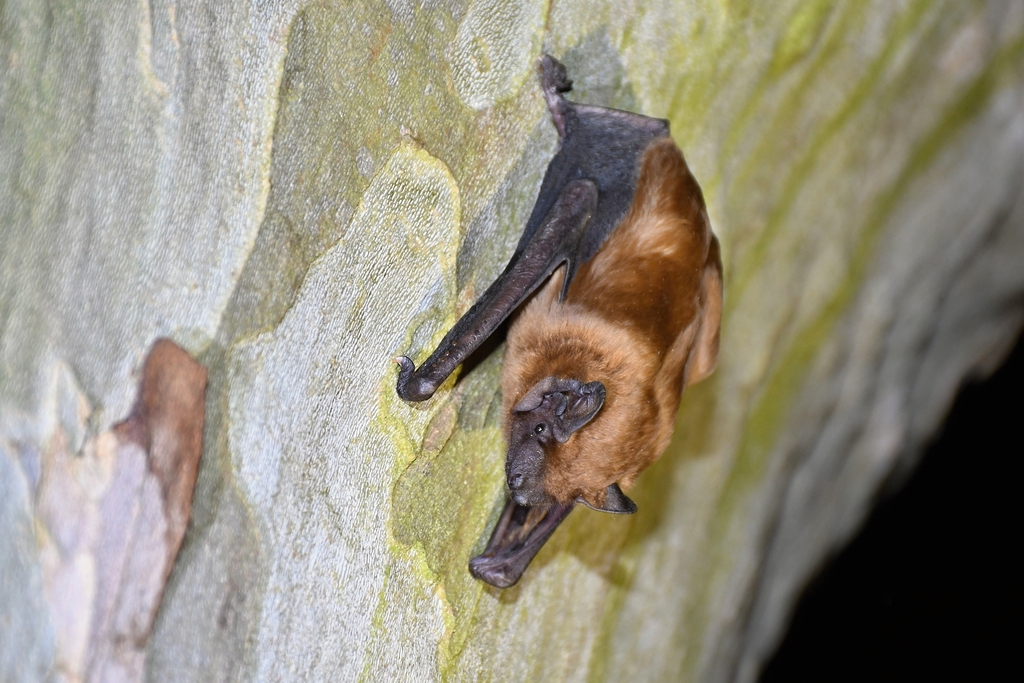
Common Noctule
Photo © Daniel Benák
Photo © Daniel Benák — CC BY 4.0 — Source: iNaturalist photo #285744616Identification
The common noctule is a robust bat with a distinctive pointed snout and large ears essential for echolocation. Adults weigh 25–30 g with a wingspan of 37–40 cm (15–16 in). Its short fur is dark brown immediately after moulting in June (males) or July/August (females), later changing to red-brown before winter. When airborne, noctules are characterized by their long, broad wings and rapid, powerful flight.
Range & Habitat
This species is common throughout Europe, Asia, and North Africa, ranging from western Europe through central Russia, across the Ural Mountains, the Caucasus, Turkey, and the Near East to southwestern Siberia, the Himalayas, China, Malaysia, Taiwan, and Japan. Noctules typically occur at altitudes up to 2,000 meters across diverse habitats including deciduous forests, agricultural landscapes, and small to medium-sized woodlands. They have adapted exceptionally well to urban environments, with thriving populations in cities such as Hamburg, Vienna, and Brno.
The species commonly roosts in tree cavities and buildings—particularly attics—during daylight hours, though bat boxes attached to trees are also utilized. Despite their woodland preference, noctules forage up to 20 kilometers away from woodland at night, often exploiting street lights to locate insects.
Behaviour & Diet
Common noctules are renowned for their high-flying foraging technique, hunting at altitudes reaching 1,000 meters with speeds of 20–60 km/h. They begin flying in early dusk, earlier than most European bats, and possess short daily activity periods totaling one hour or less before sunrise and after sunset. This means they must cope with up to twenty-three hours of fasting daily due to the temporal scarcity of insect prey.
Their diet consists mainly of beetles, moths, and winged ants, which they detect using sophisticated echolocation. The species uses two main echolocation calls: one at 26–47 kHz (peaking at 27 kHz) and another at 22–33 kHz (peaking at 22 kHz). Noctules are highly migratory, with females traveling from northern breeding grounds—as far as the Baltic region—to southern wintering areas hundreds of kilometers away, while males remain sedentary. Females give birth to one or two young annually after six to eight weeks of pregnancy, rearing offspring to full size on milk alone within three to four weeks.
Best Time & Places to See It
Noctules are most active during dusk and early evening hours, making early evening the prime time to observe them in flight. Summer is ideal for seeing solitary males or small bachelor groups in forested areas, while late summer and early autumn offer opportunities to observe males displaying elaborate singing behavior to attract females in harem roosts. Urban observers should look toward street lights after sunset, where insects concentrate and noctules hunt.
Central European cities offer reliable viewing opportunities year-round. In winter, hibernation colonies sometimes exceed 1,000 individuals in caves, church steeples, and building cavities, though these roosting sites require careful approach to avoid disturbing the hibernating bats.
Photography Tips
Photographing noctules requires preparation for low-light conditions and fast-moving subjects. Position yourself near street lights or forest edges during early dusk to capture them in flight against remaining twilight. Their high-flying foraging behavior means wide-angle compositions may work better than traditional close-ups. Fast shutter speeds (1/1000 or faster) are essential to freeze their rapid wing beats. Early autumn offers additional opportunities to capture males' dramatic courtship displays in harem roosts, though these require specialized permits and careful ethics to avoid disturbance.
Stenshuvuds National Park
Skåne län, Sweden
+224 birds+19 mammals
Where limestone cliffs rise sharply above the Øresund Strait, Stenshuvuds National Park commands the southeastern tip of Skåne, a landscape carved by glaciation into rolling beech…
VIEW NATIONAL PARKFärnebofjärden National Park
Gävleborgs län, Sweden
+170 birds+20 mammals
Where the Gävle River widens into a sprawling delta before meeting the Gulf of Bothnia, Färnebofjärden National Park unfolds across a landscape of exceptional ecological complexity.…
VIEW NATIONAL PARKSöderåsens National Park
Skåne län, Sweden
+136 birds+18 mammals
Steep beech-clad ravines and limestone escarpments carve through the landscape of southern Sweden's Skåne region, creating Söderåsens—a textbook example of temperate woodland gorge habitat. The park's…
VIEW NATIONAL PARKSchleswig-Holsteinisches Wattenmeer National Park
Germany
+378 birds+49 mammals
Where the North Sea ebbs and flows across a vast expanse of exposed mud and sand, the Schleswig-Holsteinisches Wattenmeer National Park reveals one of Europe's most…
VIEW NATIONAL PARKPembrokeshire Coast National Park
Pembrokeshire, United Kingdom
+250 birds+41 mammals
Where the Cambrian coastline meets the Celtic Sea, cliff-top moorland and hidden coves define a landscape carved by 300 million years of geological drama. Pembrokeshire Coast…
VIEW NATIONAL PARKEryri National Park
Gwynedd, United Kingdom
+199 birds+36 mammals
Where granite peaks rise abruptly from the Snowdonia landscape, Eryri National Park encompasses one of Britain's most dramatic mountain terrain. The park's rugged plateaus, deep glacial…
VIEW NATIONAL PARKLake District National Park
Westmorland and Furness, United Kingdom
+209 birds+36 mammals
Where slate fells rise steeply from mirror-still waters, the Lake District unfolds as one of Britain's most ecologically intricate mountain landscapes. The park's patchwork of deep…
VIEW NATIONAL PARKYorkshire Dales National Park
North Yorkshire, United Kingdom
+169 birds+25 mammals
Limestone pavements and deep limestone gorges carved by glaciation dominate the landscape of the Yorkshire Dales, creating a landscape of exceptional geological drama where moorland plateaus…
VIEW NATIONAL PARKBannau Brycheiniog National Park
Powys, United Kingdom
+178 birds+36 mammals
Where sandstone ridges rise above the rolling moorlands of mid-Wales, Bannau Brycheiniog National Park protects one of Britain's most compelling upland landscapes. The park's dramatic peaks,…
VIEW NATIONAL PARKNorth York Moors National Park
North Yorkshire, United Kingdom
+234 birds+32 mammals
Across the high moorlands of North Yorkshire, where heather and bilberry sprawl beneath vast skies, the landscape rises and falls in gentle undulation—a patchwork of open…
VIEW NATIONAL PARKNorthumberland National Park
Northumberland, United Kingdom
+133 birds+20 mammals
Granite ridges and moorland sweep across the Cheviot Hills in northern England, where windswept uplands give way to deep river valleys carved through ancient bedrock. Northumberland…
VIEW NATIONAL PARKSouth Downs National Park
Chichester, United Kingdom
+298 birds+45 mammals
Chalk downland ridges rise and fall across the South Downs, their open grasslands and beech hangers creating a mosaic of habitats that has shaped human settlement…
VIEW NATIONAL PARKDartmoor National Park
West Devon, United Kingdom
+162 birds+33 mammals
Across the high moorlands of Devon, where granite tors pierce through rolling heather and acid grassland, Dartmoor rises as one of Britain's most expansive upland wilderness…
VIEW NATIONAL PARKCévennes National Park
Vebron, France
+187 birds+63 mammals
Where granite gorges slice through the limestone plateaux of southern France, the Cévennes Cœur National Park unfolds across nearly 3,500 square kilometres of one of Europe's…
VIEW NATIONAL PARKForêts National Park
Lucey, France
+140 birds+50 mammals
Across the rolling plateaux of central Burgundy, where limestone uplands give way to deep valleys carved by time and water, lies a landscape of profound ecological…
VIEW NATIONAL PARKAggtelek National Park
Szin, Hungary
+119 birds+13 mammals
Where limestone karst terrain rises and plunges across North Hungary's borderlands, Aggtelek National Park unfolds across 543 square kilometres of one of Europe's most geologically dramatic…
VIEW NATIONAL PARKÅsnens National Park
Kronoberg County, Sweden
+141 birds+8 mammals
Where forest meets water in the heart of Kronoberg County, Åsnens National Park unfolds across roughly 57 square kilometres of southern Swedish landscape, a mosaic of…
VIEW NATIONAL PARKCamargue Regional Nature Park
Saintes-Maries-de-la-Mer, France
+378 birds+48 mammals
Where the Rhône Delta sprawls into the Mediterranean, a landscape of stark and haunting beauty emerges—vast salt marshes punctuated by shallow lagoons, reed beds, and scrubland…
VIEW NATURAL PARKMachakhela Planned National Park
Skurdidi, Georgia
+32 birds+2 mammals
Where the Lesser Caucasus mountains plunge toward the lowlands of southern Georgia, a landscape of dramatic contrasts unfolds. Steep limestone canyons carve through mixed deciduous and…
VIEW NATIONAL PARKRegional Park of the Catalan Pyrenees
Olette, France
+244 birds+63 mammals
Where granite peaks thrust skyward above cloud-laden valleys, a wild tapestry of Mediterranean and alpine ecosystems interweaves across the Franco-Spanish frontier. These Pyrenean slopes harbour extraordinary…
VIEW NATURE RESERVELoch Lomond & the Trossachs National Park
Duchray, United Kingdom
+188 birds+40 mammals
Where ancient woodlands rise from glassy lochs and rugged Highland peaks pierce the lowland horizon, Scotland's most biodiverse landscape unfolds across 720 square kilometres of wild…
VIEW NATIONAL PARKVratsa Balkan
Zgorigrad, Bulgaria
+128 birds+10 mammals
Where limestone cliffs plunge into deep river canyons and beech forests give way to rocky karst plateaus, one of Bulgaria's most dramatic mountain landscapes unfolds across…
VIEW NATURE RESERVELahemaa National Park
Lääne-Viru County, Estonia
+237 birds+25 mammals
Where the Baltic coast meets temperate forest in northwestern Estonia, Lahemaa National Park sprawls across more than 1,300 square kilometers of deeply character-filled terrain. Coastal wetlands…
VIEW NATIONAL PARKWolin National Park
Kamień County, Poland
+232 birds+21 mammals
Where the Baltic shoreline meets vast wetland complexes and Pleistocene woodlands, Wolin National Park unfolds across nearly 440 square kilometres of northwestern Poland's most biodiverse terrain.…
VIEW NATIONAL PARKKampinos National Park
Roztoka, Poland
+183 birds+18 mammals
Sandy pine forests and wetland mosaics spread across the glacial plains northwest of Warsaw, where Kampinos National Park protects one of central Europe's most distinctive lowland…
VIEW NATIONAL PARKUjście Warty National Park
Gorzów County, Poland
+212 birds+9 mammals
Where the Warta River spreads into its delta before joining the Oder, wetland and woodland merge into one of central Europe's most vital ecological crossroads. Ujście…
VIEW NATIONAL PARKBiałowieża National Park
Bialowieza, Poland
+177 birds+23 mammals
Straddling the border between Poland and Belarus, this primordial forest landscape encompasses one of Europe's last remaining expanses of old-growth woodland, where ancient trees rise through…
VIEW NATIONAL PARKCaerlaverock National Nature Reserve
Carsethorn, United Kingdom
+109 birds+16 mammals
Where the Solway Firth meets the Scottish coast, saltmarsh and mudflat create a landscape shaped by tidal rhythms and temperate maritime climate. Caerlaverock's mosaic of habitats—brackish…
VIEW NATURE RESERVEDyfi National Nature Reserve
Aberdyfi, United Kingdom
+148 birds+25 mammals
Where the River Dyfi widens into a broad coastal basin, a 2,400-hectare mosaic of saltmarsh, reedbed, mudflat and freshwater wetland spreads across the Cardigan Bay estuary…
VIEW NATURE RESERVEBerwyn National Nature Reserve
Llangywer, United Kingdom
+77 birds+11 mammals
Where the Berwyn Mountains rise across the borderlands of north Wales, upland moorland and mixed woodland create a landscape of profound ecological richness, shaped by oceanic…
VIEW NATURE RESERVECors Fochno National Nature Reserve
Borth, United Kingdom
+179 birds+27 mammals
Where the Dovey Estuary opens to the Irish Sea, a sprawling wetland mosaic of reedbed, fen and mire transforms the coastal flats of mid-Wales into one…
VIEW NATURE RESERVEKielderhead National Nature Reserve
Catcleugh, United Kingdom
+108 birds+21 mammals
High moorland sweeps across the Pennines at Kielderhead, where blanket bog and heathland dominate a landscape shaped by cool, moist Atlantic winds and the reserve's temperate…
VIEW NATURE RESERVENo community photos yet. Log in to add the first one.
No community observations of this species yet.