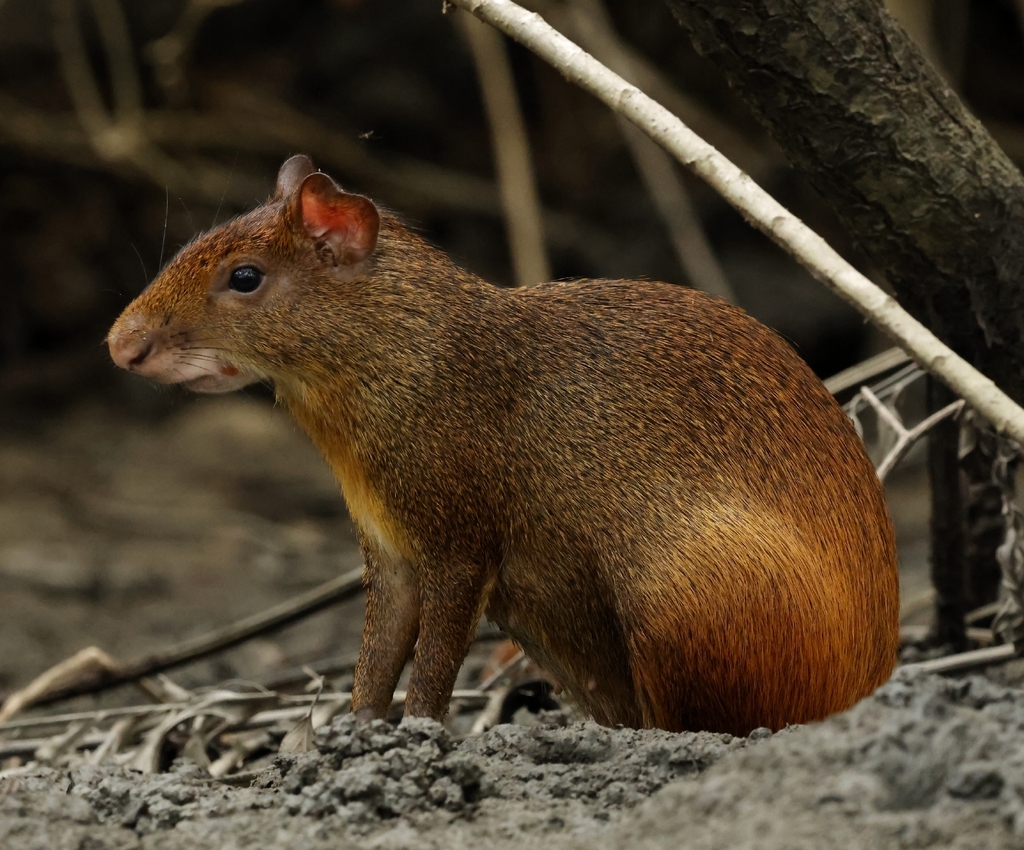
Common Red-rumped Agouti
Photo © Miguel
Photo © Miguel — CC BY-SA 4.0 — Source: iNaturalist #361870646The red-rumped agouti (Dasyprocta leporina), also known as the golden-rumped agouti, orange-rumped agouti or Brazilian agouti, is a species of agouti from the family Dasyproctidae. == Distribution == It is native to northeastern South America, mainly in Venezuela, Guyana, Suriname, French Guiana, northeastern Brazil, Trinidad and Tobago and Saint Lucia in the Caribbean. It has also been introduced to Florida, the U.S. Virgin Islands, Grenada, and Dominica. == Names == Despite the alternative name Brazilian agouti, it is neither the only nor the most widespread species of agouti in Brazil. In Brazil all agoutis are often called "cutia" [kuˈtʃiɐ]. == Habitat == It is found in a wide range of forests, including rainforest and secondary forest. == Description == The red-rumped agouti weighs about 3 to 6 kilograms (6.6 to 13.2 lb). It is about 48 to 64 cm (19 to 25 in) long. The females are larger than males but otherwise look similar. It is brownish with darker spots on the upper body. The fur becomes more orange as it goes past (going down) the middle area of the animal. The ears are somewhat square in shape. The front feet have four toes and the back have three each.…
Tijuca National Park
Brazil
+317 birds+13 mammals
Where the Atlantic forest rises steeply from Rio de Janeiro's urban edge, Tijuca National Park encompasses a landscape of dramatic granite peaks, cascading waterfalls, and closed-canopy…
VIEW NATIONAL PARKViruá National Park
Brazil
+389 birds+6 mammals
Across the northern frontier of Roraima, where the forest canopy rises from ancient Amazonian lowlands, Viruá National Park protects nearly 3,700 square kilometres of terra firme…
VIEW NATIONAL PARKAmazônia National Park
Brazil
+439 birds+6 mammals
Where the Rio Amazonas and its tributaries weave through the heart of Pará state, a vast tapestry of rainforest stretches across 23,611 square kilometers of unbroken…
VIEW NATIONAL PARKNo community photos yet. Log in to add the first one.
No community observations of this species yet.