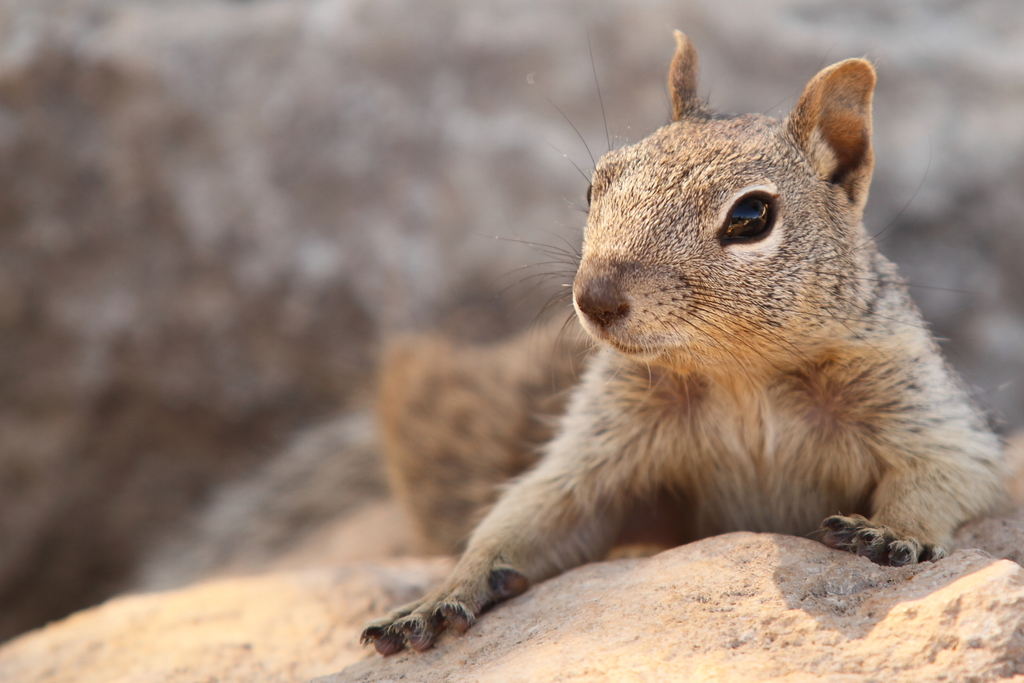
Common Rock Squirrel
Photo © BJ Smit
Photo © BJ Smit — CC BY 4.0 — Source: iNaturalist photo #90004Identification
The Common Rock Squirrel is one of the largest members of the squirrel family, with adults reaching up to 21 inches (53 cm) in length. Their distinctive coat is speckled grayish brown on the front and top, transitioning to a mottled brownish-black on the rear and underside. A striking light-colored ring encircles each eye, and their pointed ears project noticeably above their heads. Their long, bushy tail features distinctive white edges, making it a key identifying feature in the field.
Range & Habitat
Native to Mexico and the Southwestern United States, Common Rock Squirrels are found in southern Nevada, Utah, Colorado, Arizona, New Mexico, Texas, and Oklahoma's panhandle. In Texas, they are especially common in the Hill Country region. These squirrels have specialized habitat requirements, inhabiting rocky mountains, canyon walls, cliffs, and steep rocky hills. In Mexico, they occupy areas of Jalisco, Guerrero, Guanajuato, Mexico, Morelos, Colima, and Puebla, notably absent from eastern coastal lowlands.
Behaviour & Diet
Rock Squirrels are highly social, living in colonies dominated by one male who defends the group against rivals. They are most active during early morning and late afternoon, estivating during extreme heat. In northern regions they hibernate; southern populations may remain active year-round. They can survive extended periods without water, sometimes up to 100 days. Predominantly herbivorous, they eat leaves, stems, seeds, acorns, pine nuts, juniper berries, agaves, and cacti, occasionally supplemented with grasshoppers, beetles, earthworms, and small vertebrates. Females produce two litters annually, typically born April–June and August–September.
Best Time & Places to See It
Early morning and late afternoon hours offer the best viewing opportunities when these squirrels are most active. The Texas Hill Country provides excellent locations for observation. Rocky terrain with canyons, cliff faces, and steep hills represents their preferred habitat. Look for them foraging in trees, bushes, and on the ground, or resting and sunbathing on high rocks and stumps where they can watch for predators and communicate with colony members.
Photography Tips
Position yourself near rocky outcrops and canyon walls where squirrels regularly forage. Early morning light enhances the detail of their speckled coat and distinctive facial markings. The white-edged tail and light eye-rings are key features to capture. Since foraging trips typically last only about 12 minutes, patience and anticipation are essential. Watch for them climbing trees and bushes, as elevated vantage points provide excellent photographic opportunities with natural rocky backgrounds.
Arches National Park
Big Bend National Park
Black Canyon of the Gunnison National Park
Bosque del Apache National Wildlife Refuge
Bryce Canyon National Park
Capitol Reef National Park
Carlsbad Caverns National Park
Cave Creek Canyon
Chiricahua Mountains
Nothing matches these filters.
No community photos yet. Log in to add the first one.
No community observations of this species yet.