Common Tent-making Bat
Photo © Rosario Douglas
Photo © Rosario Douglas — CC BY 4.0 — Source: iNaturalist photo #372573858Identification
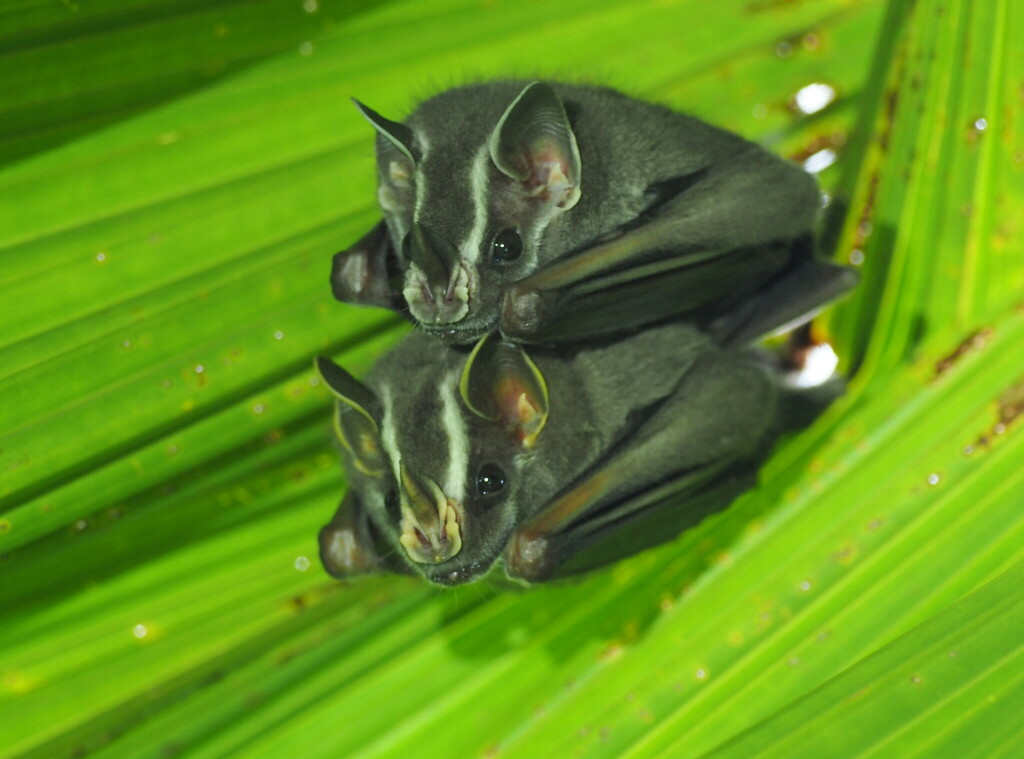
The common tent-making bat is a medium-sized species, weighing between 13 and 20 grams with a body length of 59–69 mm. Its most distinctive feature is a thin, white stripe running down the middle of the back from behind the head to the rump, contrasting against its gray to grayish-brown coat. The face is equally striking, marked by two symmetrical pairs of white stripes: one pair running over the head between and behind the ears, and another just below the eyes. This facial pattern may serve as camouflage by making the eyes less obvious to predators. The nose-leaf and ears are rimmed with yellow or white, and the bat possesses a characteristic U-shaped tail membrane that is practically hairless.
Range & Habitat
This species is found throughout lowland forests of Central and South America, ranging from Oaxaca and Veracruz in Mexico through Central America to Peru, Bolivia, and southeastern Brazil, with populations also present on the island of Trinidad. Most specimens occur below 600 meters elevation, though some have been recorded as high as 1500 meters. The bats inhabit low-elevation evergreen and deciduous forests, second-growth forests, and fruit groves.
Behaviour & Diet
The common tent-making bat's name derives from its remarkable behavior of constructing tents from large, fan-shaped leaves. These ingenious roosts provide excellent protection from tropical rainfall and typically house several bats simultaneously. The species is primarily frugivorous, with particular preference for small, unripe figs, palm fruit pericarp, and common guavas. To supplement this diet, they occasionally feed on insects, flower parts, nectar, and pollen. As an important seed disperser, this bat plays a significant ecological role in its forest habitats. Interestingly, these bats spend only about 30 minutes per day in active flight, an adaptation linked to their efficient energy conservation strategy.
Best Time & Places to See It
The common tent-making bat is quite common throughout its geographic range and listed as Least Concern for conservation status, making it a reliable species for observers in Central and South American lowland forests. The bats are nocturnal foragers, so evening observations around fruiting trees and known tent roosts offer the best opportunities. In some regions, such as Costa Rica, females congregate in coconut groves during the wet season beginning in July, potentially offering increased sighting opportunities during these periods.
Photography Tips
Photographing these bats presents moderate challenges due to their nocturnal habits and relatively modest size. Focus your efforts on locating their characteristic leaf tents during daylight hours, then position yourself nearby at dusk when bats emerge to forage. Use high-speed film or digital sensors with good low-light performance, and consider employing infrared or red-light illumination to minimize disturbance. The bats' striking facial markings and white dorsal stripe make them visually distinctive subjects—position yourself to capture these diagnostic features when the opportunity arises.
Corcovado National Park
Puerto Jiménez, Costa Rica
+444 birds+48 mammals
Where the Osa Peninsula juts into the Pacific, rainforest descends almost to the tide line, and Corcovado National Park protects one of Central America's most intact…
VIEW NATIONAL PARKManuel Antonio National Park
Quepos, Costa Rica
+426 birds+22 mammals
Where tropical rainforest descends steeply to a rocky Pacific coastline, Manuel Antonio National Park distills Central American biodiversity into one of Costa Rica's most compressed and…
VIEW NATIONAL PARKPiedras Blancas National Park
Golfito, Costa Rica
+386 birds+24 mammals
Where the Golfo Dulce meets the southwestern Pacific coast of Costa Rica, Piedras Blancas National Park protects a dramatic transition zone where lowland rainforest descends toward…
VIEW NATIONAL PARKNatural Sierra de Chiribiquete National Park
Solano, Colombia
+359 birds+27 mammals
Massive table-top mountains rise abruptly from the lowland rainforest of southeastern Colombia, their sheer sandstone cliffs and isolated summits creating some of the most dramatic topography…
VIEW NATIONAL PARKSoberanía National Park
Cristóbal, Panama
+495 birds+34 mammals
Rainforest and riverine woodland blanket the rolling terrain of this 714-square-kilometre national park in Colón Province, where the Caribbean watershed feeds a maze of streams and…
VIEW NATIONAL PARKDarién National Park
Tucutí, Panama
+534 birds+13 mammals
Where the spine of Central America crumbles into wetland and rainforest, Darién National Park sprawls across more than 20,000 square kilometres of some of the tropics'…
VIEW NATIONAL PARKMontes Azules
Candelaria, Mexico
+395 birds+47 mammals
Where jungle-clad limestone plateaus plunge into canyon systems carved by the Usumacinta River, Mexico's most pristine rainforest reserve unfolds across the Lacandón region of Chiapas. Montes…
VIEW BIOSPHERE RESERVECarara National Park
Tárcoles, Costa Rica
+397 birds+19 mammals
Where the Pacific coastal plain meets transitional forest, Carara National Park straddles one of Central America's most dynamic ecological boundaries. The park's landscape encompasses lowland deciduous…
VIEW NATIONAL PARKBarra del Colorado National Wildlife Refuge
Tortuguero, Costa Rica
+462 birds+36 mammals
Where the Caribbean's restless waters meet the Limón Province coastline, Barra del Colorado National Wildlife Sanctuary unfolds across a landscape of extraordinary ecological complexity. This equatorial…
VIEW WILDLIFE SANCTUARYNo community photos yet. Log in to add the first one.
No community observations of this species yet.