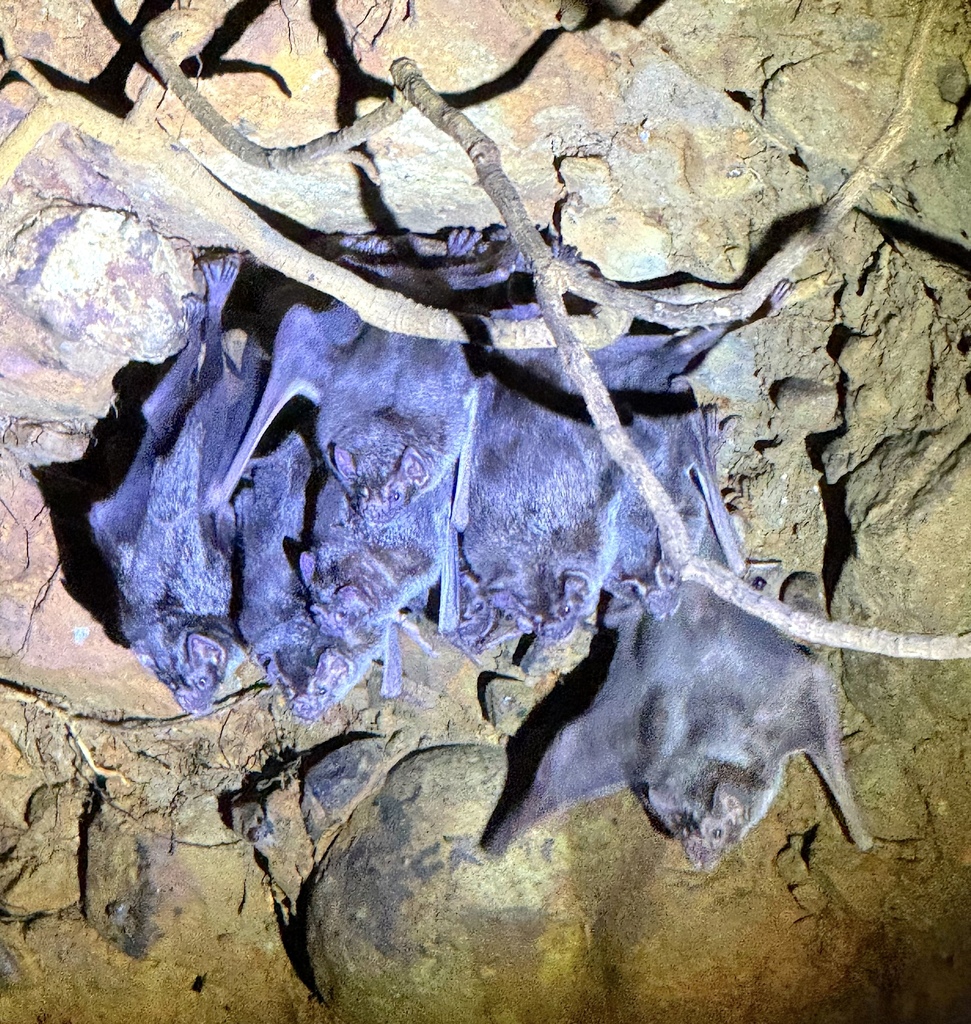
Common Vampire Bat
Photo © desertnaturalist
Photo © desertnaturalist — CC BY 4.0 — Source: iNaturalist #335290067Identification
The common vampire bat is a small, leaf-nosed bat averaging about 9 cm (3.5 in) long with a wingspan of 18 cm (7 in), weighing 25–40 grams under normal conditions. It is immediately recognizable by its distinctive flat, leaf-shaped nose and deeply grooved lower lip. The bat has short hair with silver-gray fur on its undersides, contrasting with darker fur on its back. A well-developed, clawed thumb on each wing is notably longer than in related vampire bat species, aiding in climbing and takeoff. The bat has a relatively large braincase and reduced snout that accommodates prominent razor-sharp upper incisors lacking enamel, along with reduced canines—it has the fewest teeth among all bat species, numbering only 18.
Range & Habitat
The common vampire bat is found throughout parts of Mexico, Central America, South America, and the Caribbean islands of Margarita and Trinidad. Its range extends as far north as 280 kilometres south of the Mexico–United States border and as far south as Uruguay, northern Argentina, and central Chile. The species is particularly common in southeastern Brazil and prefers warm, humid climates.
These bats roost in trees, caves, abandoned buildings, old wells, and mines, typically occupying the darkest and highest places within roosts shared with about 45 other bat species. They forage in tropical and subtropical woodlands and open grasslands, typically hunting within 5 to 8 km of their roosts.
Behaviour & Diet
The common vampire bat is one of the world's only true blood-feeding mammals, practicing hematophagy and feeding primarily on mammalian blood, particularly that of livestock such as cattle and horses. The bat hunts at night using echolocation and olfaction to locate prey while they sleep. It possesses good eyesight for long-range orientation and highly developed senses of smell and hearing, including a cochlea sensitive to low-frequency acoustics.
Once it selects a target, the bat uses its razor-sharp teeth to cut open the skin and laps up blood with its long tongue. Despite feeding on wild prey like tapirs, the species favors domesticated animals. The common vampire bat is one of the most social bat species, exhibiting highly polygynous mating behavior where dominant adult males defend groups of females. It demonstrates numerous cooperative behaviors including social grooming and food sharing among colony members. Uniquely among bats, vampire bats can maneuver effectively on land using a distinctive bounding gait powered by their forelimbs, with three pads under the thumb functioning like a sole.
Best Time & Places to See It
The common vampire bat is active throughout the year in its tropical and subtropical range. Southeastern Brazil offers the best opportunities to encounter this species, as it is the most common bat species in that region. Look for them emerging from roosts in caves, abandoned buildings, old wells, and mines at dusk, when they begin their nightly hunts. Visiting during the warmer months in Central and South America will maximize encounter opportunities.
Photography Tips
Photographing common vampire bats presents unique challenges due to their nocturnal nature and preference for dark roost sites. Fast film, high ISO settings, and artificial lighting are essential for capturing images in the low-light conditions of caves and abandoned structures where they roost. Their small size (9 cm long) requires macro or telephoto lenses to capture detail. The distinctive facial features—the leaf-shaped nose and grooved lower lip—make excellent subjects when the bat is at rest. Since they fly with their mouths open for echolocation, you may capture this characteristic behavior in flight photography. Exercise caution and respect when approaching roosts, as disturbance can stress colonies.
Corcovado National Park
Puerto Jiménez, Costa Rica
+444 birds+48 mammals
Where the Osa Peninsula juts into the Pacific, rainforest descends almost to the tide line, and Corcovado National Park protects one of Central America's most intact…
VIEW NATIONAL PARKPiedras Blancas National Park
Golfito, Costa Rica
+386 birds+24 mammals
Where the Golfo Dulce meets the southwestern Pacific coast of Costa Rica, Piedras Blancas National Park protects a dramatic transition zone where lowland rainforest descends toward…
VIEW NATIONAL PARKSanta Rosa National Park
Santa Elena, Costa Rica
+359 birds+30 mammals
Where Pacific-facing slopes descend from volcanic uplands toward the Guanacaste lowlands, Santa Rosa National Park unfolds across a mosaic of tropical dry forest, gallery woodland, and…
VIEW NATIONAL PARKLlanganates National Park
Tena, Ecuador
+239 birds+8 mammals
Where the eastern slopes of the Andes plunge toward the Amazon basin, Llanganates National Park sprawls across nearly 3,500 square kilometers of montane wilderness, its terrain…
VIEW NATIONAL PARKNatural Farallones de Cali National Park
Buenaventura, Colombia
+733 birds+27 mammals
Where the Pacific coastal plain meets the western slopes of the Andes, Farallones de Cali National Park sprawls across nearly 3,500 square kilometers of dramatic topography…
VIEW NATIONAL PARKNatural Sierra de la Macarena National Park
Vista Hermosa, Colombia
+566 birds+15 mammals
Across nearly 20,000 square kilometres of Colombia's Meta Department, the terrain rises from lowland savanna into Andean foothills through a mosaic of gallery forests, palm-fringed wetlands,…
VIEW NATIONAL PARKCatimbau National Park
Brazil
+118 birds+6 mammals
Where sandstone plateaus rise from the semi-arid scrublands of northeastern Brazil, Catimbau National Park unfolds across more than 1,000 square kilometres of geological drama and surprising…
VIEW NATIONAL PARKEl Palmar National Park
Distrito Sexto, Argentina
+244 birds+14 mammals
Across the Paraná River floodplain in northeastern Argentina, palms rise from wetland and grassland in a landscape shaped by water and time. El Palmar National Park…
VIEW NATIONAL PARKSierra de Tamaulipas
El Porvenir, Mexico
+98 birds+19 mammals
Where limestone peaks thrust skyward through dense subtropical forest, Mexico's northeastern frontier reveals one of the continent's most biodiverse mountain ranges. Canyons carved by perennial rivers…
VIEW NATURE RESERVELaguna del Tigre National Park
Petén, Guatemala
+399 birds+29 mammals
Where the Petén lowlands dissolve into wetland and forest, Laguna del Tigre National Park protects one of Guatemala's most ecologically vital landscapes. This sprawling reserve encompasses…
VIEW NATIONAL PARKPalo Verde National Park
Bagaces, Costa Rica
+318 birds+24 mammals
Dry forest spreads across Palo Verde's low-lying terrain in northwestern Guanacaste, where seasonal rivers and lagoons etch through deciduous woodland that sheds its canopy each winter.…
VIEW NATIONAL PARKCaño Negro National Wildlife Refuge
Caño Negro District, Costa Rica
+486 birds+16 mammals
Where the San Juan River's seasonal floodplain opens into expansive wetlands, Caño Negro Wildlife Sanctuary sprawls across one of Central America's most productive freshwater ecosystems. This…
VIEW WILDLIFE SANCTUARYBarra del Colorado National Wildlife Refuge
Tortuguero, Costa Rica
+462 birds+36 mammals
Where the Caribbean's restless waters meet the Limón Province coastline, Barra del Colorado National Wildlife Sanctuary unfolds across a landscape of extraordinary ecological complexity. This equatorial…
VIEW WILDLIFE SANCTUARYNo community photos yet. Log in to add the first one.
No community observations of this species yet.