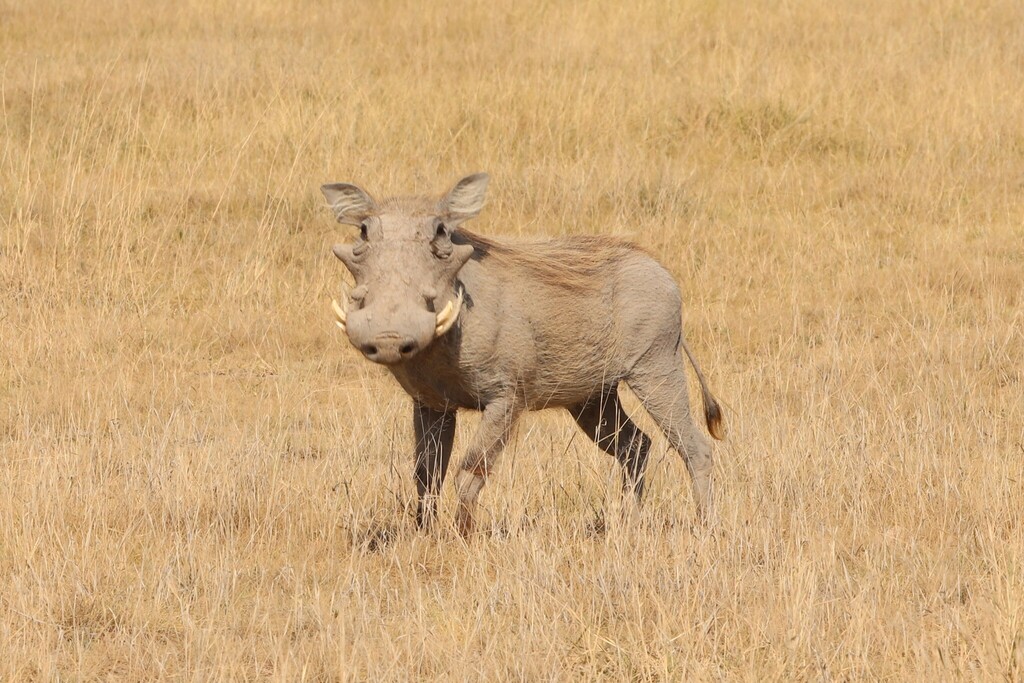
Common Warthog
Photo © Adrien Jailloux
Photo © Adrien Jailloux — CC BY 4.0 — Source: iNaturalist photo #608898685Identification
The common warthog is a medium-sized pig with a distinctive appearance dominated by its remarkable tusks. Adults measure 0.9 to 1.5 metres in head-and-body length, with shoulder heights between 63.5 and 85 centimetres. Females weigh 45 to 75 kilograms, while males are considerably heavier at 60 to 150 kilograms. The species is instantly recognisable by two pairs of tusks curving upwards from the mouth—the lower pair shorter but razor-sharp from constant friction against the upper pair, while the upper canines can grow to 25.5 centimetres long. These tusks are used for combat and defence, not digging.
Beyond the tusks, common warthogs have a large head with a prominent mane running down the spine to the middle of the back. Their body is covered in sparse hair, typically black or brown in colour, with a long tail ending in a distinctive tuft. Notably, warthogs lack subcutaneous fat and their thin coat makes them sensitive to extreme temperatures, which influences their behaviour throughout the year.
Range & Habitat
The common warthog is found throughout sub-Saharan Africa in grassland, savanna, and woodland environments. It is the only pig species to have successfully adapted to grazing in savanna habitats, distinguishing it from its relatives within the Suidae family. The species occupies a range that excludes the desert warthog, which is restricted to northern Kenya, Somalia, and eastern Ethiopia.
Behaviour & Diet
Common warthogs are omnivorous feeders with a diet that changes seasonally. During wet seasons, they graze on short perennial grasses, while dry seasons see them subsisting on bulbs, rhizomes, and nutritious roots. They also consume berries, fruits, bark, fungi, insects, eggs, and carrion. When feeding, warthogs often bend their front feet backwards and move around on their wrists—a behaviour supported by specialised calloused pads that develop early in foetal life. Though capable of digging their own burrows, they frequently occupy abandoned holes made by aardvarks and other animals, backing into them rear-first with tusks facing outward as a defensive posture.
Warthogs are social animals living in groups called sounders, typically comprising females and their young. Males are largely solitary once adult, though subadult males associate in bachelor groups. When threatened, their primary defence is to flee at speeds of up to 48 kilometres per hour with their tails raised high. They face predation from lions, leopards, cheetahs, crocodiles, wild dogs, hyenas, and humans. To manage temperature extremes, warthogs wallow in mud during heat and huddle together in cold conditions.
Best Time & Places to See It
Common warthogs inhabit the savannas and grasslands across sub-Saharan Africa, making them accessible to wildlife travellers in many popular safari destinations. They are seasonal breeders, with rutting beginning in the late rainy or early dry season and birthing near the start of the following rainy season. Your best opportunities to observe them come during the rainy seasons when grasses are lush and warthogs are actively grazing in open habitats, and during dry seasons when they concentrate around waterholes and feeding areas.
Photography Tips
Photograph warthogs in open grassland and savanna where their distinctive silhouettes are most striking. The characteristic upright tail and lowered head posture during grazing create memorable compositions. Early morning and late afternoon light accentuates their sparse hair and highlights the impressive tusks. When warthogs are near their burrows, be patient and ready for the remarkable moment when they reverse in rear-first with tusks facing outward—a behaviour unique to the species that makes for compelling images. Look for females with piglets during the rainy season; mothers are attentive to their young and will display defensive behaviours worth documenting from a safe distance.
Nothing matches these filters.
Lake Mburo National Park
Murchison Falls National Park
Queen Elizabeth National Park
Aberdare National Park
Abijata-Shalla Lakes National Park
Addo Elephant National Park
Amboseli National Park
Arusha National Park
Awash National Park
Nothing matches these filters.
No community photos yet. Log in to add the first one.