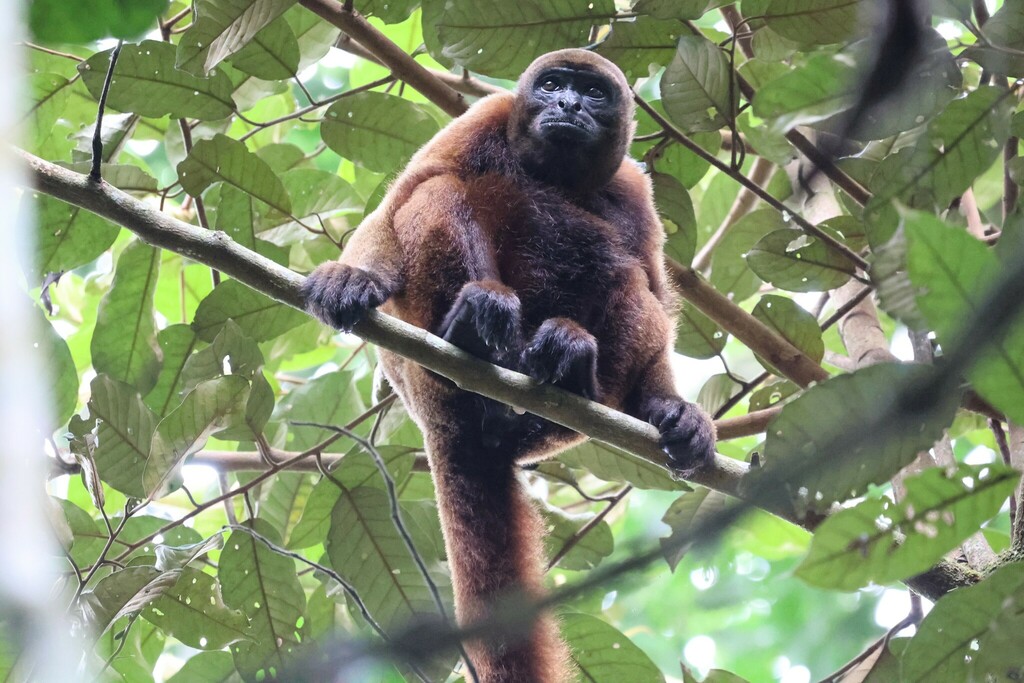
Common Woolly Monkey
Photo © Tommy Andriollo
Photo © Tommy Andriollo — CC BY 4.0 — Source: iNaturalist photo #333584254Identification
The common woolly monkey is a large tree-dwelling primate with a head-body length of 40 to 60 centimetres and a distinctive prehensile tail measuring 55 to 75 centimetres, which aids in movement through the canopy. Adults typically weigh between 5.5 and 10.8 kilograms, with males notably larger than females and possessing more prominent canines. Despite their name, these monkeys display considerable colour variation, ranging from brown to grey or black, with darker colouration on the head and underparts. Their most distinctive feature is a naked black face that contrasts sharply with their densely furred body. These diurnal primates are among the largest arboreal monkeys in their range.
Range & Habitat
Common woolly monkeys inhabit the upper Amazon basin across six South American countries: Colombia, Ecuador, Peru, Brazil, Bolivia, and Venezuela, with their range extending from the Rio Tapajos in Brazil to scattered northern populations in Venezuela. They are predominantly found in rainforest canopies, favouring the tallest trees but occasionally descending to the shrub layer. During certain seasons, groups venture into flooded forests where berry availability is concentrated, making these seasonal habitats important feeding grounds.
Behaviour & Diet
These highly social monkeys live in groups ranging from two to 70 individuals, which typically subdivide into smaller foraging units when active. Common woolly monkeys are primarily frugivorous but adopt an omnivorous diet that shifts seasonally. They show strong preferences for fruits from legume, fig, morning glory, and sapodilla families, which comprise roughly half their feeding time, though fruit availability ultimately drives their dietary choices. During fruit scarcity, they increase consumption of leaves and insects; nursing females preferentially eat protein-rich leaves to support milk production, while juveniles consume more arthropods than other group members.
Their foraging behaviour is highly generalist and opportunistic, covering approximately 2 kilometres daily in search of food. They prefer fruit species with clumped distributions produced by large trees, which minimise travel distances between feeding patches. Interestingly, females with offspring forage more efficiently than juveniles and adult males, though inter-group competition often displaces younger animals during feeding times.
Best Time & Places to See It
Common woolly monkeys occur throughout the Amazon basin within their range, both inside and outside protected national park areas. They are most active during daytime hours, making them accessible for observation. Seasonal movements to flooded forests during berry production periods offer particularly rewarding viewing opportunities, as group concentrations increase in these habitats.
Photography Tips
The canopy habitat where woolly monkeys spend most of their time presents significant challenges for photographers. Their preference for the tallest trees and their tendency to move actively through intermediate branches rather than just terminal tips require patience and positioning. The monkeys' dark facial features and varied coat colours can create challenging contrast conditions; shooting during overcast conditions or early morning light will help capture detail in both the naked face and fur. Their distinctive prehensile tail in action, often used for balance and climbing, offers excellent compositional opportunities for action shots.
Yasuní National Park
Aguarico, Ecuador
+601 birds+43 mammals
Where the western Amazon basin converges with Ecuador's Orellana Province, lowland rainforest reaches toward the horizon in an unbroken canopy of staggering botanical density. Yasuní National…
VIEW NATIONAL PARKSangay National Park
Cebadas, Ecuador
+320 birds+10 mammals
High in Ecuador's Andean spine, where the Western Cordillera rises to touch perpetual snow, a landscape of volcanic drama and ecological intensity unfolds across Sangay National…
VIEW NATIONAL PARKNatural Serranía de los Churumbelos National Park
Santa Rosa, Colombia
+70 birds+2 mammals
Where the western cordillera of Colombia rises toward the Pacific watershed, the Serranía de los Churumbelos unfolds across more than 3,200 square kilometers of some of…
VIEW NATIONAL PARKNatural la Paya National Park
Puerto Leguízamo, Colombia
+262 birds+4 mammals
Where the Amazon's western reaches fold into the Andes foothills, La Paya National Park sprawls across more than 8,500 square kilometers of pristine Amazonian rainforest in…
VIEW NATIONAL PARKNatural Chingaza National Park
Junín, Colombia
+285 birds+6 mammals
Where the Andes rise above three thousand metres in the Cundinamarca region, high-altitude grasslands and cloud forests converge in a landscape shaped by both geology and…
VIEW NATIONAL PARKNatural el Cocuy National Park
Güicán, Colombia
+313 birds+3 mammals
Where the Andes rise to their highest peaks in Colombia's eastern cordillera, El Cocuy National Park sprawls across more than 6,600 square kilometers of some of…
VIEW NATIONAL PARKCampos Amazónicos National Park
Amazonas, Brazil
+434 birds+7 mammals
Sprawling across the southwestern Amazon basin in Amazonas state, this 27,263-square-kilometre national park encompasses some of the region's most pristine lowland rainforest, where terra firme forest…
VIEW NATIONAL PARKSerra do Divisor National Park
Brazil
+448 birds+10 mammals
Where the western Amazon meets the Andes foothills, Serra do Divisor National Park sprawls across one of South America's most biodiverse and least accessible frontiers. Spanning…
VIEW NATIONAL PARKYanachaga–chemillén National Park
Palcazu, Peru
+639 birds+6 mammals
Where the eastern slopes of Peru's central cordillera plunge into cloud forest, Yanachaga–Chemillén National Park protects nearly three thousand square kilometres of montane wilderness that few…
VIEW NATIONAL PARKManu National Park
Manu, Peru
+892 birds+26 mammals
Across the eastern slopes of the Peruvian Andes, tropical rainforest descends into the Amazon basin with a complexity that few terrestrial ecosystems match. Manu National Park…
VIEW NATIONAL PARKSierra del Divisor National Park
Alto Tapiche, Peru
+298 birds+2 mammals
Where the western Amazon meets the Andes foothills, nearly 41,000 square kilometres of pristine rainforest rise across Peru's Alto Tapiche region in a landscape of extraordinary…
VIEW NATIONAL PARKNo community photos yet. Log in to add the first one.
No community observations of this species yet.