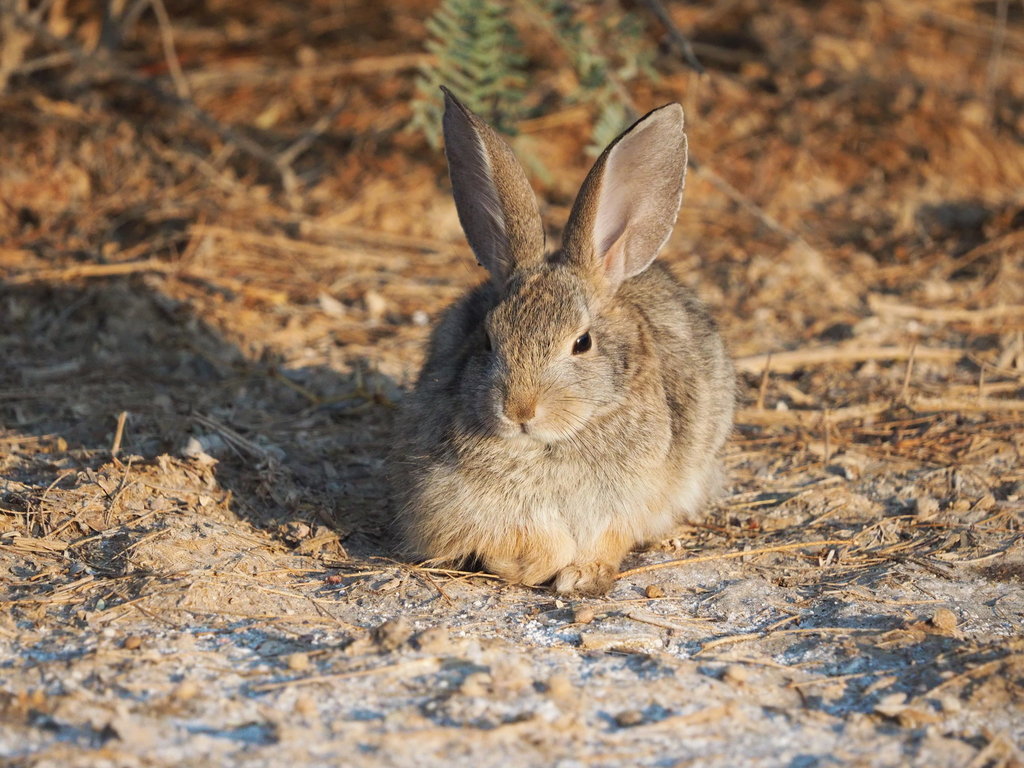
Desert Cottontail
Photo © Clay Gibbons
Photo © Clay Gibbons — CC BY 4.0 — Source: iNaturalist photo #159410492Identification
The desert cottontail is a small rabbit, 36 to 42 cm long and weighing 700 to 1,200 g, with prominent upright ears measuring 6 to 9 cm. Its most distinctive feature is its fluffy tail: greyish-brown on top with a broad white edge and white underside, conspicuously visible when the rabbit bounds away. The belly is also white. Females are slightly larger than males, though sexual dimorphism is minimal. The large hindfeet (7 to 9 cm) are well-adapted for desert locomotion.
Desert cottontails are often mistaken for European rabbits, but they can be distinguished by their larger, more prominently erect ears. They are social animals, frequently seen gathering in small groups, and their behaviour is notably tolerant of other individuals in the vicinity—unusual among leporids.
Range & Habitat
The desert cottontail ranges throughout the western United States, from eastern Montana to western Texas, with its eastern limits barely extending into the Great Plains. Westward, it reaches central Nevada, California, and Baja California, touching the Pacific coast. The species is found from sea level to elevations of 1,830 m (6,000 ft).
True to its name, the desert cottontail is particularly associated with dry near-desert grasslands of the American Southwest, though it also inhabits less arid environments such as pinyon-juniper forest. Riparian zones in arid regions are also favored habitats. This habitat flexibility allows the species to thrive across diverse southwestern landscapes.
Behaviour & Diet
Desert cottontails are herbivores, with grass comprising 90 percent of their diet. They also consume mesquite leaves and seed pods, barks, fallen fruit, prickly pear pads, and shrub twigs. Like other lagomorphs, they are coprophagic, re-ingesting their own feces to extract maximum nutrition. Remarkably, they rarely need to drink, obtaining most water from vegetation and dew. Their diet shifts seasonally according to plant availability and moisture content.
These rabbits are crepuscular, most active during early morning and evening hours, and shelter in burrows abandoned by other mammals or in shallow scrapes they create with their front paws. They are particularly reluctant to forage on windy days, when wind masks the sounds of approaching predators—their primary defense mechanism. When threatened, they freeze initially; if danger persists, they flee in erratic zigzag patterns at speeds exceeding 30 km/h.
Best Time & Places to See It
Desert cottontails are best observed during dawn and dusk, when they emerge to feed. Early morning offers the most reliable sightings, particularly in open near-desert grasslands and riparian areas of the American Southwest. Look in areas with scattered vegetation where animals can quickly access shelter. Patience and quiet observation are essential, as movement and noise will send rabbits bolting.
The species is present year-round throughout its range, though seasonal vegetation changes will influence local abundance. Riparian zones maintain consistent food availability, making these areas particularly productive for observation. Avoid searching during windy conditions, when cottontails remain in their burrows.
Photography Tips
Early morning light provides ideal conditions for photographing desert cottontails. Use a telephoto lens (200–400mm) to maintain distance and avoid startling these wary animals. Position yourself downwind when possible, and move slowly. The white tail and belly are excellent identifying features to capture—particularly the distinctive flash of white as the rabbit bounds away.
Focus on the large upright ears and alert expression, which convey the species' constant vigilance against predators. Photograph animals in their natural habitat among desert grasses or shrubs rather than in isolation. Since cottontails are often seen in small feeding groups, try to capture multiple individuals together, showcasing their social tolerance. Overcast morning conditions reduce harsh shadows and are often preferable for detailed fur texture.
Arches National Park
Badlands National Park
Big Bend National Park
Bitter Lake National Wildlife Refuge
Black Canyon of the Gunnison National Park
Bosque del Apache National Wildlife Refuge
Cabeza Prieta National Wildlife Refuge
Canyonlands National Park
Capitol Reef National Park
Nothing matches these filters.
No community photos yet. Log in to add the first one.
No community observations of this species yet.