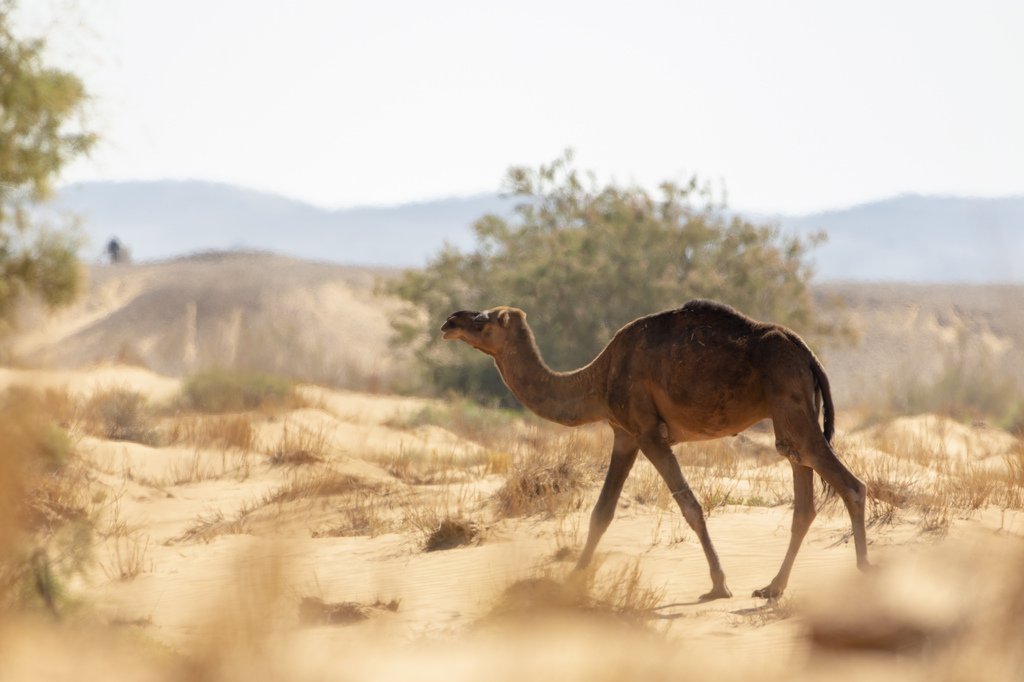
Dromedary Camel
Photo © David F. Belmonte
Photo © David F. Belmonte — CC BY 4.0 — Source: iNaturalist photo #329518455Identification
The dromedary, also known as the Arabian camel or one-humped camel, is the tallest of the three camel species. Adult males stand 1.8–2.4 m at the shoulder, while females reach 1.7–1.9 m in height. Males typically weigh 400–690 kg, with females weighing 300–540 kg. The dromedary is instantly recognizable by its single hump, which rises 20 cm or more and consists of fat bound together by fibrous tissue. Other distinctive features include a long, curved neck, narrow chest, and long hairs adorning the throat, shoulders, and hump. The coat is generally some shade of brown.
Range & Habitat
The dromedary has not occurred naturally in the wild for nearly 2,000 years, though it probably originated in the Arabian Peninsula or Somalia and historically inhabited arid regions including the Sahara. Today, domesticated dromedaries are kept throughout the semiarid to arid regions of the Old World, primarily in Africa, the Arabian Peninsula, and the Thar Desert in Pakistan and India. A notable feral population also exists in Australia.
Behaviour & Diet
Dromedaries feed on foliage and desert vegetation, with remarkable physiological adaptations that allow them to thrive in harsh desert environments, including the ability to tolerate losing more than 30% of their total water content. These social animals are mainly active during daylight hours and form herds of approximately 20 individuals, led by a dominant male. Mating occurs annually and peaks during the rainy season, with females bearing a single calf after a gestation period of 15 months.
Best Time & Places to See It
For wildlife travellers seeking dromedaries in their working habitat, the semiarid and arid regions of North Africa and the Arabian Peninsula offer the most authentic experiences. The animals are diurnal and can be observed during daylight hours. In regions where dromedaries support local tribes, visitors may encounter them being used for riding, as pack animals, or in traditional pastoral settings.
Photography Tips
The dromedary's distinctive silhouette—with its prominent single hump, long curved neck, and lean frame—makes for striking photography, particularly during golden-hour light when the brown coat glows warmly. Capture the animals in herds to convey their social nature, or focus on close-ups of the characteristic long hairs on the hump, shoulders, and throat. The desert landscape provides dramatic backdrops; photograph during daylight hours when dromedaries are most active.
Awash National Park
Djoudj National Bird Sanctuary
Iriqui National Park
Meru National Park
Ngorongoro Conservation Area
Ras Mohammed National Park
Samburu National Reserve
Souss-Massa National Park
Uluru-Kata Tjuta National Park
Nothing matches these filters.
No community photos yet. Log in to add the first one.
No community observations of this species yet.