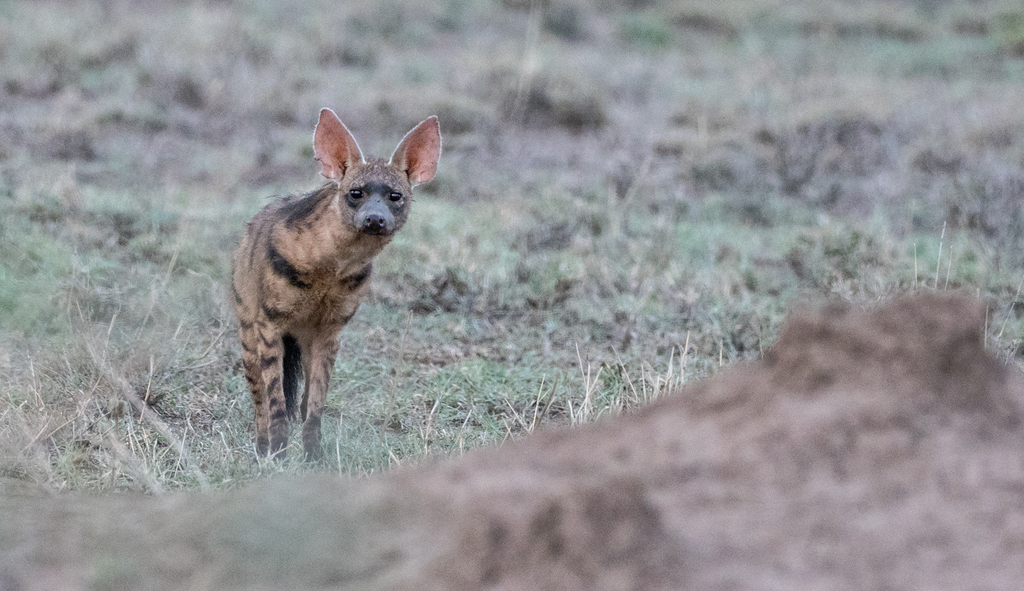
Eastern Aardwolf
Photo © Forest Botial-Jarvis
Photo © Forest Botial-Jarvis — CC BY 4.0 — Source: iNaturalist photo #45006499The aardwolf (Proteles cristatus) is an insectivorous hyaenid species, native to East and Southern Africa. Its name means 'earth-wolf' in Afrikaans and Dutch. It is also called the maanhaarjakkals (Afrikaans for 'mane-jackal'), termite-eating hyena and civet hyena, based on its habit of secreting substances from its anal gland, a characteristic shared with the African civet. Unlike many of its relatives in the order Carnivora, the aardwolf does not hunt large animals. It eats insects and their larvae, mainly termites; one aardwolf can lap up as many as 300,000 termites during a single night using its long, sticky tongue. The aardwolf's tongue has adapted to be tough enough to withstand the strong bite of termites. The aardwolf lives in the shrublands of eastern and southern Africa – open lands covered with stunted trees and shrubs. It is nocturnal, resting in burrows during the day and emerging at night to seek food. == Taxonomy == The aardwolf is generally classified as part of the hyena family Hyaenidae. However, it was formerly placed in its own family Protelidae. Early on, scientists felt that it was merely mimicking the striped hyena, which subsequently led to the creation of Protelidae. Recent studies have suggested that…
Serengeti National Park
Tanzania
+558 birds+57 mammals
Across Tanzania's northern plateau, where volcanic soils meet acacia woodland and open grassland, unfolds one of Earth's most dynamic ecosystems. The Serengeti National Park sprawls across…
VIEW NATIONAL PARKTsavo East National Park
Athi ward, Kenya
+468 birds+50 mammals
Across the semi-arid lowlands of southeastern Kenya, where acacia woodland fragments into scrubland and the landscape rolls toward the Indian Ocean horizon, lies one of Africa's…
VIEW NATIONAL PARKAwash National Park
Didiga, Ethiopia
+473 birds+23 mammals
Where the Ethiopian Rift Valley carves through volcanic plateaus, a ribbon of riverine forest winds through acacia scrubland and grassland, creating a mosaic of habitats that…
VIEW NATURAL PARKNo community photos yet. Log in to add the first one.
No community observations of this species yet.