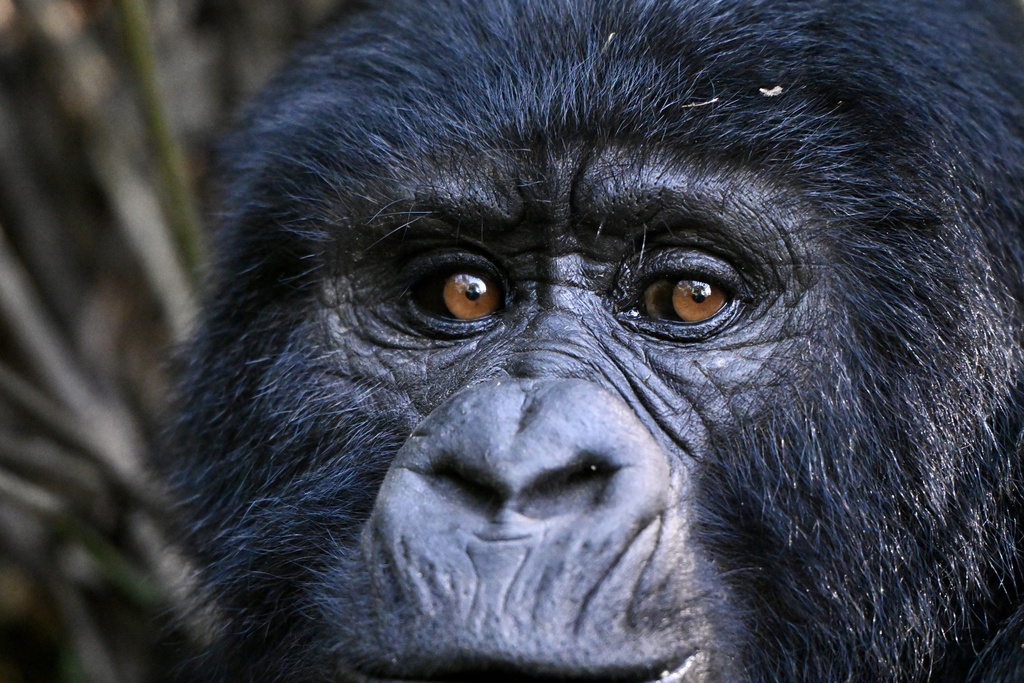
Eastern Gorilla
Photo © Lukas Zangl
Photo © Lukas Zangl — CC BY 4.0 — Source: iNaturalist photo #542091973Identification
The eastern gorilla is the largest living primate, with a powerfully built body characterized by a large head, broad chest, and long arms. Both sexes have bald faces, hands, feet, and breasts, with mainly black fur covering the rest of their bodies. Adult males develop a distinctive silvery "saddle" across their backs—a feature that becomes whiter with age, earning older males the name "silverbacks." The two subspecies show subtle differences: Grauer's gorilla possesses shorter, thicker, deep black fur, while the mountain gorilla displays a more bluish tint and is slightly smaller overall.
Sexual dimorphism is pronounced in this species. Males typically weigh 140–205.5 kg and stand 1.7 m tall, while females are considerably smaller at 90–100 kg and 1.5 m in height. The species' flat nose with large nostrils and distinctive facial structure make individual identification possible for experienced observers and photographers.
Range & Habitat
Eastern gorillas are found exclusively in Central Africa, divided into two geographically distinct subspecies. Mountain gorillas inhabit the mountain rainforest and subalpine forest regions of eastern Democratic Republic of the Congo, southwestern Uganda, and Rwanda. Grauer's gorillas, the more numerous subspecies, range across the forests of the Albertine Rift in eastern Democratic Republic of the Congo.
The species is critically endangered, with populations severely fragmented. Current estimates place the total population at fewer than 6,000 individuals, comprising approximately 6,800 Grauer's gorillas and around 1,000 mountain gorillas. This represents a catastrophic decline of more than 70 percent between 1996 and 2016, though mountain gorilla numbers have shown recent growth.
Behaviour & Diet
Eastern gorillas are highly social animals living in stable, cohesive family groups led by a dominant silverback male. These groups are typically larger than those of western gorillas, sometimes numbering up to 35 individuals. The silverback defends his family through intimidating displays involving charging and chest-beating, protecting females and offspring with his imposing size.
These herbivores subsist entirely on foliage, an adaptation to their forest habitats where fruit is scarce. They are diurnal, with most foraging occurring during morning and late afternoon hours. At night, gorillas construct ground nests by folding over vegetation. Reproduction is slow; females give birth only once every 3–4 years following a gestation period of 8.5 months, and young remain dependent until approximately 3.5 years of age.
Best Time & Places to See It
Mountain gorilla viewing is possible year-round in several protected areas, making it one of Africa's most sought wildlife experiences. Primary locations include Volcanoes National Park in Rwanda, Virunga National Park in the Democratic Republic of the Congo, and Mgahinga Gorilla National Park and Bwindi Impenetrable National Park in Uganda. These national parks offer guided gorilla trekking experiences that support conservation efforts through ecotourism revenue.
Mountain gorillas, the more accessible subspecies, have shown population recovery and are the focus of most gorilla tourism. Grauer's gorillas remain far more difficult to observe in the wild due to habitat fragmentation and security concerns in their range. Visitors should note that habituated gorillas—those accustomed to human presence—may carry higher disease burdens, prompting strict health protocols at viewing sites.
Photography Tips
Photographing eastern gorillas presents extraordinary opportunities for compelling wildlife imagery. The striking contrast between the gorillas' black fur and silvery or white saddle markings of mature males creates dramatic compositional potential. Close-up portraits of their distinctive facial features—the flat nose, prominent nostrils, and expressive eyes—are particularly rewarding subjects that reveal their intelligence and personality.
Family group dynamics offer rich storytelling possibilities, from tender moments between mothers and offspring to dominant displays by silverbacks. Action shots of chest-beating displays and charging behaviors can capture the raw power of these remarkable primates. Work with experienced guides familiar with gorilla behavior to anticipate moments and maintain appropriate distance while respecting both the animals' wellbeing and photography regulations at protected sites.
No community photos yet. Log in to add the first one.
No community observations of this species yet.