Identification
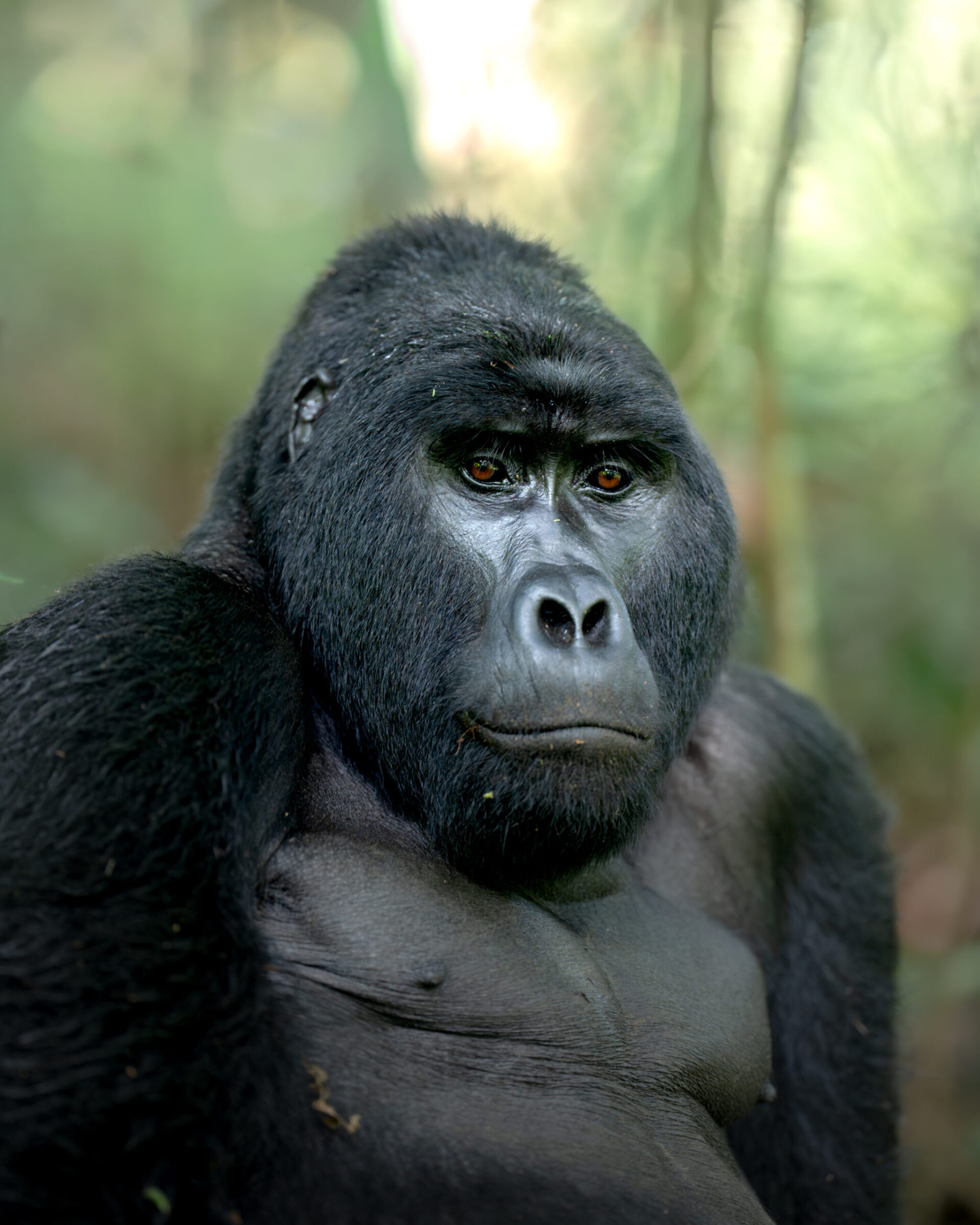
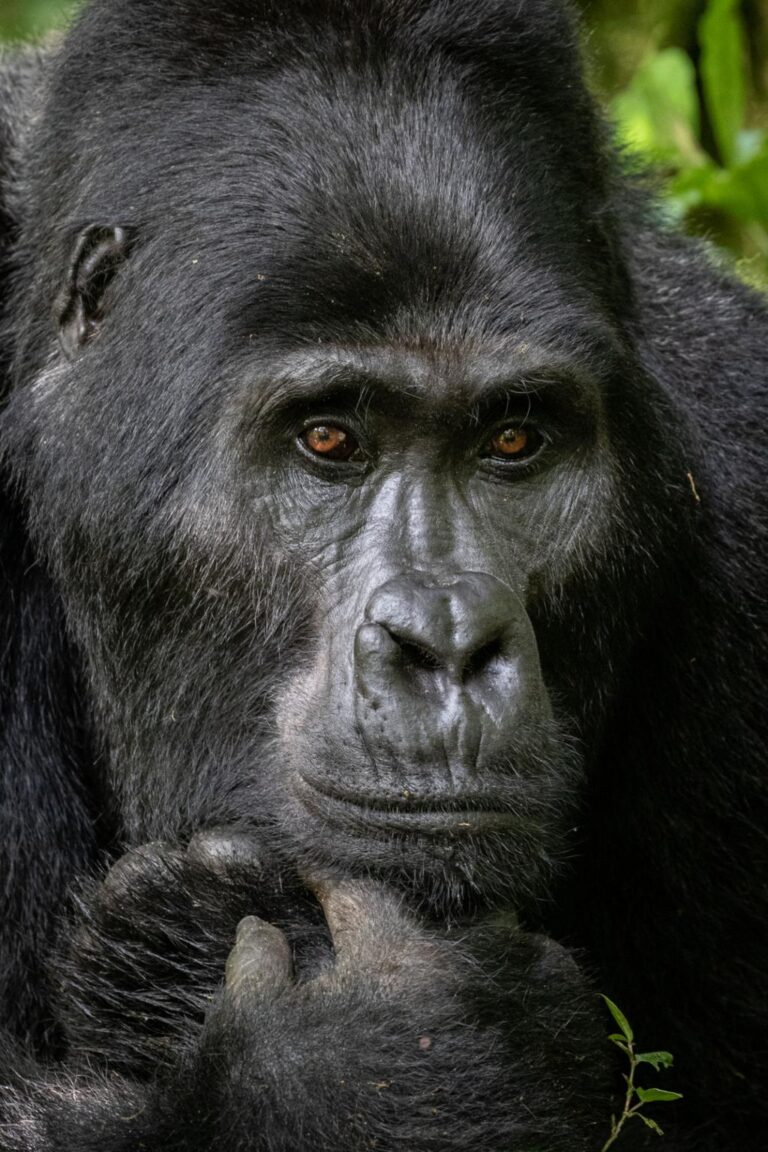
The mountain gorilla is one of the two subspecies of the eastern gorilla, distinguished by its thicker and longer fur than other gorilla species, an adaptation that allows it to survive in colder mountain environments. Each individual can be identified by its unique nose prints. Adult males, known as silverbacks, develop a distinctive saddle of gray or silver-colored hair across their backs as they age, combined with especially long arm hair and a conical head shape created by pronounced bony crests on the skull.
Males are substantially larger than females, reaching heights of 1.61–1.71 m (5.3–5.6 ft) and weighing 120–191 kg (265–421 lb), while females weigh 70–98 kg (154–216 lb). All mountain gorillas share the dark brown eyes of their species, framed by a black ring around the iris. Like other great apes except humans, their arms are notably longer than their legs, and they move by knuckle-walking, supporting their weight on the backs of their curved fingers.
Range & Habitat
Mountain gorillas are found in two separate populations across the Albertine Rift montane cloud forest region. One population inhabits the Virunga Mountains, which span the borders of southwestern Uganda (Mgahinga), northwestern Rwanda (Volcanoes), and the eastern Democratic Republic of Congo (Virunga National Park). The second population lives in Uganda's Bwindi Impenetrable National Park, and some primatologists speculate it may represent a separate subspecies.
These gorillas inhabit elevations ranging from 2,200 to 4,300 m (7,200 to 14,100 ft), with most groups living on the slopes of three dormant volcanoes: Karisimbi, Mikeno, and Visoke. The habitat is characterized by dense vegetation at lower elevations that becomes increasingly sparse at higher altitudes, with forests that are frequently cloudy, misty, and cold. As of 2019, an estimated 1,063 mountain gorillas remain in the world, classified as endangered by the IUCN as of 2018.
Behaviour & Diet
Mountain gorillas are diurnal and primarily terrestrial, spending most of their day eating to fuel their massive bodies. They follow a predictable daily routine: foraging in the early morning, resting during late morning and midday, then foraging again in the afternoon before resting at night. In cold or overcast conditions, they may remain in their nests longer after sunrise, typically departing around 6 am when conditions are favorable.
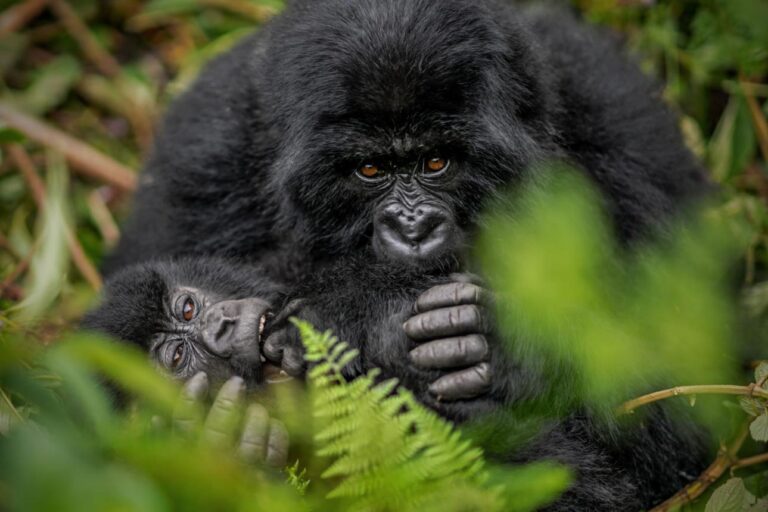
Each gorilla constructs a new nest from surrounding vegetation every evening for sleeping, with only infants sharing nests with their mothers. Their home ranges vary based on food availability and typically encompass several vegetation zones, from bamboo forest at lower elevations through Hagenia forest (where mountain gorillas spend most of their time) to the giant senecio zone at higher altitudes. Although primarily quadrupedal, mountain gorillas will climb into fruiting trees when branches can support their weight.
Best Time & Places to See It
The two primary destinations for viewing mountain gorillas are Uganda's Bwindi Impenetrable National Park and the Virunga Mountains region, which includes protected areas in Uganda, Rwanda, and the Democratic Republic of Congo. The Virunga Mountains population can be accessed through Rwanda's Volcanoes National Park, Uganda's Mgahinga Gorilla National Park, or the Democratic Republic of Congo's Virunga National Park.
The montane cloud forest habitat is frequently misty and cold, particularly at higher elevations where most gorilla groups reside. Visitors should be prepared for wet, cool conditions and dense vegetation that can limit visibility. Early morning departures maximize chances of locating gorillas before they settle into their midday rest periods.
Photography Tips
The dense, misty cloud forest habitat and frequent overcast conditions present significant challenges for photography. High ISO settings and fast lenses will be essential for capturing detail in the dim, diffused light typical of these montane forests. The thick vegetation often limits sight lines, so patience and positioning are crucial for obtaining clear shots.
The distinctive features of mountain gorillas—the silvery saddle of adult males, their powerful builds, and their expressive faces—offer compelling photographic subjects. Wide-angle lenses may be useful for capturing gorillas within their lush forest habitat, while medium telephoto lenses help isolate individuals from cluttered backgrounds. Early morning sessions, when gorillas forage and are more active, typically offer better opportunities than midday rest periods.