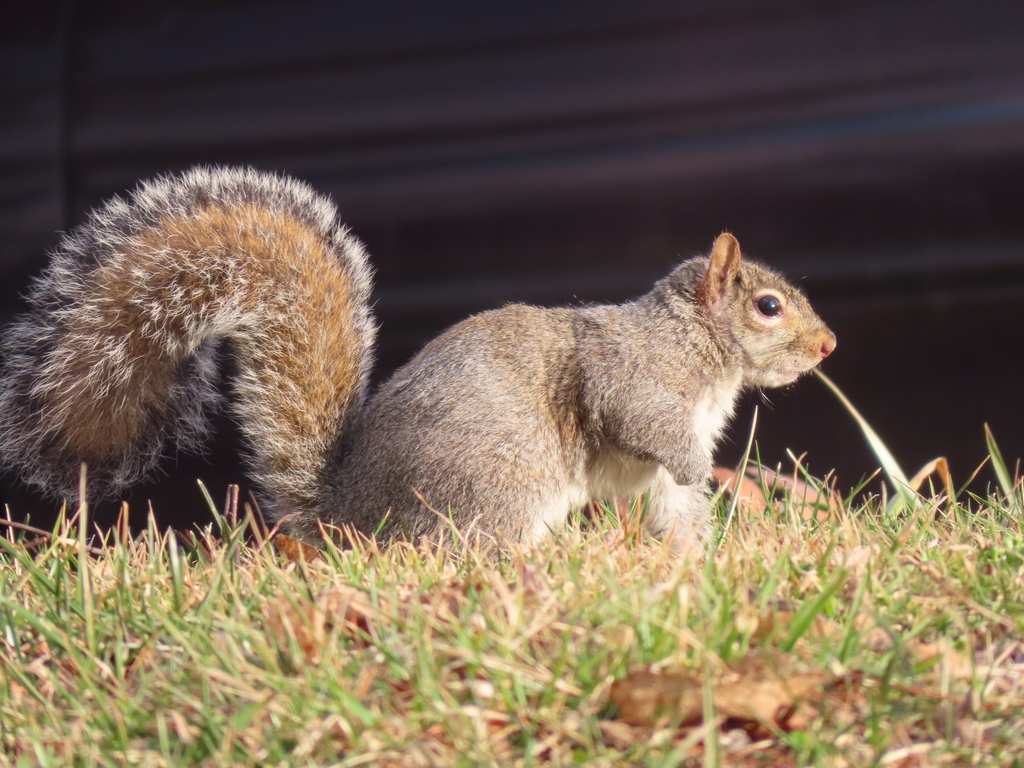
Eastern Gray Squirrel
Photo © Mila C.
Photo © Mila C. — CC BY 4.0 — Source: iNaturalist photo #180841098Identification
The eastern gray squirrel has predominantly gray fur with brown spots and streaks, distinguished by its white underside—contrasting with the brownish-orange underside of the similar fox squirrel. It boasts a large bushy tail and shows countershading, a common camouflage pattern. Head and body length ranges from 23 to 30 cm, with a tail of 19 to 25 cm and adult weight between 400 and 600 g. Males and females are identical in size and coloration, displaying no sexual dimorphism.
Color variations are common, particularly in urban areas where predation risk is lower. Both white-colored and black-colored individuals occur frequently. The melanistic form, almost entirely black, is predominant in certain populations and geographic areas, especially in southeastern Canada. Black squirrels exhibit superior cold tolerance, showing an 18% reduction in heat loss compared to the common gray morph when exposed to freezing temperatures.
Range & Habitat
Native to eastern and midwestern North America, the eastern gray squirrel ranges from New Brunswick through southwestern Quebec and southern Ontario, extending into southern Manitoba, and south to East Texas and Florida. In the mid-1800s, populations in the Midwest were described as "truly astonishing," but human predation and deforestation caused drastic declines—the species was almost absent from Illinois by 1900. Breeding populations now reach as far north as Nova Scotia, though whether this represents natural range expansion or introduction remains unknown.
As a prolific and highly adaptable species, eastern gray squirrels have been successfully introduced to parts of the western United States, western Canada (Vancouver Island since 1966), Europe, Italy, South Africa, and Australia (though extirpated there by 1973). In Europe particularly, they are now classified as an invasive species of concern, having largely displaced native red squirrels in Britain and competing with Eurasian red squirrels in Ireland.
Behaviour & Diet
The eastern gray squirrel is recognized as the most prodigious and ecologically essential natural forest regenerator in its native eastern North American range. Like all squirrels, it has four toes on its front feet and five on its hind feet. When bounding or moving at speed, front foot tracks appear behind hind foot tracks, with a bounding stride of 60 to 90 cm. Its dental formula totals 22 teeth, with incisors that exhibit indeterminate growth, continuously growing throughout the squirrel's life—a characteristic shared by all rodents.
Best Time & Places to See It
Throughout its native range in eastern North America, from Canada's southern provinces through the eastern and midwestern United States to Texas and Florida, the eastern gray squirrel remains extremely common, particularly in the Carolinas where it was first recorded. Urban parks, gardens, and woodlands across its range offer reliable viewing opportunities year-round.
Photography Tips
The species' large bushy tail makes it a visually striking subject for photography. In urban settings where habituation to humans is higher, eastern gray squirrels offer excellent opportunities for close approach. Look for color morphs—black individuals are particularly photogenic and common in southeastern Canada and certain urban populations. The contrast between their gray or black fur and white underside creates natural compositional depth, while their distinctive bushy tail frames excellent action shots during bounding movement.
Acadia National Park
Algonquin Provincial Park
Alligator River National Wildlife Refuge
Banff National Park
Bannau Brycheiniog National Park
Blackwater National Wildlife Refuge
Bombay Hook National Wildlife Refuge
Caerlaverock National Nature Reserve
Cairngorms National Park
Nothing matches these filters.
No community photos yet. Log in to add the first one.
No community observations of this species yet.