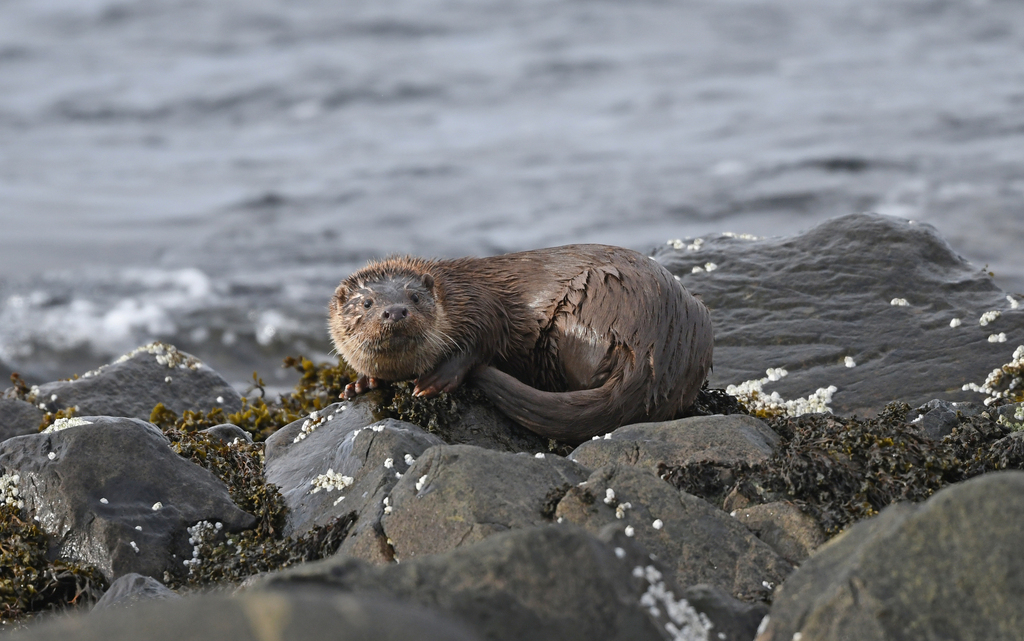
Eurasian Otter
Photo © Julia Moning
Photo © Julia Moning — CC BY 4.0 — Source: iNaturalist photo #252090468Identification
The Eurasian otter is a sleek, semiaquatic mammal with distinctive colouring: brown fur on the back contrasts sharply with cream-coloured fur on the belly. These long, slender creatures are perfectly adapted for aquatic life, with dense bones that reduce buoyancy and help them dive effectively. Typically measuring 57 to 95 cm in body length with a tail of 35–45 cm, they weigh between 7 and 12 kg on average, though large males can reach 17 kg. Females are noticeably smaller than males. The Eurasian otter differs from its North American cousin by its shorter neck, broader face, greater space between the ears, and longer tail.
Range & Habitat
The Eurasian otter is the world's most widely distributed otter species, inhabiting waterways across Europe, much of Asia, and parts of North Africa. It thrives in Great Britain and Ireland, along Scandinavian coasts, in Spain and Portugal, and across parts of Asia including Nepal and India's Himalayan foothills and Western Ghats. Though extinct in Switzerland and Liechtenstein, populations have recovered dramatically in places like Latvia and England, where otters have returned to every county.
These otters favour unpolluted freshwater habitats—rivers, streams, lakes, canals and ponds—where food is plentiful. They also inhabit coastal salt water but require regular access to fresh water to maintain their fur. Remarkably adaptable, they are found at elevations around 1,600 metres in Himalayan regions and even use artificial lakes on Spanish golf courses in Andalusia.
Behaviour & Diet
Eurasian otters are strongly territorial, solitary animals. Territory size varies dramatically from 1 to 40 kilometres depending on food availability and habitat width, typically averaging around 18 km on rivers but remaining shorter on more productive coasts. They mark territories using spraints (faeces), and while they defend territories against same-sex rivals, male and female territories often overlap.
Fish form the primary diet, supplemented seasonally with amphibians, crustaceans, insects, clams, worms, eggs, birds, and small mammals including young beavers. Despite their modest size, Eurasian otters can overpower surprisingly large prey—they occasionally hunt adult greylag geese. Breeding occurs year-round; females reach sexual maturity at 18–24 months and give birth after a 60–64 day gestation to one to four pups, which depend on their mother for approximately 13 months.
Best Time & Places to See It
For the best chance of encountering Eurasian otters, visit recovering populations in the United Kingdom, Norway, or the Iberian Peninsula. England's rivers and coasts offer particularly good opportunities following the species' remarkable return to every English county. Scan quiet stretches of unpolluted rivers, coastal areas, and freshwater lakes, particularly in early morning or dusk when otters are most active. Look for spraints on rocks and logs to confirm recent otter presence in an area.
Photography Tips
Patience and stealth are essential when photographing these wary, solitary creatures. Position yourself quietly along riverbanks or coasts before dawn, keeping low and downwind. Otters are most active during twilight hours, so plan sessions accordingly. Watch for ripples and disturbances in the water, and listen for splashing. A telephoto lens (at least 200–400 mm) is vital to maintain distance and avoid startling your subject. Coastal populations may be slightly more approachable than river otters, offering better opportunities for close encounters and compelling behaviour shots.
Iberian Lynx Photography Workshop at Gato Clavo
Nothing matches these filters.
Alpilles Regional Nature Park
Appennino Lucano Val d’Agri Lagonegrese National Park
Åsnens National Park
Bardenas Reales
Baronnies Provençales Regional Nature Park
Bavarian Forest National Park
Beinn Eighe National Nature Reserve
Berwyn National Nature Reserve
Białowieża National Park
Nothing matches these filters.
No community photos yet. Log in to add the first one.
No community observations of this species yet.