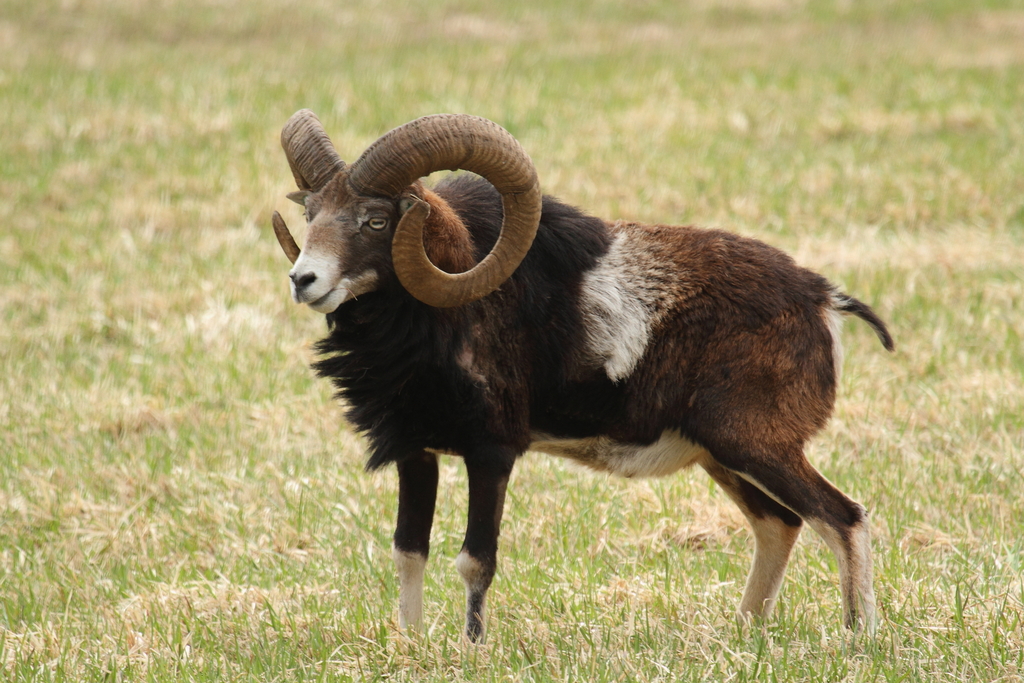
European Mouflon
Photo © Mikael Nyman
Photo © Mikael Nyman — CC BY 4.0 — Source: iNaturalist photo #105900234Identification
The European mouflon is a feral subspecies of primitive domestic sheep, distinguished by its compact, muscular build and striking coloration. Males (rams) measure up to 120 cm in body length with a shoulder height of 90 cm, weighing 35–55 kg, while females (ewes) are smaller at 25–40 kg. Rams are fox red-brown in summer, typically marked with a whitish saddle patch across the back, darkening considerably in winter; ewes are generally brownish year-round. The most conspicuous feature in males is their impressive helix-shaped horns, which can reach 80 cm in length. Female horns vary geographically—absent on Sardinia but present on Corsica as smaller, slightly curved structures. Lambs are the young of both sexes.
Range & Habitat
Originally native to western Asia, European mouflon today inhabit parts of Central Europe, particularly deciduous and mixed forests in regions such as Germany's Central Uplands, occurring in both lowland and upland areas. They prefer dry, stony soils; humid conditions promote fatal diseases including bowel infections and foot rot. Their escape behaviour is adapted to high mountain terrain with rocky outcrops, making them vulnerable in lowland areas where natural predators are present. Predation by grey wolves and Eurasian lynx has significantly impacted populations, particularly in areas like Lusatia and the Harz Mountains.
Behaviour & Diet
Mouflon are highly gregarious, forming small herds typically led by an older ewe. During the rutting season (October–November), rams separate from mixed herds to compete fiercely for breeding access, engaging in dramatic horn-clashing battles. They are strict herbivores with a wide-ranging diet, though they also debark trees and can hinder forest regeneration. After a five-month gestation, ewes give birth to one or two lambs in March–April, nursing them for approximately six months. Communication within herds is sophisticated, involving bleating for mother-lamb contact, hissing and foot-stomping as alarm signals, and elaborate vocalizations during the rut. Their laterally-positioned eyes provide excellent panoramic vision to scan for distant threats, though binocular depth perception is limited to a narrow frontal arc.
Best Time & Places to See It
October and November offer exceptional viewing opportunities as the rutting season brings rams into more visible and animated behaviour, with frequent horn-clashing contests. Spring (March–April) is rewarding for observing mothers with newborn lambs. Central European forests, particularly in Germany's uplands, provide the most accessible populations. Early morning and late afternoon visits maximize sightings, as mouflon are most active during these cooler periods. Dry, rocky terrain within their forest habitat should be prioritized, as these preferred microhabitats concentrate populations.
Photography Tips
Position yourself upwind to avoid detection by their keen sense of smell, and maintain distances of at least 100 metres to prevent alarming the herd. During rutting season, frame the dramatic horn-clashing battles that define mouflon behaviour—use a telephoto lens (400–600 mm) to capture action without disturbance. The striking contrast between the foxed-red coat and whitish saddle patch of rams is most vivid in summer light; exploit golden-hour illumination for rich colour saturation. Photograph herds against rocky backgrounds to showcase their natural mountain habitat and emphasize their sure-footed posture. Lambs in spring provide endearing subjects; capture the close bonds between mothers and young. Their exceptional eyesight means they detect movement rapidly—remain still and let them approach rather than pursuing them.
Iberian Lynx Photography Workshop at Gato Clavo
Nothing matches these filters.
Alt Pirineu Natural Park
Asinara National Park
Brijuni National Park
Capçaleres del Ter i del Freser Natural Park
De Hoge Veluwe National Park
Los Alcornocales Natural Park
Mercantour National Park
Regional Park of the Catalan Pyrenees
Serra de Mariola Natural Park
Nothing matches these filters.
No community photos yet. Log in to add the first one.
No community observations of this species yet.