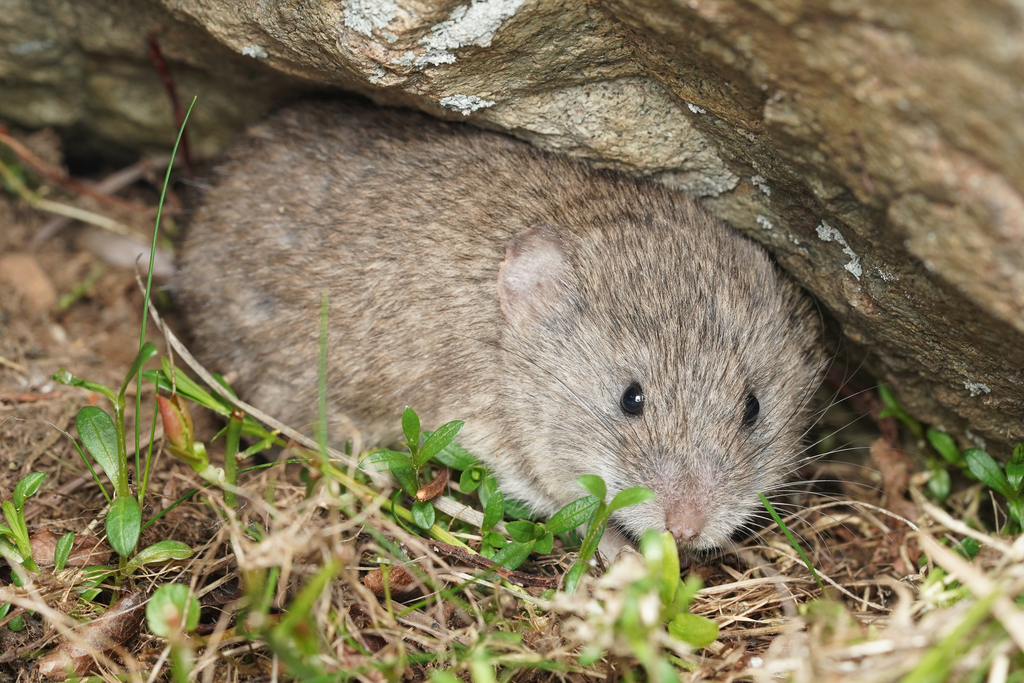
European Snow Vole
Photo © Dr. Sven Gippner
Photo © Dr. Sven Gippner — CC BY 4.0 — Source: iNaturalist photo #384196035Identification
The European snow vole is a small rodent with distinctive pale grey fur tinged with brown, measuring around 14 cm (5.5 in) in head and body length, with a comparatively long whitish tail of about 7 cm (2.8 in). Adults weigh between 1 and 2 ounces. Look for its rounded nose, black beady eyes, long whitish whiskers, and moderately large ears. The soft, dense fur provides excellent insulation for alpine life. In the field, you may hear its characteristic squeak or even the chattering of its teeth.
Range & Habitat
This species is native to mountainous regions across southern and eastern Europe and southwestern Asia, with populations in the Pyrenees, Alps, Apennines, Carpathians, Balkans, and ranges extending into the Caucasus, Lebanon, Syria, Iran, and southern Turkmenistan. It is a glacial relict species, now restricted to fragmented alpine habitats above the tree line. The only Mediterranean island where it occurs is Euboea, off Greece's coast.
European snow voles are rock-dwelling specialists, inhabiting rocky areas and screes in alpine meadows and boulder-covered slopes. They favour areas with dwarf mountain pines, alpine rose, and scrubby vegetation, living among rocks, in crevices, and in scree areas. Interestingly, their presence in any location depends more on microhabitat suitability and petricolic soils than on temperature alone. They are less common in forests where they face competition from other mammals such as dormice.
Behaviour & Diet
These voles are primarily solitary, living under boulders and in crevices and tunnels among rocks and scree. During summer breeding season, females maintain mutually exclusive territories and display considerable aggression towards each other, while males have larger, overlapping ranges and are more socially tolerant. Come winter, territorial boundaries break down and individuals become nomadic and solitary, though still aggressive towards their own species. They do not hibernate and may shelter in mountain huts during harsh weather.
Active both day and night, European snow voles are particularly easy to spot in summer lying on rocks during sunny days. They hold their tails upright when running. Their diet consists of green plant parts, grasses, buds, shoots, and roots, occasionally supplemented with insects and larvae. Notably, in summer they gather grass and leaves to dry in the sun before storing them in underground chambers for winter food supplies. They are promiscuous breeders, typically producing two litters per year.
Best Time & Places to See It
Summer is the best season for observing European snow voles, when they are quite easy to spot lying on rocks, especially during sunny days. Visit high alpine regions above the tree line in the major European mountain ranges—the Alps, Pyrenees, Carpathians, or Balkans offer excellent opportunities. Rocky scree slopes with scattered juniper and alpine vegetation are ideal habitats to search. Early morning or late afternoon often yields the best sightings when voles are active.
Photography Tips
Patience and a slow approach are essential when photographing this small, alert rodent. Summer visits offer the best light and the highest chance of finding active voles on exposed rocks. Bring a macro or telephoto lens, as the voles are tiny and easily disturbed. Work during bright sunny days when they are most likely to be visible on rocks. Move slowly and quietly, as they are quick to disappear into crevices. Early morning light on rocky slopes will provide excellent conditions for capturing their pale fur against dark stone.
Picos de Europa National Park
Posada de Valdeón, Spain
+166 birds+26 mammals
Where limestone massifs rise abruptly from the Castilian plateau, the Picos de Europa create one of Spain's most dramatic mountain wilderness areas. The park's jagged peaks,…
VIEW NATIONAL PARKSierra Nevada National Park
Válor, Spain
+137 birds+7 mammals
Where granite ridges rise above 3,000 metres across the Alpujarra foothills, Sierra Nevada National Park crowns southern Spain's most dramatic mountain landscape. The park encompasses a…
VIEW NATIONAL PARKMontaña Palentina Natural Park
Vidrieros, Spain
+180 birds+29 mammals
Where the Cantabrian mountains rise above the Palencia plateau, Montaña Palentina Nature Park sprawls across nearly 1,500 square kilometres of some of northern Spain's most dramatic…
VIEW NATURAL PARKCévennes National Park
Vebron, France
+187 birds+63 mammals
Where granite gorges slice through the limestone plateaux of southern France, the Cévennes Cœur National Park unfolds across nearly 3,500 square kilometres of one of Europe's…
VIEW NATIONAL PARKMercantour National Park
Isola, France
+146 birds+32 mammals
Where alpine meadows surrender to vertiginous limestone cliffs, the Mercantour's beating heart pulses with Mediterranean and Alpine rhythms. This 4,221-square-kilometre sanctuary straddles France's southeastern border, its…
VIEW NATIONAL PARKÉcrins National Park
La Chapelle-en-Valgaudémar, France
+143 birds+36 mammals
Where granite peaks and Alpine meadows converge across nearly 2,100 square kilometres, Écrins National Park forms one of the wildest mountainous strongholds of the French Alps.…
VIEW NATIONAL PARKVanoise National Park
Val-Cenis, France
+107 birds+29 mammals
Where the French Alps rise in serrated ranks above the Maurienne valley, Vanoise National Park sprawls across more than 1,700 square kilometres of high-altitude wilderness—a realm…
VIEW NATIONAL PARKSierra de Guadarrama National Park
Rascafría, Spain
+179 birds+13 mammals
Where granite peaks rise abruptly from the central Spanish plateau, the Sierra de Guadarrama National Park unfolds across more than eleven hundred square kilometres of montane…
VIEW NATIONAL PARKRegional Park of the Catalan Pyrenees
Olette, France
+244 birds+63 mammals
Where granite peaks thrust skyward above cloud-laden valleys, a wild tapestry of Mediterranean and alpine ecosystems interweaves across the Franco-Spanish frontier. These Pyrenean slopes harbour extraordinary…
VIEW NATURE RESERVEStelvio National Park
Valfurva, Italy
+116 birds+17 mammals
Where granite peaks rise above three thousand metres and alpine meadows give way to rocky scree, Stelvio National Park guards one of Europe's most dramatically vertical…
VIEW NATIONAL PARKGran Paradiso National Park
Cogne, Italy
+120 birds+16 mammals
Where the western Alps rise steeply above the Aosta Valley, granite ridges and alpine meadows converge in a landscape shaped as much by glacial history as…
VIEW NATIONAL PARKPyrénées National Park
Hautes Pyrenees, France
+150 birds+35 mammals
Where alpine meadows give way to limestone cliffs and rushing torrents carve through ancient stone, the Pyrénées National Park spans a landscape of austere beauty along…
VIEW NATIONAL PARKAbruzzo, Lazio and Molise National Park
Pescasseroli, Italy
+139 birds+18 mammals
Where the central Apennines rise in dramatic limestone and clay ridges, the Gran Sasso e Monti della Laga National Park unfolds across one of Italy's most…
VIEW NATIONAL PARKNo community photos yet. Log in to add the first one.
No community observations of this species yet.