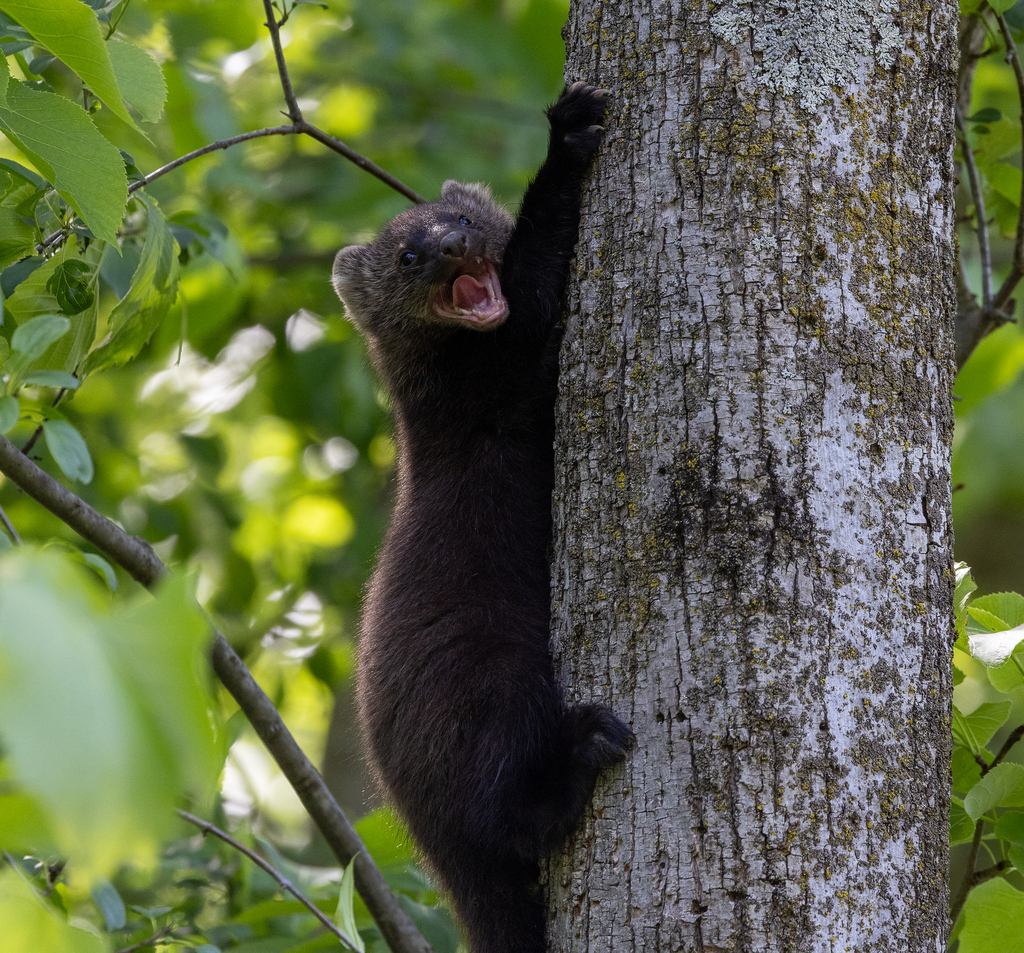
Fisher
Photo © Greg Harrington
Photo © Greg Harrington — CC BY 4.0 — Source: iNaturalist #367909261Identification
The fisher (Pekania pennanti) is a carnivorous member of the mustelid family, despite its misleading common name—it is not a feline and rarely eats fish. It is larger than its close relatives, the American marten and Pacific marten, with a long, thin body close to the ground. Males are substantially larger than females, sometimes weighing up to twice as much. The fisher's fur varies seasonally: in winter it becomes denser and glossier, while in summer it takes on a more mottled appearance as the animal goes through its moulting cycle.
Range & Habitat
The fisher is native to North America, with a range spanning much of the boreal forest in Canada and extending into the northern United States. However, its current distribution is reduced from historical limits. Heavy trapping for pelts since the 18th century caused local extinctions across much of the United States in the early 20th century, though conservation efforts have allowed populations to rebound. Fossil evidence suggests the fisher's range once extended farther south than it does today.
This is a forest-dwelling creature that prefers intact woodland habitat. It hunts primarily in full forest and spends most of its time on the forest floor, favouring areas around fallen trees where it can forage.
Behaviour & Diet
Although an agile climber, the fisher is primarily a ground-forager. It is an omnivore that feeds on a wide variety of small animals, occasionally supplemented with fruits and mushrooms. The fisher shows a marked preference for snowshoe hares and is notably one of the few animals able to successfully prey on porcupines. Despite its name, fish rarely feature in its diet.
The fisher has an unusual reproductive cycle lasting almost a year, involving delayed implantation of the blastocyst. Females give birth to litters of three or four kits in spring and care for them until late summer. Remarkably, females enter estrus shortly after giving birth and seek mates while still nursing. The fisher has few natural predators besides humans, though it typically avoids human contact.
Best Time & Places to See It
Finding fishers in the wild is challenging, as they are elusive forest dwellers. Your best opportunities lie in boreal forest regions of Canada and the northern United States where habitat remains intact. Look in areas with dense, mature forest and fallen trees, especially during early morning or dusk hours when the fisher is most active. Spring and early summer may offer slightly better chances of observation, as females range more widely while nursing and seeking mates.
Photography Tips
Photographing fishers requires patience and fieldcraft. Remote camera traps set along forest trails and near fallen logs where fishers forage offer the most reliable method of capture. If attempting to photograph them directly, move slowly and quietly through suitable habitat during low-light hours. The fisher's sleek fur and low-slung profile create striking images, particularly in winter when the coat is densest and glossiest. Take advantage of seasonal colour variations—the mottled summer coat and rich winter pelage each offer distinct photographic opportunities.
No community photos yet. Log in to add the first one.
No community observations of this species yet.