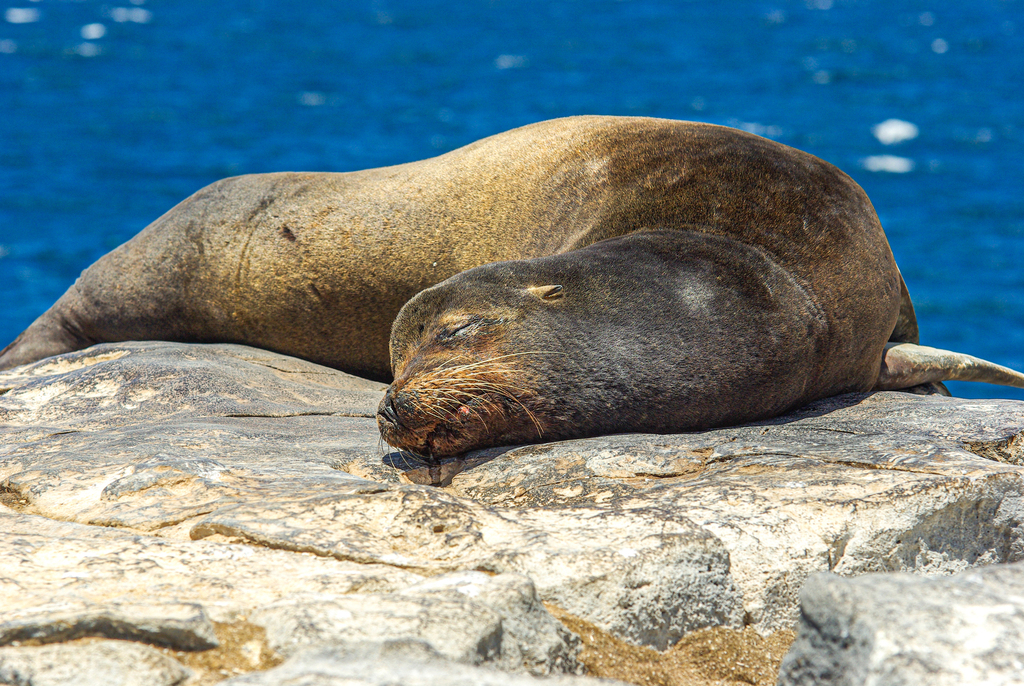
Galapagos Sea Lion
Photo © Dirk Froebel
Photo © Dirk Froebel — CC BY 4.0 — Source: iNaturalist photo #289996594Identification
The Galápagos sea lion is the smallest sea lion species, ranging from 1.5 to 2.5 metres in length and weighing between 50 and 400 kg. Males are noticeably larger than females and develop a distinctive bump-like projection on the forehead—the sagittal crest—upon reaching sexual maturity. Females have a longer, more slender neck and thicker torso, while males display a more robust neck, chest, and shoulders tapering to a slender abdomen. All individuals possess the characteristic pinnae (external ears) that distinguish sea lions from seals, along with a pointy, whiskered nose and long, narrow muzzle. Young pups are almost dog-like in appearance. When wet, sea lions are dark brown; when dry, their colour varies considerably, with females lighter than males and pups displaying a chestnut brown. Pups are born with a longer, brownish-black coat that gradually fades within five months before their first molt into adult plumage.
Range & Habitat
Galápagos sea lions inhabit all the main islands of the Galápagos archipelago and numerous smaller islands within it, with fewer than a quarter of the population residing on San Cristóbal Island. They have also colonized Isla de la Plata, just offshore mainland Ecuador, and can be spotted from the Ecuadorian coast north to Isla Gorgona in Colombia. These adaptable animals occupy many different shoreline types, from steep, rocky cliff sides to low-lying sandy beaches. To avoid overheating during the day, they take refuge from the sun under vegetation, rocks, and cliffs.
Behaviour & Diet
Galápagos sea lions are highly social and vocal animals. Adult males produce long, loud, and distinctive repeated barking sequences, while females and juveniles produce different vocalizations including growls from young pups. Remarkably, mother sea lions can recognize their pup's distinct bark and pinpoint it from a crowd of 30 or more barking individuals. Territorial males vocalize at higher rates than non-territorial males, using these calls to establish dominance and ward off rivals.
These carnivorous sea lions feed mostly on sardines, but also consume other marine life including crustaceans, squid, lanternfish, and octopus. They sometimes travel 10–15 kilometres from the coast over several days to hunt, during which they encounter their main predators: sharks and killer whales. During El Niño events, when water temperature changes cause sardine populations to decline or migrate, sea lions dive deeper to feed on lanternfish. Their inquisitive nature has led them to scavenge from fishing boats and learn hunting methods that exploit boat lights.
Best Time & Places to See It
Galápagos sea lions are found year-round throughout the Galápagos Islands, with all main islands offering viewing opportunities. The archipelago's various shoreline habitats—from rocky cliffs to sandy beaches—provide excellent vantage points. Their social nature and inquisitive approach to humans make them relatively approachable, though visitors should maintain respectful distances. Smaller populations also inhabit Isla de la Plata off Ecuador's coast.
Photography Tips
The sea lions' streamlined bodies and agile movements in water create dynamic photographic subjects, particularly when they navigate crashing surf and coastal rocks. Their distinctive facial features—the pointy, whiskered nose and characteristic forehead bump in mature males—reward close-up portraiture. Pups display endearing, dog-like profiles ideal for compelling wildlife imagery. Early morning or late afternoon light enhances their varied coat colours, from dark brown when wet to lighter tones when dry. Their vocal behaviour and social interactions provide opportunities for behavioural photography, while their tendency to rest under rocks and vegetation during the heat of the day offers chances to capture them in natural settings.
No community photos yet. Log in to add the first one.
No community observations of this species yet.