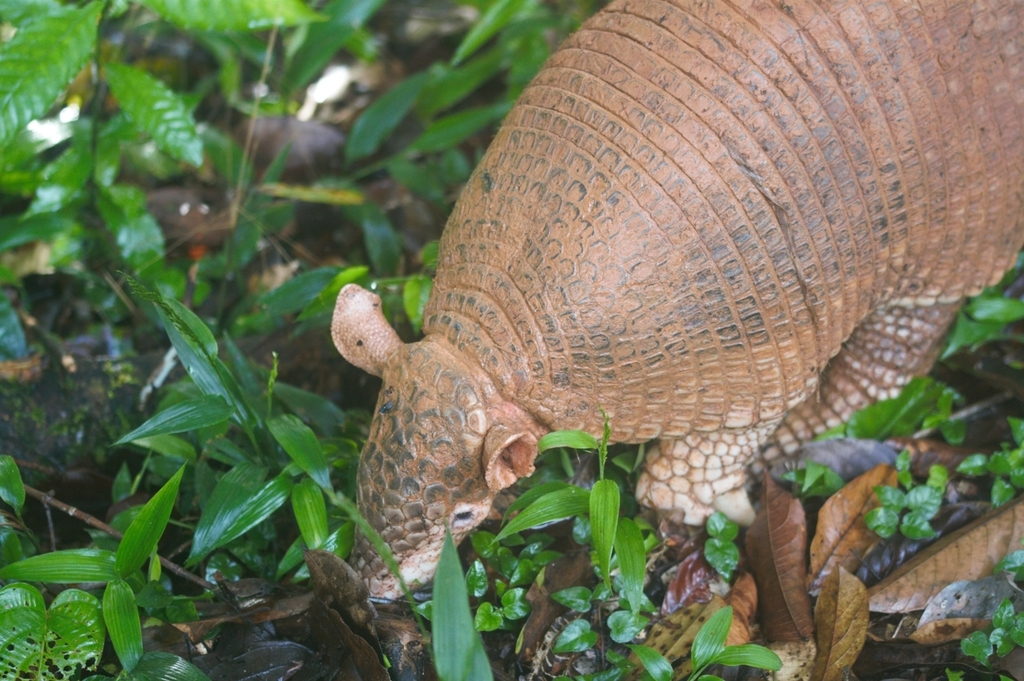
Giant Armadillo
Photo © Guillaume Delaitre
Photo © Guillaume Delaitre — CC BY 4.0 — Source: iNaturalist photo #177595792The giant armadillo (Priodontes maximus), colloquially tatu-canastra, tatou, ocarro or tatú carreta, is the largest living species of armadillo (although their extinct relatives the glyptodonts were much larger). It lives in South America, ranging throughout as far south as northern Argentina. This species is considered vulnerable to extinction. The giant armadillo prefers termites and some ants as prey, and often consumes the entire population of a termite mound. It also has been known to prey upon worms, larvae and larger creatures, such as spiders and snakes, and plants. Some giant armadillos have been reported to have eaten bees by digging into beehives. == Description == The giant armadillo is the largest living species of armadillo, with 11 to 13 hinged bands protecting the body and a further three or four on the neck. Its body is dark brown in color, with a lighter, yellowish band running along the sides, and a pale, yellow-white head. These armadillos have around 80 to 100 teeth, which is more than any other terrestrial mammal. The teeth are all similar in appearance, being reduced premolars and molars, grow constantly throughout life, and lack enamel. They also possess extremely long front claws, including a sickle-shaped third…
Emas National Park
Brazil
+333 birds+23 mammals
Across the high plateaux of central Brazil, where the cerrado grasslands roll toward distant horizons under an immense sky, Emas National Park anchors one of South…
VIEW NATIONAL PARKYasuní National Park
Aguarico, Ecuador
+601 birds+43 mammals
Where the western Amazon basin converges with Ecuador's Orellana Province, lowland rainforest reaches toward the horizon in an unbroken canopy of staggering botanical density. Yasuní National…
VIEW NATIONAL PARKBrasília National Park
Plano Piloto, Brazil
+338 birds+15 mammals
Cerrado grassland and scattered woodland sweep across the central Brazilian plateau where this national park sprawls across more than a thousand square kilometres of the Federal…
VIEW NATIONAL PARKNo community photos yet. Log in to add the first one.
No community observations of this species yet.