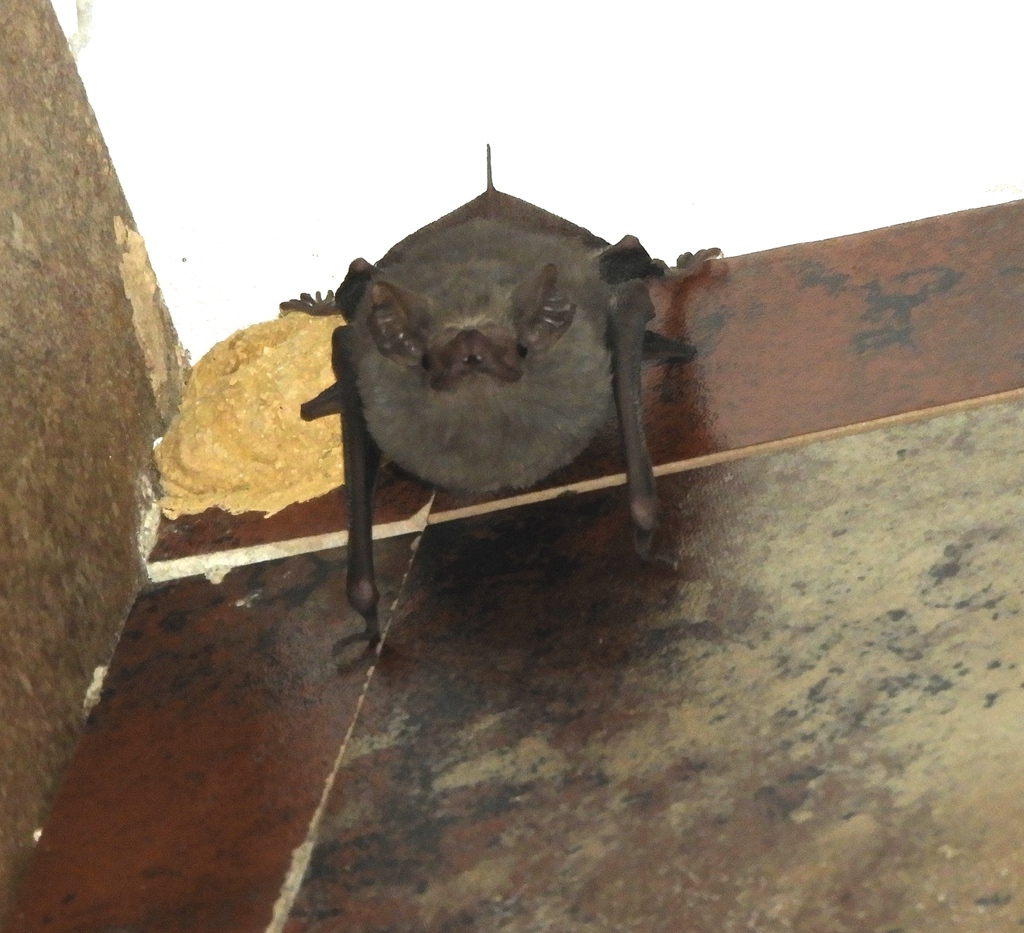
Gray Sac-winged Bat
Photo © Francisco Farriols Sarabia
Photo © Francisco Farriols Sarabia — CC BY 4.0 — Source: iNaturalist #65719447Identification
The gray sac-winged bat is a small insectivore, with males averaging 6.1 grams and females 7.1 grams, and a body length around 66.6 mm. Its most distinctive feature is the pair of prominent sacs located between the wrist and neck on the wing membrane—far more developed in males than females. The sac sits centrally on the antebrachial membrane and has a proximal opening; its interior varies in color and texture with the bat's age and season. The bat's coloring ranges from gray to rich brown, with all varieties displaying white trim, darker fur on the back and lighter fur on the underside. Like all members of the Emballonuridae family, it has a characteristic sheath tail: a membrane stretching between the ankles with the tail mostly enclosed and only the tip protruding about 6 mm from the body. The bat has rounded ears, an unusually long and thin thumb (about 5 mm), and an inflated rostrum without a dorsal furrow between the nostrils.
Range & Habitat
The gray sac-winged bat inhabits Mexico from Baja California Sur and Sonora southward through Central America—Guatemala, El Salvador, Honduras, Nicaragua, and Costa Rica—extending into northern Colombia, at elevations up to 1,500 metres. It shows a strong preference for dry, arid climates over wet environments, favoring evergreen forests rather than swamps. The species typically roosts near cave entrances, in barns, and other buildings, preferring open, well-lit areas. Colonies require at least 25% humidity and benefit from multiple roost exits. These highly social bats form large aggregations, often numbering fifty or more individuals, with colonies sometimes reaching up to 10,000 members.
Behaviour & Diet
The gray sac-winged bat is an opportunistic insectivore, feeding on whatever insects are seasonally available. Unlike some bat species, its population remains stable year-round regardless of seasonal food fluctuations. These bats forage both alone and in groups, typically over open spaces several kilometres from their roosts, flying at relatively slow speeds of approximately 9.76 km/h for males and 9.14 km/h for females. Hunting begins shortly before sunset. Interestingly, a study demonstrated that when these bats can see, they prefer vision to echolocation; they only resort to echolocation at night. When roosting, bats maintain spacing of about twenty centimetres apart, except when young are present, and all face the same direction. Both roosting and foraging sites change frequently, and the bats are non-territorial, often sharing roosts with other bat species.
Best Time & Places to See It
Look for gray sac-winged bats near cave entrances, barns, and other structures in open, lit areas throughout their range in Mexico and Central America. The best viewing opportunities occur around the beginning of the dry season when mating activity increases and males congregate in colonies. Since these bats hunt in groups over open spaces at dusk and into the night, positioning yourself near known roost sites at dawn or dusk offers the best chance of observation. Their preference for dry, arid climates and evergreen forests makes them more likely to be found in such habitats than in swampy regions.
Photography Tips
Photograph these bats at dusk when they emerge to hunt, using fast shutter speeds to capture their relatively slow but steady flight. Males are easier to photograph than females due to their more prominent wing sacs, which are a key identifying feature. Position yourself near roosting sites such as cave mouths or buildings where colonies congregate. The bat's distinctive central wing sac and white-trimmed coloration (whether gray or brown) are worth emphasizing in images. Since these bats emit audible echolocation pulses through the mouth and prefer vision in daylight conditions, early evening or dawn light may offer better opportunities for detailed photography than complete darkness.
Santa Rosa National Park
Santa Elena, Costa Rica
+359 birds+30 mammals
Where Pacific-facing slopes descend from volcanic uplands toward the Guanacaste lowlands, Santa Rosa National Park unfolds across a mosaic of tropical dry forest, gallery woodland, and…
VIEW NATIONAL PARKPalo Verde National Park
Bagaces, Costa Rica
+318 birds+24 mammals
Dry forest spreads across Palo Verde's low-lying terrain in northwestern Guanacaste, where seasonal rivers and lagoons etch through deciduous woodland that sheds its canopy each winter.…
VIEW NATIONAL PARKNo community photos yet. Log in to add the first one.
No community observations of this species yet.