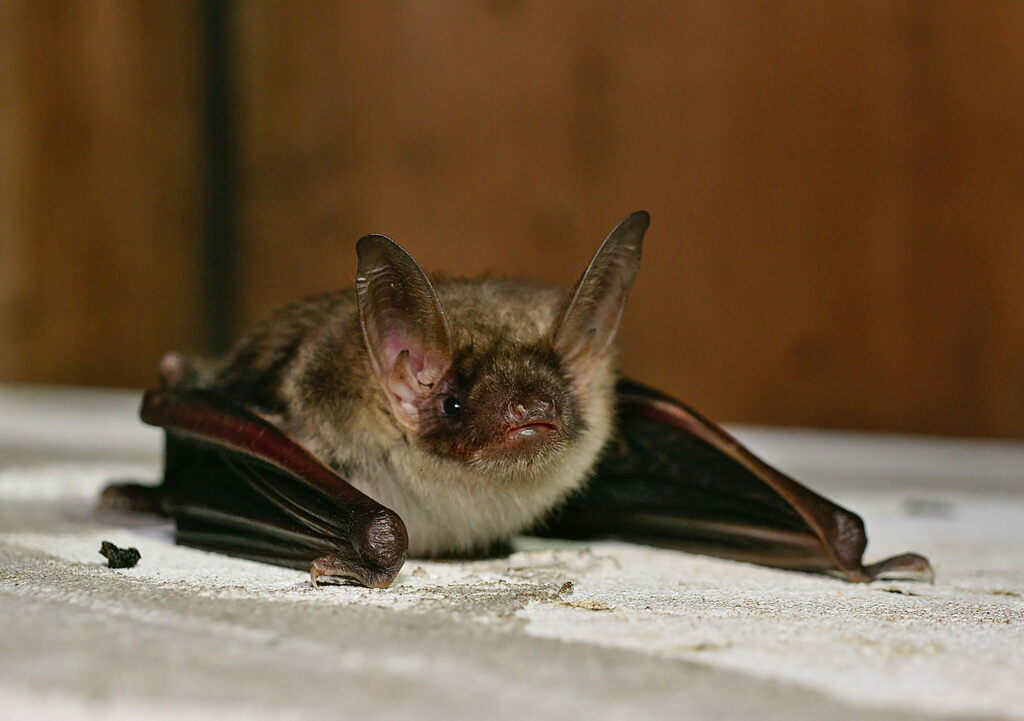
Greater Myotis
Photo © Gilles San Martin
Photo © Gilles San Martin — CC BY-SA 4.0 — Source: iNaturalist photo #376483380Identification
The greater mouse-eared bat is one of Europe's largest bat species, weighing up to 45 grams with a 40 cm wingspan—roughly the size of a house mouse. Its most distinctive features are its long, broad muzzle and noticeably large ears, which give it its characteristic appearance. The dorsal side is brown to reddish-brown, contrasting with a dirty white or beige underside. The tragus (the small projection inside the ear) forms half the ear and typically bears a small black tip. Wing membranes are brownish. With a head-to-tail length of 8 to 9 cm, a forearm of 6 cm, and a tail of 4 to 5 cm, this species is unmistakably larger than most European bats. Remarkably for its size, the greater mouse-eared bat is exceptionally long-lived, with lifespans exceeding 35 years.
Range & Habitat
This species is widespread throughout Europe, occurring in most countries except Ireland, Denmark, Latvia, Estonia, Finland, and the Scandinavian Peninsula. Its range extends to Mediterranean islands including Sicily, Malta, and the Gymnesian Islands, and into the Middle East in Turkey, Israel, Syria, Jordan, and Lebanon. It is very common in the Iberian Peninsula and France, and is the most abundant bat species on Mallorca in the Balearics, where it also inhabits Menorca. The species roosts underground year-round in most of its range, though in Northern Europe colonies also occupy attics and lofts of buildings, with rare small tree-based colonies elsewhere.
Behaviour & Diet
Unlike many bat species, the greater mouse-eared bat hunts by gleaning prey from the ground rather than capturing insects in flight. It locates food by listening passively for the sounds produced by carabid beetles, grass beetles, other beetles, large moths, centipedes, and spiders. It forages in open deciduous woodlands, forest edges, and pastures, using echolocation primarily for spatial orientation rather than prey capture. Colonies vary in size, typically holding up to 500 individuals on Mediterranean islands, though continental European colonies occasionally exceed 4,500 bats. It sometimes roosts alongside other bat species. Mating occurs in autumn, with females giving birth from May to June to 1–2 pups each. Females form nursery colonies from which males are excluded, carrying pups for approximately 45 days.
Best Time & Places to See It
The greater mouse-eared bat is most reliably encountered in southern France and the Iberian Peninsula, where populations remain robust. Mallorca in the Balearics is an excellent destination, hosting numerous large colonies in caves with hundreds of individuals. The Gola della Rossa and Frasassi Nature Park in Italy's Marches region protects several thousand individuals and offers dedicated protection and observation opportunities. In spring, watch for annual dispersions of up to 200 km as bats move between winter and summer roosts. Early evening hours during the warmer months offer the best opportunities for observation.
Photography Tips
Photographing this species requires patience and specialized equipment. Seek permission to photograph at known roosts or caves where colonies congregate, such as those on Mallorca or in the Marches. Use high-speed flash photography to capture nocturnal flight sequences, and infrared or thermal imaging to locate bats within roosts. The species' large size relative to other European bats makes it a rewarding subject, particularly during nursery colony formation in early summer. Photographing roosting individuals during daylight hours in caves or buildings often yields clearer images than attempting to capture them in flight.
Harz National Park
Harz (LK Goslar), Germany
+141 birds+38 mammals
Where granite peaks rise above beech and spruce forests, the Harz unfolds as one of Germany's most biodiverse upland landscapes. Straddling the border between Lower Saxony…
VIEW NATIONAL PARKSouth Downs National Park
Chichester, United Kingdom
+298 birds+45 mammals
Chalk downland ridges rise and fall across the South Downs, their open grasslands and beech hangers creating a mosaic of habitats that has shaped human settlement…
VIEW NATIONAL PARKCévennes National Park
Vebron, France
+187 birds+63 mammals
Where granite gorges slice through the limestone plateaux of southern France, the Cévennes Cœur National Park unfolds across nearly 3,500 square kilometres of one of Europe's…
VIEW NATIONAL PARKForêts National Park
Lucey, France
+140 birds+50 mammals
Across the rolling plateaux of central Burgundy, where limestone uplands give way to deep valleys carved by time and water, lies a landscape of profound ecological…
VIEW NATIONAL PARKBükk National Park
Répáshuta, Hungary
+161 birds+15 mammals
Where forested limestone ridges rise across northern Hungary, Bükk National Park unfolds across nearly 900 square kilometres of temperate woodland, rocky gorges, and karst formations that…
VIEW NATIONAL PARKSierra de Andújar Natural Park
Our Lady of Cabeza, Spain
+198 birds+19 mammals
Where granite gorges slice through Mediterranean scrubland and cork forests cascade down Andalusian hillsides, one of Spain's most pristine wilderness areas unfolds across 74,000 hectares of…
VIEW NATURAL PARKRegional Park of the Catalan Pyrenees
Olette, France
+244 birds+63 mammals
Where granite peaks thrust skyward above cloud-laden valleys, a wild tapestry of Mediterranean and alpine ecosystems interweaves across the Franco-Spanish frontier. These Pyrenean slopes harbour extraordinary…
VIEW NATURE RESERVED’Armorique Regional Nature Park
Le Faou, France
+103 birds+23 mammals
Where granite ridges meet Atlantic moorland, one of Brittany's wildest regions reveals itself in layers of ecological richness. The landscape shifts dramatically from heather-clad uplands to…
VIEW NATURAL PARKVitosha Nature Park
Chuypetlovo, Bulgaria
+137 birds+12 mammals
Where ancient granite peaks rise above the Bulgarian capital, a wild sanctuary unfolds across nearly 27,000 hectares of pristine montane wilderness. Vitosha's character shifts dramatically with…
VIEW NATURAL PARKVratsa Balkan
Zgorigrad, Bulgaria
+128 birds+10 mammals
Where limestone cliffs plunge into deep river canyons and beech forests give way to rocky karst plateaus, one of Bulgaria's most dramatic mountain landscapes unfolds across…
VIEW NATURE RESERVENo community photos yet. Log in to add the first one.
No community observations of this species yet.