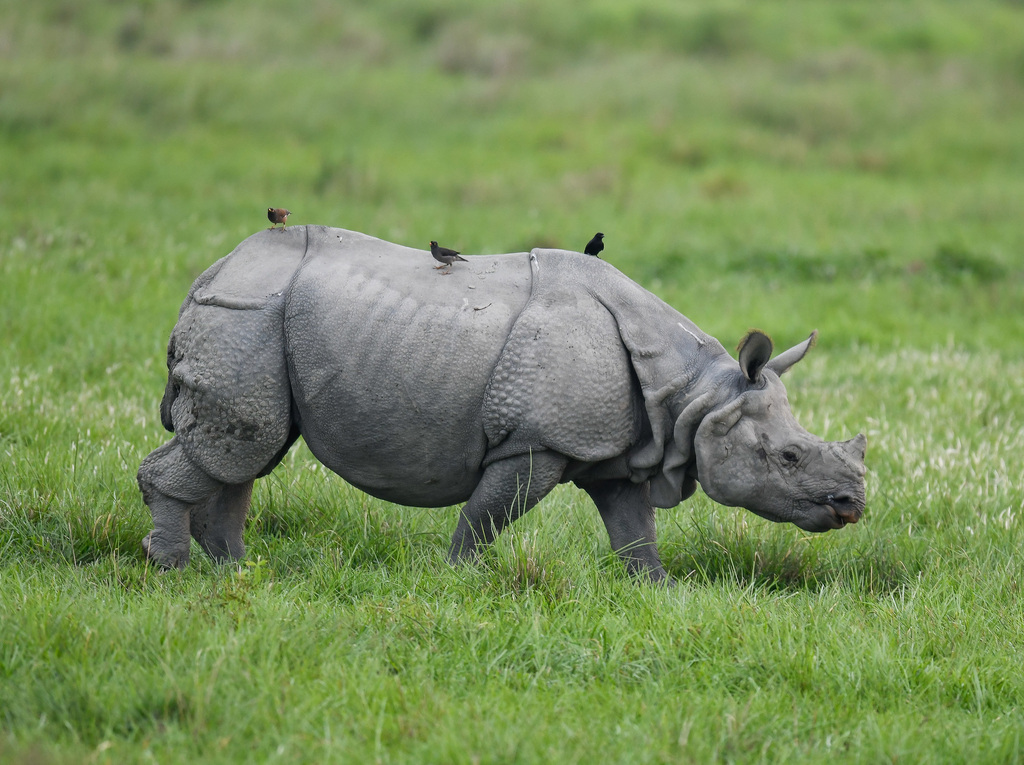
Greater One-horned Rhinoceros
Photo © Rejoice Gassah
Photo © Rejoice Gassah — CC BY 4.0 — Source: iNaturalist photo #549685983The Indian rhinoceros (Rhinoceros unicornis), also known as the greater one-horned rhinoceros, great Indian rhinoceros or Indian rhino, is a rhinoceros species native to the Indian subcontinent. It is the second largest living rhinoceros and the largest in Asia, with adult males weighing 2.07–2.2 t (2.04–2.17 long tons; 2.28–2.43 short tons) and adult females 1.6 t (1.6 long tons; 1.8 short tons). Its thick skin is grey-brown with pinkish skin folds. It has a single horn on its snout that grows up to 57.2–61.6 cm (22.5–24.3 in) long. Its upper legs and shoulders are covered in wart-like bumps, and it is nearly hairless aside from the eyelashes, ear fringes and tail brush. The Indian rhinoceros occurs in the Indo-Gangetic Plain in 12 protected areas in northern India and southern Nepal. It is a grazer, eating mainly grass, but also twigs, leaves, branches, shrubs, flowers, fruits and aquatic plants. It is a largely solitary animal, only associating in the breeding season and when rearing calves. Females give birth to a single calf after a gestation of 15.7 months. The birth interval is 34–51 months. Captive individuals can live up to 47 years. It is susceptible to diseases such as anthrax, and…
Orang National Park
Rangagarapathar, India
+298 birds+1 mammals
Where the Brahmaputra's floodplains meet the foothills of Assam, Orang National Park unfolds across a mosaic of riverine grasslands, forests and wetlands that pulse with the…
VIEW NATIONAL PARKValmiki National Park
Ramnagar, India
+66 birds+6 mammals
Along Bihar's western frontier, where the Gandak River winds through subtropical forest and grassland, Valmiki National Park sprawls across terrain shaped by monsoon rains and seasonal…
VIEW NATIONAL PARKKaziranga National Park
Kohora, India
+422 birds+26 mammals
Dawn breaks over the floodplains of the Brahmaputra, where tall grasslands stretch endlessly beneath monsoon-heavy skies. This sprawling wilderness of northeastern Assam is a mosaic of…
VIEW NATIONAL PARKNo community photos yet. Log in to add the first one.
No community observations of this species yet.