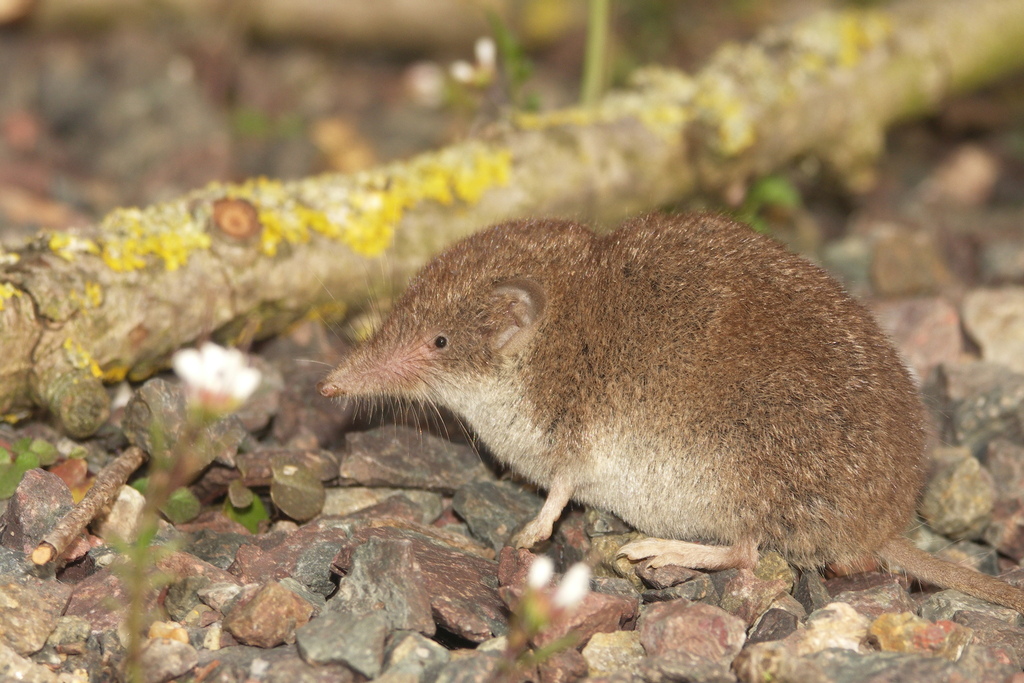
Greater White-toothed Shrew
Photo © Sylvain Montagner
Photo © Sylvain Montagner — CC BY 4.0 — Source: iNaturalist photo #304719715Identification
The greater white-toothed shrew is a small, elusive insectivore that challenges even experienced naturalists to distinguish it from its close relative, the lesser white-toothed shrew. At 6 to 9 centimetres in head and body length with a tail averaging 3 to 4.3 centimetres, it weighs around 11 to 14 grams—making it a truly pocket-sized mammal. The most reliable identifying feature is its unpigmented teeth, which lack the iron deposits visible in other shrew species. Look for a greyish or reddish-brown upper coat contrasting with a yellowish-grey underside. Close inspection of the teeth, rather than general appearance, is essential for certain identification.
Range & Habitat
This is the most common of the white-toothed shrews, with a scattered distribution across Europe and North Africa. Populations occur along the Mediterranean, in the Netherlands, Belgium, Ireland, Germany, and Portugal, with a subspecies found on the Spanish island of Ibiza. Remarkably, introduced populations have established themselves as far as the Canary Islands. The species has recently expanded its range, discovered in Ireland in April 2008 and in England in 2021.
These shrews favour temperate regions abundant in insects, preferring grasslands, woodlands, hedgerows, and agricultural areas. They typically remain below 1000 metres altitude, nesting under stones, logs, and in abandoned burrows. In colder months, they venture near farms and gardens in preparation for winter survival.
Behaviour & Diet
Greater white-toothed shrews are semi-social and highly vocal mammals. They possess a primitive form of echolocation, producing high-pitched twittering calls to navigate their environment alongside their sensitive whiskers. During winter, they share nests and enter torpor to conserve energy. Mated pairs guard territories together, and these shrews are notably monogamous with unusual female-biased dispersal—a rare pattern in mammals that helps prevent inbreeding.
As carnivores, they feed primarily on invertebrates, with occasional small rodents, lizards, and amphibians supplementing their diet. Their cryptic coloration and preference for cover beneath vegetation and leaf litter provide protection from predators including barn owls, snakes, weasels, and genets.
Best Time & Places to See It
The breeding season from March to September offers the best opportunity to encounter this species, as females produce up to four litters during this period. Search grasslands, woodlands, and hedgerows in Mediterranean regions, the Low Countries, Ireland, Portugal, and Germany. Early morning and dusk provide optimal viewing windows, though these secretive creatures remain largely nocturnal. Listen for their distinctive high-pitched calls in suitable habitat, particularly near farm edges and gardens where they forage for insects. Southern Irish counties have experienced rapid population expansion since 2008, making them increasingly accessible locations for observation.
Photography Tips
Photographing this diminutive shrew presents considerable challenges due to its cryptic nature and rapid movements. Use high-speed film or elevated ISO settings to compensate for low-light conditions during dawn and dusk activity. A macro lens will be essential to capture fine details, particularly the unpigmented teeth for identification purposes. Position yourself near potential nest sites under logs or stones, or along hedgerow margins, and remain patient and motionless. Infrared or night-vision equipment may be necessary for successful captures of this largely nocturnal mammal. Remember that your presence may drive them deeper into cover, so approach slowly and avoid sudden movements.
Serra D’Irta Natural Park
Alcossebre, Spain
+122 birds+13 mammals
Where Mediterranean limestone cliffs meet the Balearic Sea, Serra d'Irta unfolds as a tapestry of dramatic coastal terrain and diverse terrestrial habitats. This Category 5 protected…
VIEW NATURAL PARKL’Albufera Natural Park
València, Spain
+321 birds+18 mammals
Where shallow lagoons meet Mediterranean coastal marshland, L'Albufera Nature Park unfolds as one of Spain's most vital wetland complexes. This protected landscape, designated under IUCN Category…
VIEW NATURAL PARKSchleswig-Holsteinisches Wattenmeer National Park
Germany
+378 birds+49 mammals
Where the North Sea ebbs and flows across a vast expanse of exposed mud and sand, the Schleswig-Holsteinisches Wattenmeer National Park reveals one of Europe's most…
VIEW NATIONAL PARKDoñana National Park
Hinojos, Spain
+300 birds+13 mammals
Where the Guadalquivir River delta spreads into the Atlantic, vast marshes, cork woodlands, and coastal dunes converge to create one of southwestern Europe's most biodiverse wetland…
VIEW NATIONAL PARKCabo de Gata-Níjar Natural Park
San José, Spain
+274 birds+11 mammals
Where volcanic ridges plunge toward the Mediterranean, Cabo de Gata-Níjar Nature Park unfolds across one of Europe's most arid coastlines, a landscape sculpted by tectonic violence…
VIEW NATURAL PARKSerra de Montsant Natural Park
La Morera de Montsant, Spain
+134 birds+15 mammals
Rugged limestone ridges and deeply incised gorges define the Serra de Montsant, a 10,000-hectare protected landscape that rises abruptly from the wine-growing plains of Tarragona in…
VIEW NATURAL PARKMontaña Palentina Natural Park
Vidrieros, Spain
+180 birds+29 mammals
Where the Cantabrian mountains rise above the Palencia plateau, Montaña Palentina Nature Park sprawls across nearly 1,500 square kilometres of some of northern Spain's most dramatic…
VIEW NATURAL PARKDelta de l’Ebre Natural Park
Eucaliptus, Spain
+341 birds+18 mammals
Where the Ebro River spreads into a vast labyrinth of shallow lagoons, reed beds, and brackish marshes before surrendering to the Mediterranean, one of southern Europe's…
VIEW NATURAL PARKCap de Creus Natural Park
Roses, Spain
+245 birds+23 mammals
Where the Pyrenees tumble into the Mediterranean, Cap de Creus Nature Park unfolds across 300 square kilometres of one of northeastern Spain's most dramatic coastal wilderness…
VIEW NATURAL PARKCévennes National Park
Vebron, France
+187 birds+63 mammals
Where granite gorges slice through the limestone plateaux of southern France, the Cévennes Cœur National Park unfolds across nearly 3,500 square kilometres of one of Europe's…
VIEW NATIONAL PARKSierra de Cazorla, Segura y las Villas Nature Park
Las Canalejas, Spain
+176 birds+21 mammals
Where granite gorges slice through mountainous terrain in eastern Andalusia, the Sierra de Cazorla, Segura y las Villas Nature Park sprawls across more than 5,200 square…
VIEW NATURAL PARKParc del Garraf
Rat-Penat, Spain
+190 birds+15 mammals
Where limestone ridges rise abruptly from the Mediterranean coastal plain, Parc Natural del Garraf unfolds across 319 square kilometers of one of Catalonia's most dramatic protected…
VIEW NATURAL PARKCollserola Natural Park
Barcelona, Spain
+194 birds+20 mammals
Where Mediterranean scrubland rises steeply from Barcelona's urban edge, Collserola unfolds across 173 square kilometres of low mountains that form a crucial ecological buffer between city…
VIEW NATURAL PARKParc del Montnegre i el Corredor
Font-Montnegre, Spain
+148 birds+16 mammals
Where Mediterranean scrubland gives way to deciduous and coniferous woodland, the Parc Natural del Montnegre i el Corredor unfolds across nearly 478 square kilometres of northeastern…
VIEW NATURAL PARKForêts National Park
Lucey, France
+140 birds+50 mammals
Across the rolling plateaux of central Burgundy, where limestone uplands give way to deep valleys carved by time and water, lies a landscape of profound ecological…
VIEW NATIONAL PARKMontseny Natural Park
Viladrau, Spain
+156 birds+30 mammals
The Montseny Natural Park is one of Catalonia’s most remarkable protected areas, offering an extraordinary blend of biodiversity, scenic landscapes, and cultural heritage within easy reach…
VIEW NATURAL PARKEspacio Natural Remolar-Filipinas
El Prat del Llobregat, Spain
+297 birds+7 mammals
Where the Llobregat River delta meets the Mediterranean, a patchwork of salt marshes, reed beds, and shallow lagoons creates one of Catalonia's most dynamic wetland ecosystems.…
VIEW NATURE RESERVEUrdaibai Biosphere Reserve
Txatxarramendi, Spain
+268 birds+8 mammals
Where the Pyrenean foothills surrender to the Bay of Biscay, tidal estuaries carve through Basque limestone, creating one of Europe's most ecologically vital wetland complexes. Salt…
VIEW BIOSPHERE RESERVESierra de Gredos Regional Park
Candeleda, Spain
+180 birds+18 mammals
Where granite peaks claw at 2,592 metres and alpine meadows give way to cork oak scrubland, Spain's central highlands reveal a landscape of remarkable vertical drama.…
VIEW NATURE RESERVERegional Park of the Catalan Pyrenees
Olette, France
+244 birds+63 mammals
Where granite peaks thrust skyward above cloud-laden valleys, a wild tapestry of Mediterranean and alpine ecosystems interweaves across the Franco-Spanish frontier. These Pyrenean slopes harbour extraordinary…
VIEW NATURE RESERVEEspai d’interès natural de les Gavarres
Cruïlles, Monells i Sant Sadurní de l'Heura, Spain
+143 birds+16 mammals
Where Mediterranean scrubland rises and falls across the gentle hills of inland Catalonia, the Espai d'interès natural de les Gavarres protects one of the region's most…
VIEW NATURE RESERVESerra de Mariola Natural Park
Bocairent, Spain
+164 birds+19 mammals
Where limestone ridges rise above the Valencian interior, Serra de Mariola unfolds across 225 square kilometers of Mediterranean mountain terrain that shifts between dense evergreen woodland,…
VIEW NATURE RESERVEEstrecho Natural Park
Pedro Valiente, Spain
+281 birds+20 mammals
Where Mediterranean pine forests meet wind-sculpted coastal cliffs, one of Europe's most dynamic ecological crossroads unfolds across the Strait of Gibraltar. Spanning 686 square kilometers of…
VIEW NATURAL PARKCapçaleres del Ter i del Freser Natural Park
La Farga, Spain
+125 birds+20 mammals
Where the eastern Pyrenees yield their first waters, granite gorges slice through dense forests of beech and fir, creating one of Catalonia's most hydrologically vital landscapes.…
VIEW NATURAL PARKParcial de la Fageda d’en Jordà Nature Reserve
Santa Pau, Spain
+117 birds+5 mammals
Where volcanic slopes rise above the Catalan heartland, the Parcial de la Fagada d'en Jordà unfolds across five square kilometres of one of Europe's most botanically…
VIEW NATURE RESERVESomiedo Natural Park
Pola de Somiedo, Spain
+165 birds+25 mammals
Where granite gorges cleave through the Cantabrian Mountains of northern Spain, alpine meadows roll toward beech and oak forests in a landscape virtually untouched by industrial…
VIEW NATURAL PARKMontañas de Prades
Capafonts, Spain
+151 birds+13 mammals
Where granite peaks rise abruptly from the Tarragona hinterland, a wild mosaic of pine forests, scrubland, and limestone cliffs creates one of northeastern Spain's most biodiverse…
VIEW MOUNTAIN & ALPINEPort-Cros National Park
Hyères, France
+271 birds+29 mammals
Where Mediterranean granite islands rise from crystalline waters off the Provençal coast, Port-Cros National Park protects one of Europe's most intact marine and terrestrial ecosystems. The…
VIEW NATIONAL PARKNo community photos yet. Log in to add the first one.
No community observations of this species yet.