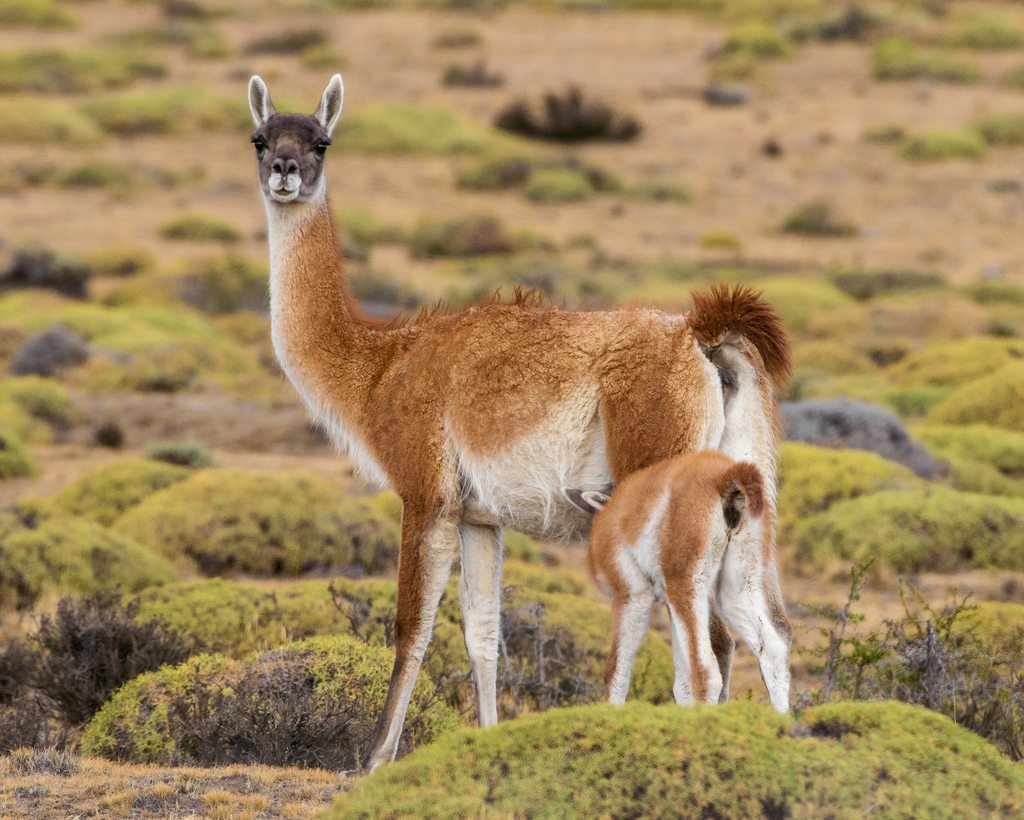
Guanaco
Photo © Nicolás Villaseca Merino
Photo © Nicolás Villaseca Merino — CC BY-SA 4.0 — Source: iNaturalist photo #259400234Identification
The guanaco is a graceful camelid standing 1.0 to 1.3 metres at the shoulder, with a body length of 2.1 to 2.2 metres and weighing 90 to 140 kilograms. One of South America's largest native terrestrial mammals, it is closely related to the domesticated llama. The guanaco's coat is remarkably uniform in colour, ranging from light brown to dark cinnamon with white underparts and a distinctive grey face. Its small, straight ears and thick-skinned neck are characteristic features. The fibre is particularly prized for its softness and warmth, comparable to cashmere, with guard hairs surrounding a luxuriously soft undercoat.
Range & Habitat
Guanacos inhabit the steppes, scrublands and mountainous regions across South America, found in the altiplano of Peru, Bolivia and Chile, and throughout Patagonia, with small populations in Paraguay and a reintroduced group in the Falkland Islands. They are most numerous in Argentina and the Patagonian regions, where livestock competition is limited. Remarkably, some guanacos survive in the Atacama Desert, one of Earth's driest places, exploiting "fog oases" or lomas where cool ocean air creates moisture that sustains cacti and lichens. They inhabit altitudes up to 4,000 metres, except in southern Patagonia where ice prevents this.
Behaviour & Diet
Guanacos are diurnal herbivores that live in herds of females and young led by a dominant male, while bachelor males form separate groups that may contain up to 50 individuals. They graze on grasses, shrubs, herbs, lichens, fungi, cacti and flowers, using a specialised three-chambered forestomach for digestion similar to ruminants. When danger approaches, the herd male alerts others with a bleating call. Their blood is exceptionally rich in red blood cells—approximately 68 million per teaspoon, four times that of humans—enabling survival at high altitudes with low oxygen levels.
Best Time & Places to See It
Guanacos are most robustly populations in Argentine and Chilean Patagonia, particularly in Tierra del Fuego and Torres del Paine National Park, where populations have recovered significantly. They are diurnal animals, making daytime observation possible across open grasslands and scrublands. The species responds to forage availability, occupying different zones seasonally, so visiting during the breeding season may offer better viewing opportunities as herds concentrate in areas of lower food availability.
Photography Tips
The guanaco's uniform colouration and graceful build photograph well against Patagonian landscapes. Their speed—capable of running at 56 kilometres per hour over steep, rocky terrain—means fast shutter speeds are essential for action shots. The open grasslands where they graze offer excellent visibility and minimal obstruction. Their alert nature means patience is rewarded; position yourself downwind and move slowly to capture behavioural moments such as the herd male's warning calls or the distinctive grey face in detail.
Pan de Azúcar National Park
Chañaral, Chile
+74 birds+4 mammals
Where the Atacama Desert plunges toward the Pacific, Pan de Azúcar National Park sprawls across 727 square kilometres of one of Earth's most extreme transitions—a landscape…
VIEW NATIONAL PARKTorres del Paine National Park
Torres del Paine, Chile
+143 birds+10 mammals
Where granite spires pierce the Patagonian sky, Torres del Paine commands one of South America's most dramatic landscapes. Across 4,106 square kilometres of southern Chile, jagged…
VIEW NATIONAL PARKLauca National Park
Putre, Chile
+139 birds+17 mammals
Where the Andes rise toward the altiplano in Chile's far north, Lauca National Park sprawls across more than 3,000 square kilometres of some of South America's…
VIEW NATIONAL PARKCerro Castillo National Park
Coyhaique, Chile
+89 birds+3 mammals
Granite peaks and windswept steppe converge across this vast Patagonian landscape, where the Andes' eastern flank drops into terrain sculpted by ice age glaciers and relentless…
VIEW NATIONAL PARKPatagonia National Park
Cochrane, Chile
+133 birds+8 mammals
Where the Andes meet the Patagonian steppe, vast grasslands and shrublands sweep across rolling terrain carved by ancient glaciation, their contours softened by distance and dramatic…
VIEW NATIONAL PARKMonte León National Park
Argentina
+100 birds+4 mammals
Where the Patagonian steppe meets the Atlantic, Monte León National Park protects a landscape of windswept coastal cliffs, rocky outcrops, and semi-arid grassland spanning over 1,200…
VIEW NATIONAL PARKLos Cardones National Park
Argentina
+193 birds+6 mammals
Where the Andes descend into northwestern Argentina, Los Cardones National Park sprawls across nearly 1,200 square kilometres of one of South America's most distinctive high-altitude desert…
VIEW NATIONAL PARKNahuel Huapi National Park
Argentina
+124 birds+11 mammals
Where the Andes descend toward Patagonia, vast glacial lakes cut through a landscape of southern beech forest and granite peaks, creating one of South America's most…
VIEW NATIONAL PARKSierra de las Quijadas National Park
Argentina
+168 birds+5 mammals
Sandstone cliffs and deeply incised canyons define this 1,137-square-kilometre expanse in San Luis Province, where the dry Chacoan landscape of central Argentina reveals an unexpected ecological…
VIEW NATIONAL PARKNo community photos yet. Log in to add the first one.
No community observations of this species yet.