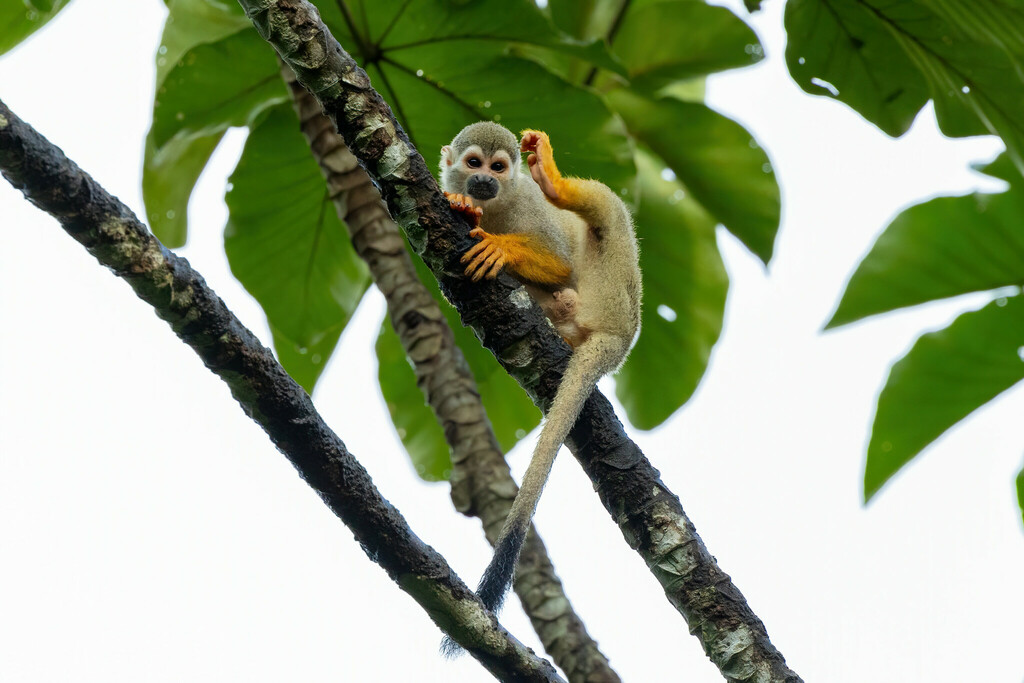
Guianan Squirrel Monkey
Photo © Thibaud Aronson
Photo © Thibaud Aronson — CC BY-SA 4.0 — Source: iNaturalist photo #412859639Identification
The Guianan squirrel monkey is a small primate with a distinctive appearance that makes it relatively easy to identify in the field. Males measure 25–37 cm in body length with tails of 36–40 cm, while females are slightly smaller at 25–34 cm with longer tails reaching 36–47 cm. Both sexes weigh between 550 and 1,400 grams. The most striking features are the pink face contrasting sharply with a black muzzle, and distinctive white arches above the eyes. The crown is olive or olive-gray, the back varies from gray to olive or orange, the belly is white, and the arms are bright yellow-orange. The long tail, characteristic of squirrel monkeys, aids in balance during rapid movement through the canopy.
Range & Habitat
The Guianan squirrel monkey is found in northern Brazil and the Guiana Shield region, including Guiana and Venezuela. Recent genetic research has clarified that this species is distinct from Humboldt's squirrel monkey (found in Colombia, Peru, and Ecuador) and Collins' squirrel monkey (from northeastern Brazil), which were previously considered subspecies. Interestingly, genetic studies reveal that despite a geographical gap between their ranges, the Guianan squirrel monkey is most closely related to the Central American squirrel monkey of Costa Rica and Panama.
Behaviour & Diet
Guianan squirrel monkeys are highly social and frequently feed and move through the forest canopy in mixed-species groups, often associating with capuchin monkeys and red-backed bearded sakis. This gregarious behaviour provides protection and may enhance foraging efficiency. Their omnivorous diet is remarkably diverse, including insects, seeds, fruit, young leaves, flowers, gum, shoots, nectar, spiders, lizards, bird eggs, and occasionally bats.
Breeding is synchronized within groups, with males becoming noticeably heavier in the upper body and more aggressive during the mating season. Females do not typically initiate mating. After a gestation period of about 5 months, infants are born in January or February, with all young in a group typically arriving within one week of each other. Although males provide no parental care, non-maternal females assist with infant care. Young are weaned at approximately 6 months, females reach sexual maturity around 2.5 years, and males mature fully at 4–5 years. These monkeys can live more than 20 years in the wild.
Best Time & Places to See It
Guianan squirrel monkeys are active during the day and are most conspicuous in primary and mature secondary forests where they forage in the middle and upper canopy. They are most easily observed during early morning hours when foraging activity is high. January and February are particularly rewarding months for viewing, as this is when infants are born and small young are visible clinging to their mothers. Listening for their distinctive vocalizations can help locate groups before you see them.
Photography Tips
The small size, rapid movements, and preference for the high canopy make photographing Guianan squirrel monkeys challenging but rewarding. A telephoto lens (at least 300mm) is essential. Position yourself early in the morning when light is optimal and monkeys are most active. Focus on mixed-species feeding groups, which are more predictable in location. The distinctive facial markings and bright yellow-orange arms provide excellent compositional opportunities; patience and a fast shutter speed will help freeze their energetic movements through the branches.
No community photos yet. Log in to add the first one.
No community observations of this species yet.