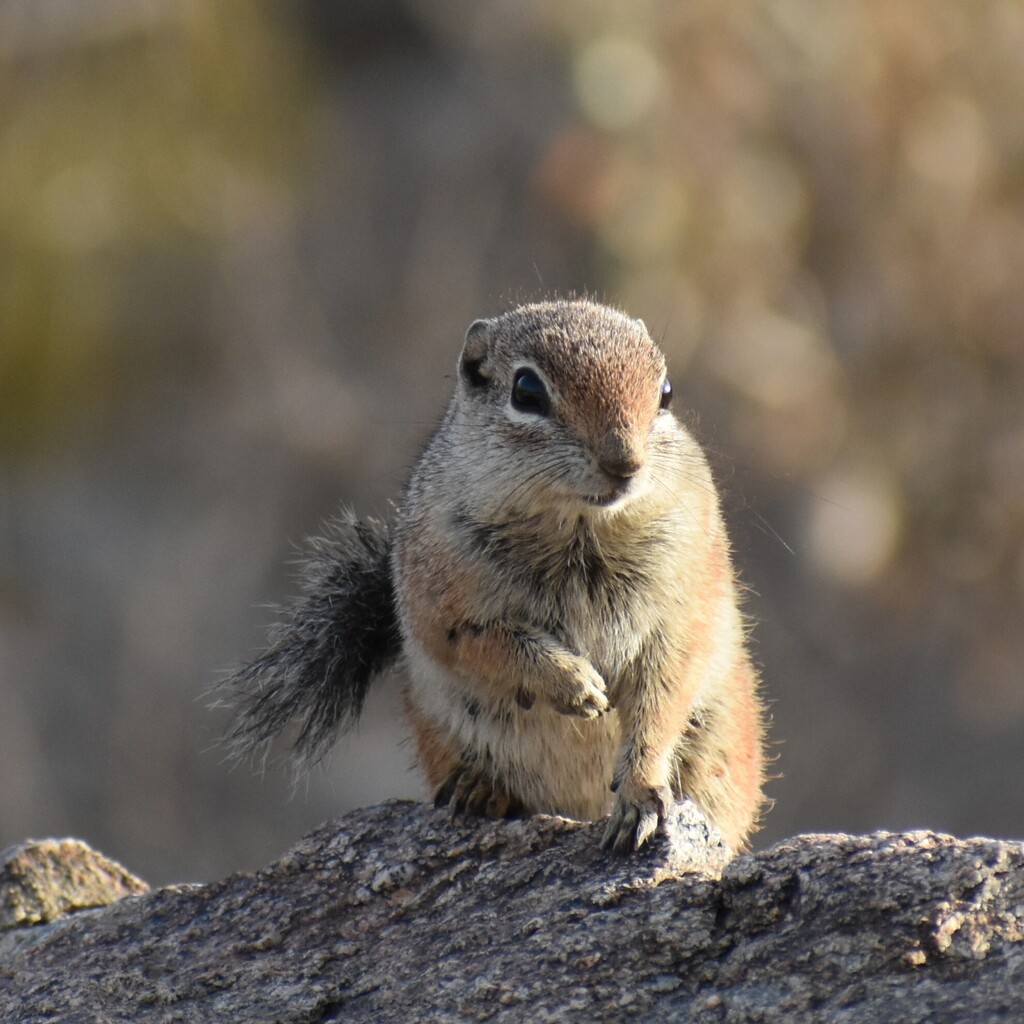
Harris’s Antelope Squirrel
Photo © Jason Leduc
Photo © Jason Leduc — CC0 1.0 — Source: iNaturalist #355748987Harris's antelope squirrel (Ammospermophilus harrisii) is a species of rodent in the family Sciuridae. It is found in Arizona and New Mexico in the United States, and in Sonora in Mexico. They are adapted to hot weather conditions including a technique called "heat dumping". They have a wide-ranging diet, including both vegetation, insects, small rodents and carrion. == Taxonomy and description == The species is named after Edward Harris. Examples of A. harrisii have distinctive markings on their grey fur, with brown highlights on the sides and legs and a white strip down the side of the torso and encircling their eyes. Their fur grows longer in the winter than it does in the summer. Adults weigh around 4–5 ounces (110–140 g), and measure 8.5–10 inches (22–25 cm) minus their tail, which measures 3–4 inches (7.6–10.2 cm). They can be mistaken for chipmunks. A. harrisii has a high body temperature of 97-107 degrees Fahrenheit (36.7 - 41.6 °C) In order to protect itself from the heat of the Sonoran Desert, A. harrisii carries their tails over their bodies in order to provide shade. A. harrisii also participates in a heat reduction method where individuals move into shaded positions and lie…
Saguaro National Park
Rincon Valley, United States
+354 birds+40 mammals
Where the Sonoran Desert meets sky-island mountains, two geographically separated districts of Saguaro National Park sprawl across nearly two thousand square kilometers of Arizona's most iconic…
VIEW NATIONAL PARKCabeza Prieta National Wildlife Refuge
United States
+155 birds+6 mammals
Across southwestern Arizona's harshest terrain, where the Colorado River marks the border with Mexico, lies a sanctuary shaped entirely by heat and aridity. Cabeza Prieta National…
VIEW WILDLIFE SANCTUARYKofa National Wildlife Refuge
Yuma County, United States
+142 birds+10 mammals
Desert mountains rise in sculptured ridges across northwestern Arizona, where the Colorado River's distant influence fades into some of the most austere terrain in the American…
VIEW WILDLIFE SANCTUARYImperial National Wildlife Refuge
La Paz County, United States
+222 birds+4 mammals
Where the Colorado River carves through the Sonoran Desert in southwestern Arizona, Imperial National Wildlife Sanctuary unfolds across a landscape shaped by water and aridity. The…
VIEW WILDLIFE SANCTUARYNo community photos yet. Log in to add the first one.
No community observations of this species yet.