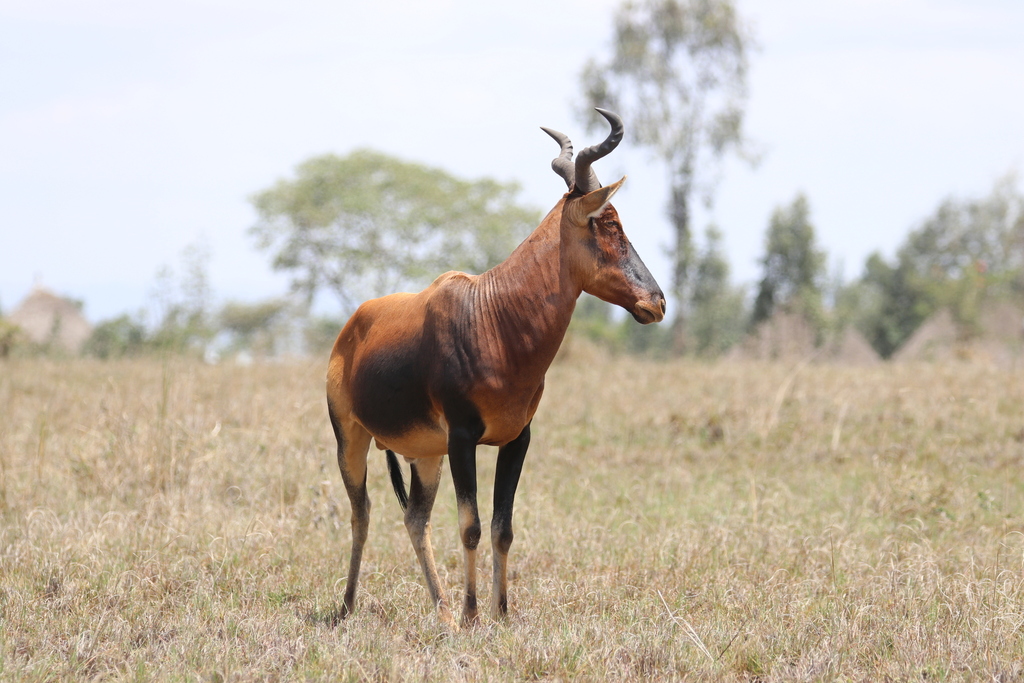
Hartebeest
Photo © Manuel Schwarz
Photo © Manuel Schwarz — CC BY 4.0 — Source: iNaturalist photo #207951653Identification
The hartebeest is a large African antelope standing just over 1 m at the shoulder, with a distinctive elongated forehead and an oddly-shaped pair of horns that can reach 45–70 cm in length. Both males and females are horned, though females have slenderer horns. The body is powerfully built, typically 2 to 2.50 m in head-and-body length, weighing between 100 and 200 kg. The coat is short and shiny, with coloration varying by subspecies from sandy brown in western hartebeest to chocolate brown in Swayne's hartebeest. A conspicuous shoulder hump, pointed ears, short neck, and unusually long legs with often black markings are key field marks. The large chest and sharply sloping back further distinguish hartebeest from other antelopes.
Range & Habitat
Hartebeest inhabit dry savannas and wooded grasslands across Africa, and have been recorded at altitudes up to 4,000 m on Mount Kenya. Once widespread across the continent, populations have undergone drastic declines due to habitat destruction, hunting, human settlement, and competition with livestock. The species is now extinct in Algeria, Egypt, Lesotho, Libya, Morocco, Somalia, and Tunisia, though it has been introduced into Eswatini and Zimbabwe. Eight subspecies are recognized, each with different conservation statuses; notably, the Bubal hartebeest was declared extinct in 1994, while red hartebeest populations are rising and Tora hartebeest populations are critically endangered and falling.
Behaviour & Diet
Hartebeest are gregarious, forming herds of 20 to 300 individuals. They are notably alert and non-aggressive animals. Primarily grazers, their diet consists mainly of grasses. After rainfall, they often move to more arid places. Mating occurs throughout the year with one or two peaks depending on subspecies and local conditions. Both males and females reach sexual maturity at one to two years of age, with gestation lasting eight to nine months and typically a single calf born per pregnancy. Births usually peak during the dry season, and the species has a lifespan of 12 to 15 years.
Best Time & Places to See It
Hartebeest are most reliably seen in protected areas across East and Southern Africa where populations remain viable. Their preference for open savannas and grasslands makes them visible animals when present. The timing of breeding activity and birthing peaks during the dry season may influence sighting opportunities, as herds concentrate around remaining water and forage sources. Local guides familiar with current hartebeest distributions in specific reserves will greatly improve your chances of encounters.
Photography Tips
The hartebeest's distinctive long face, prominent shoulder hump, and unusual horn shape make it photogenically distinctive among African antelopes. Their alert nature and tendency to form visible herds in open grasslands present good opportunities for photography. The long legs and sloping back create strong silhouettes, particularly when backlit during golden hour. Capture the herds from a distance to show their gregarious behavior, and seek closer individual portraits to highlight the elongated facial features and horn structure that define this species.
Nothing matches these filters.
Murchison Falls National Park
Addo Elephant National Park
Amboseli National Park
Augrabies Falls National Park
Bontebok National Park
Camdeboo National Park
Chyulu Hills National Park
Etosha National Park
Garden Route National Park
Nothing matches these filters.
No community photos yet. Log in to add the first one.
No community observations of this species yet.