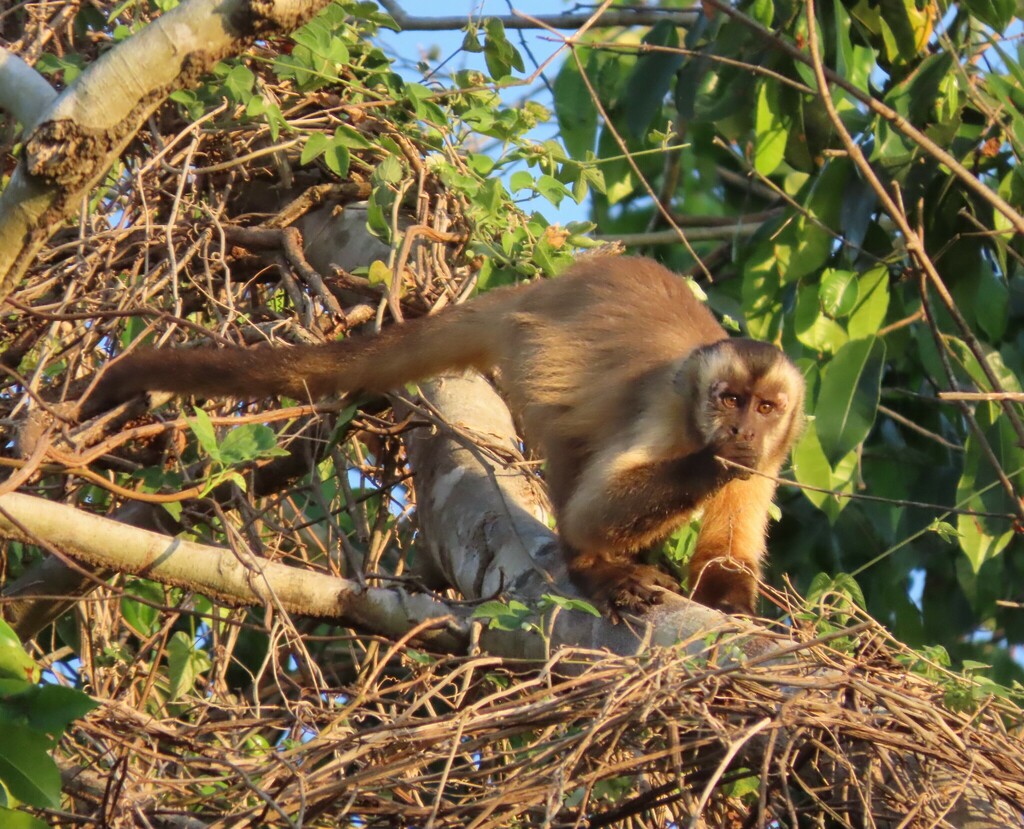
Hooded Capuchin
Photo © Nicolas Olejnik
Photo © Nicolas Olejnik — CC BY 4.0 — Source: iNaturalist photo #313132010Identification
The hooded capuchin is a robust capuchin monkey with distinctive features that set it apart from other Sapajus species. Adults display medium-length fur in various shades of brown, with darker coloring on their limbs and a characteristic dark stripe of hair on the front of their ears resembling sideburns. A tufted crest develops fully only in adulthood. Males are noticeably larger than females, weighing between 1.3–4.8 kg compared to females at 1.4–3.4 kg, with males averaging around 0.8 meters from nose to tail. Their long, prehensile tails can reach half their body length, providing essential balance as they move through the forest canopy. One distinguishing characteristic from other robust capuchins is their significantly smaller cranium size, even when fully mature.
Range & Habitat
The hooded capuchin inhabits a relatively restricted range across central South America, occurring in eastern Paraguay, southeastern Bolivia, northern Argentina, and Brazil—particularly in the Mato Grosso do Sul and Mato Grosso states within the Pantanal region. This species favors subtropical, humid, semi-deciduous gallery forests and forested areas of the Pantanals, environments that provide the dense vegetation and fruiting trees essential for their survival. The current distribution of this species remains somewhat debated among researchers due to phenotypic variations in different populations.
Behaviour & Diet
Hooded capuchins are diurnal, highly social omnivores that live in multi-male/multi-female groups ranging from fewer than a dozen to as many as 44 individuals. Each group is led by an alpha male, typically the largest and most dominant individual, who protects the group, controls access to food, and has priority mating rights. These monkeys spend most of their time resting, traveling, and foraging throughout their established territory, which they rarely leave except under extreme circumstances. They exhibit remarkable learning abilities and can retain information over long periods, contributing to their high adaptability.
Their diet consists primarily of fruits and seeds, supplemented with plant parts, invertebrates, and occasionally small vertebrates. Behavioral differences between sexes reflect dietary preferences: males consume larger prey items and spend more time resting and surveying from lower positions, while females forage more actively in the canopy of sleeping trees, compensating for smaller meal sizes.
Best Time & Places to See It
The Pantanal region of Brazil, particularly in Mato Grosso do Sul and Mato Grosso states, offers the best opportunities for encountering hooded capuchins in their natural habitat. As diurnal animals, they are active throughout daylight hours, making daytime visits to gallery forests and forested Pantanal regions most productive. Their continuous movement through home ranges means patient observation along forest trails and near fruiting trees increases your chances of sightings.
Photography Tips
Capturing images of hooded capuchins requires patience and attention to their behavioral patterns. Position yourself in gallery forests during early morning hours when groups are most active in foraging. Their prehensile tails and acrobatic movements through the canopy provide dynamic photographic opportunities—be prepared for quick movements and use a fast shutter speed. The distinctive dark stripe on their ears and facial features are worth isolating in close-up shots. Since males spend more time at lower levels surveying their territory, they may offer more accessible photo opportunities than females who frequent higher canopy levels. Overcast conditions reduce harsh shadows on their brown fur, producing better detail and color saturation.
Emas National Park
Brazil
+333 birds+23 mammals
Across the high plateaux of central Brazil, where the cerrado grasslands roll toward distant horizons under an immense sky, Emas National Park anchors one of South…
VIEW NATIONAL PARKPantanal Matogrossense National Park
Brazil
+322 birds+17 mammals
Where the flooded forests of central Brazil meet vast seasonally inundated grasslands, Pantanal Matogrossense National Park sprawls across nearly 2,900 square kilometers of one of the…
VIEW NATIONAL PARKCalilegua National Park
Municipio de Calilegua, Argentina
+288 birds+8 mammals
Where the eastern Andean slopes plunge into northwestern Argentina's humid subtropics, nearly 2,645 square kilometers of steep terrain and luxuriant forest compose one of South America's…
VIEW NATIONAL PARKNo community photos yet. Log in to add the first one.
No community observations of this species yet.