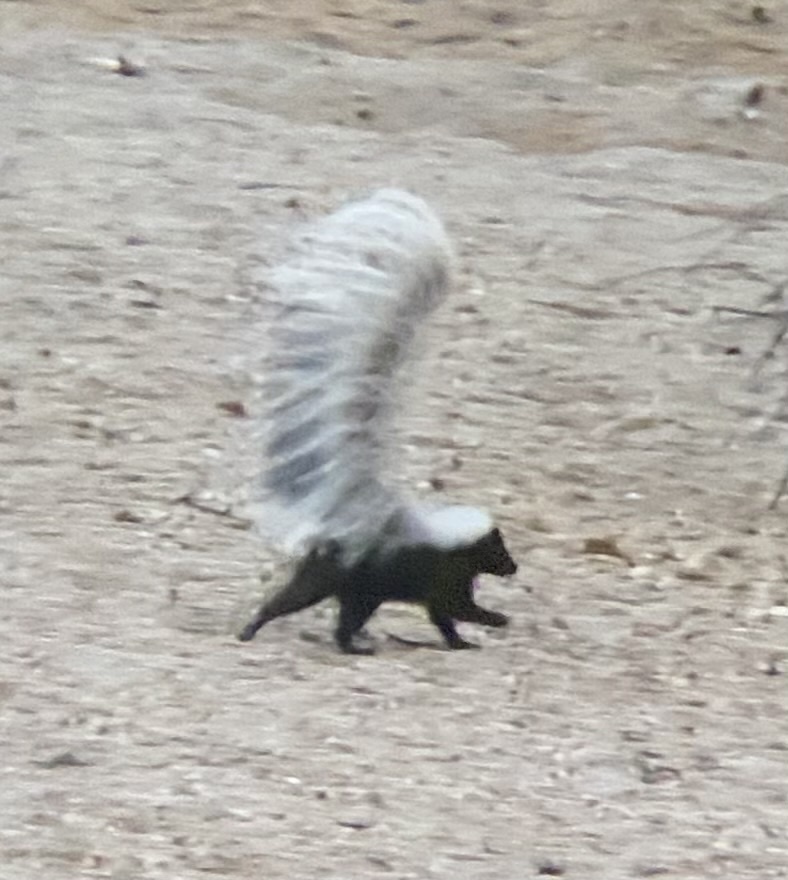
Hooded Skunk
Photo © Tristan A. McKnight
Photo © Tristan A. McKnight — CC BY 4.0 — Source: iNaturalist photo #553556645Identification
The hooded skunk is a member of the skunk family distinguished by its notably longer tail and softer, longer fur compared to the similar striped skunk. Its most characteristic feature is a distinctive ruff of white fur around the neck, which gives the species its common name. Three color phases exist: black-backed with two lateral white stripes, white-backed with a single dorsal stripe, or entirely black with sparse white hairs in the tail. All variants display a thin white medial stripe between the eyes. Males are approximately 15% larger than females.
Range & Habitat
The hooded skunk ranges from the Southwestern United States southward through Mexico, Guatemala, Honduras, Nicaragua, and into northwestern Costa Rica, with Mexico supporting the most abundant populations. Notably, individuals in southern Mexico are more than 50% smaller than their northern counterparts. The species favors grasslands, deserts, and mountain foothills while avoiding high elevations. These skunks show a strong preference for living near water sources such as rivers.
Behaviour & Diet
Hooded skunks are primarily nocturnal and solitary, sheltering in burrows or dense vegetation during daylight hours. Though solitary, they may gather peacefully at feeding sites without aggression. For defense, they spray volatile secretions from their anal glands, similar to other skunk species. Their diet is remarkably diverse: wild stomach contents show 74.3% insects (dominated by earwigs, stink bugs, and beetles), 12% vertebrate tissue, and minimal plant material. They readily consume prickly pear, small vertebrates, fruit, bird eggs, and human garbage. In Costa Rica, they have been observed using their forelimbs to throw bird eggs between their hind legs to crack them open.
Best Time & Places to See It
Hooded skunks are nocturnal, so evening and night observations offer the best chances of encounters. They are very abundant throughout Mexico and increasingly adaptable to human-modified landscapes, including suburban areas, pastures, and cultivated fields. Breeding occurs between February and March, with litter sizes ranging from three to eight young. Their abundance and habitat flexibility make them relatively reliable sightings in suitable lowland and foothill regions throughout their range.
Photography Tips
Night photography will be essential for capturing this nocturnal species. Look for them along water sources such as rivers and streams, particularly in grassland and desert margins. A headlamp or red-light flashlight may help locate them while minimizing disturbance. Exercise extreme caution at close range, as the species will spray when threatened. Wide-angle lenses work well for habitat context, while a telephoto lens is invaluable for maintaining safe distance. The distinctive white neck ruff and stripe pattern provide excellent subjects once located, particularly when illuminated against the darker surrounding landscape.
Cave Creek Canyon
Chiricahua Mountains
Madera Canyon
Saguaro National Park
Santa Rita Mountains
Nothing matches these filters.
No community photos yet. Log in to add the first one.
No community observations of this species yet.