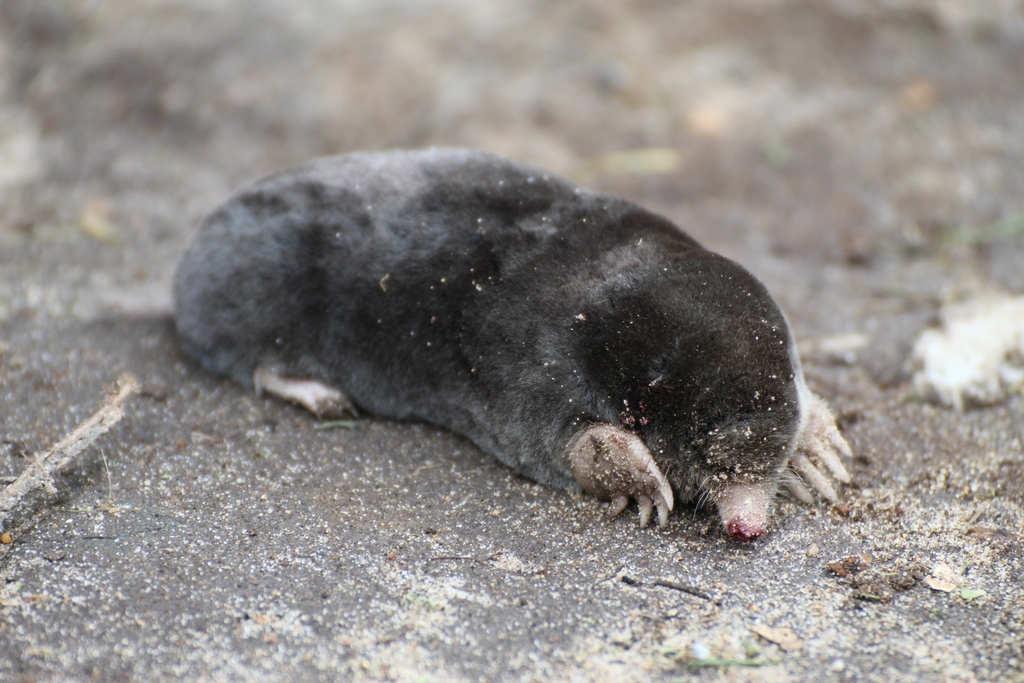
Iberian Mole
Photo © Diego González Dopico
Photo © Diego González Dopico — CC BY 4.0 — Source: iNaturalist photo #333160846Identification
The Iberian mole is a small, robust mammal belonging to the mole family Talpidae. Adult males average 65 grams (2.3 oz), while females are slightly smaller at 53.5 grams (1.89 oz). Like other moles, this species is highly adapted for an underground lifestyle, though detailed morphological features distinguishing it from closely related species are subtle and primarily involve skull structure. A notable and unusual characteristic is that females are hermaphroditic, possessing both ovarian and testicular tissue, an adaptation shared with other members of its genus.
Range & Habitat
The Iberian mole is endemic to the Iberian Peninsula, found in both Spain and Portugal, with populations concentrated primarily in the northwest. This species thrives in a variety of moist-soil habitats across temperate regions, showing a marked preference for areas rich in earthworms—its primary food source. It is most commonly encountered in meadows, cropland, pastures, and woodlands.
The species' distribution is closely tied to soil conditions. It favours deep, moist soils suitable for digging and tends to avoid areas that are too rocky, sandy, or otherwise compacted. Importantly, it does well in both naturally wet soils and in artificially irrigated croplands and pastures, and is particularly common in regions where traditional agricultural practices are maintained. The mole is considered of least concern by the IUCN, indicating stable populations across its range.
Behaviour & Diet
The Iberian mole is primarily earthworm-eating, with its habitat selection directly reflecting the availability of this prey. The breeding period extends from September to May, with pregnancies occurring from October to April. The gestation period lasts approximately 28 days, and young are typically weaned by May after about 30 days of nursing. Males reach sexual maturity at approximately one year of age.
The reproductive biology of this species is particularly fascinating. Females possess an ovotestis—tissue combining both ovarian and testicular characteristics—with the prominence of testicles relative to ovary tissue varying across the breeding season. Some phenotypically male individuals have been found to possess XX chromosomes rather than the typical XY, making them externally similar to standard males but with notably smaller testicles and internally different testicular structure. These XX males were found to be infertile, representing one of the first documented instances of "sex reversal" in wild mammals.
Best Time & Places to See It
The Iberian mole is primarily nocturnal and subterranean, making direct observation challenging. However, evidence of activity is often visible as molehills and tunnel systems in suitable habitats. The best opportunities to observe signs of this species are in the northwestern Iberian Peninsula, particularly in agricultural regions maintaining traditional farming practices, meadows, and pasture areas with moist, earthworm-rich soils. Spring and autumn, when breeding activity peaks, may offer the best chances of encountering fresh tunnel systems and surface activity.
Photography Tips
Photographing the Iberian mole itself is extremely difficult due to its secretive, underground lifestyle. Instead, wildlife photographers should focus on documenting the habitat and signs of the species' presence—molehills, characteristic tunnel patterns in soft soil, and the earthworm-rich meadows and pastures where they thrive. Macro photography of earthworms and detailed habitat shots in traditional agricultural landscapes of northwestern Spain and Portugal can effectively convey the ecological niche of this elusive species.
Picos de Europa National Park
Posada de Valdeón, Spain
+166 birds+26 mammals
Where limestone massifs rise abruptly from the Castilian plateau, the Picos de Europa create one of Spain's most dramatic mountain wilderness areas. The park's jagged peaks,…
VIEW NATIONAL PARKMontaña Palentina Natural Park
Vidrieros, Spain
+180 birds+29 mammals
Where the Cantabrian mountains rise above the Palencia plateau, Montaña Palentina Nature Park sprawls across nearly 1,500 square kilometres of some of northern Spain's most dramatic…
VIEW NATURAL PARKRedes Natural Park
Arrobio, Spain
+163 birds+16 mammals
Where the Picos de Europa cast their shadow westward, the Redes Nature Park sprawls across nearly 600 square kilometres of Asturian limestone and schist, a wild…
VIEW NATURAL PARKPonga Natural Park
San Juan de Beleño, Spain
+98 birds+13 mammals
Where the Picos de Europa rise in dramatic limestone walls, the landscape softens as you descend into Asturias' Ponga Nature Park, a 407-square-kilometre sanctuary where deciduous…
VIEW NATURAL PARKSierra de Guadarrama National Park
Rascafría, Spain
+179 birds+13 mammals
Where granite peaks rise abruptly from the central Spanish plateau, the Sierra de Guadarrama National Park unfolds across more than eleven hundred square kilometres of montane…
VIEW NATIONAL PARKPeneda-Gerês National Park
A Baixa Limia, Portugal
+156 birds+15 mammals
Where granite gorges cut through ancient montane forests, the Peneda-Gerês National Park rises across the rugged borderlands between northern Portugal and Galicia, a landscape shaped by…
VIEW NATIONAL PARKSierra de Gredos Regional Park
Candeleda, Spain
+180 birds+18 mammals
Where granite peaks claw at 2,592 metres and alpine meadows give way to cork oak scrubland, Spain's central highlands reveal a landscape of remarkable vertical drama.…
VIEW NATURE RESERVEEstrecho Natural Park
Pedro Valiente, Spain
+281 birds+20 mammals
Where Mediterranean pine forests meet wind-sculpted coastal cliffs, one of Europe's most dynamic ecological crossroads unfolds across the Strait of Gibraltar. Spanning 686 square kilometers of…
VIEW NATURAL PARKSomiedo Natural Park
Pola de Somiedo, Spain
+165 birds+25 mammals
Where granite gorges cleave through the Cantabrian Mountains of northern Spain, alpine meadows roll toward beech and oak forests in a landscape virtually untouched by industrial…
VIEW NATURAL PARKNo community photos yet. Log in to add the first one.
No community observations of this species yet.