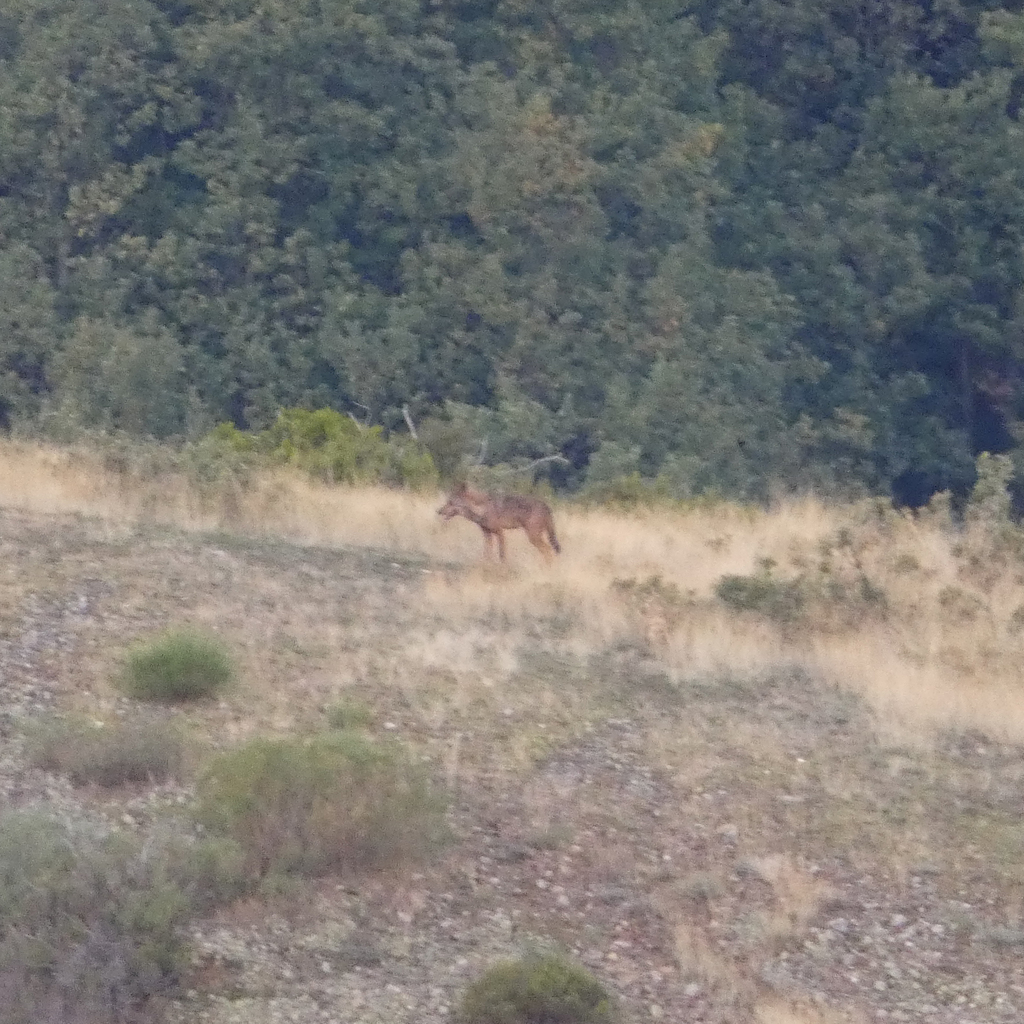
Iberian Wolf
Photo © Juan Rodríguez
Photo © Juan Rodríguez — CC BY 4.0 — Source: iNaturalist photo #439359712Identification
The Iberian wolf is a subspecies of grey wolf with a distinctly slighter frame than its Eurasian cousins. Its most characteristic features are the white marks on its upper lips, dark marks along its tail, and a pair of dark markings on its front legs—the latter giving the subspecies its scientific name, signatus, meaning "marked." Adult males typically weigh 35–55 kg (77–121 lb) and measure 110–140 cm (43–55 in) in body length, while females are noticeably smaller at 25–35 kg (55–77 lb). Average shoulder height is around 70 cm (28 in). The reddish snout and white facial markings that join the white throat distinguish it from other European wolf populations.
Range & Habitat
The Iberian wolf inhabits the northwest of the Iberian Peninsula, with populations concentrated in northwestern Spain and northern Portugal. Today, the subspecies comprises 2,200 to 2,700 individuals across more than 350 packs, distributed over approximately 140,000 km² (54,000 sq mi)—making them the largest wolf population in Western Europe. In some regions, wolf densities reach up to 7 individuals per 100 km², among the highest in Europe. The species' range has expanded significantly since the early 2000s, recovering from severe historical persecution that had reduced their territory to just 16,300 km² by 2002–2003.
Behaviour & Diet
Iberian wolves live in small packs and play an important ecological role in maintaining ecosystem balance. They are particularly valuable for controlling wild boar populations, which in turn benefits endangered capercaillie that suffer heavily from boar predation. Their diet varies considerably by location and prey availability. In Guadarrama National Park, wild animals comprise 82% of their diet, with wild boar (44%) and roe deer (35%) as primary prey, followed by ibex (3%) and red deer (0.3%). They also consume rabbits, small carnivores, fish, rodents, and birds depending on regional biodiversity and prey structure.
Best Time & Places to See It
Sighting Iberian wolves in the wild is challenging due to their vigilant nature and elusive behaviour. The best opportunities exist in the northwestern regions of the Iberian Peninsula—particularly in Galicia, Asturias, Castilla y León in Spain, and Alto Minho and Alto Trás-os-Montes in Portugal, where genetic studies have identified distinct wolf populations. While no specific seasonal recommendations are provided in available data, winter months may increase visibility as prey becomes scarcer and wolves range more widely. Local guides familiar with pack territories and movement patterns will significantly improve chances of observation.
Photography Tips
Photographing Iberian wolves requires patience, stealth, and substantial preparation. Their extreme wariness makes close approach difficult, so telephoto lenses (at least 400–600mm) are essential. Dawn and dusk are optimal lighting periods for wildlife photography in their habitat. The wolves' distinctive dark markings on the legs and tail provide excellent focal points for identification shots. Working with local naturalists or conservation organizations familiar with pack movements will increase your chances considerably. Remember that these are wild animals; maintain safe distances and respect their natural behaviour at all times.
No community photos yet. Log in to add the first one.
No community observations of this species yet.