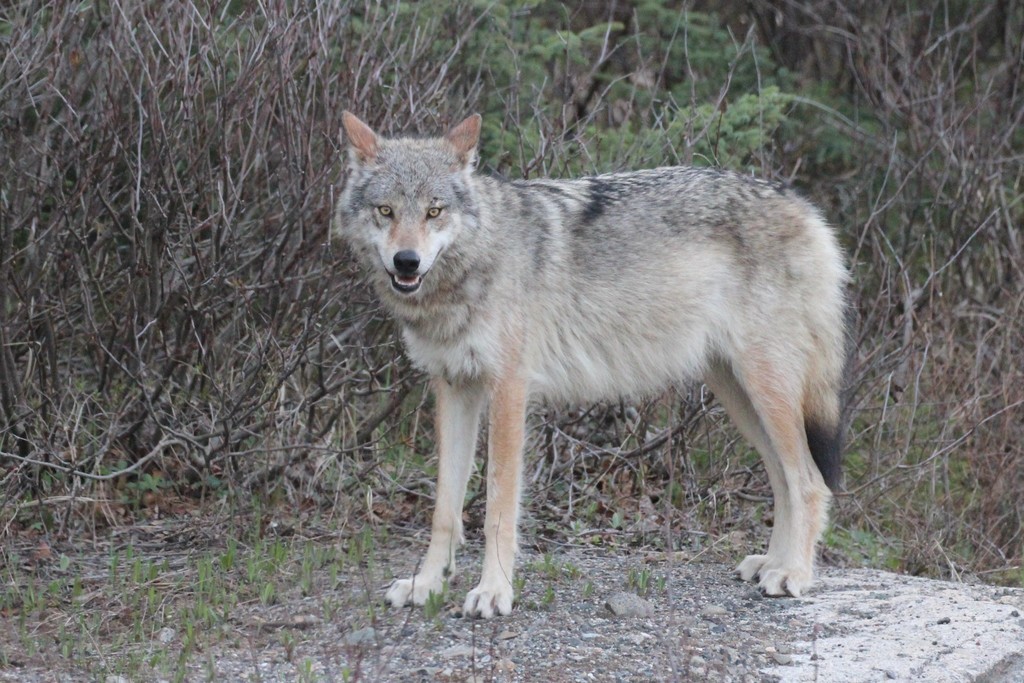
Gray Wolf
Photo © Rob Foster
Photo © Rob Foster — CC BY 4.0 — Source: iNaturalist photo #130249000Identification
The gray wolf is the largest wild member of the family Canidae, distinguished from related species by its less pointed ears and muzzle, shorter torso, and longer tail. Its fur is typically mottled in combinations of white, brown, grey, and black, though subspecies inhabiting arctic regions may be nearly all white. With more than thirty recognized subspecies found across Eurasia and North America, wolves show considerable variation, yet all share the physical adaptations that mark them as apex predators specialized for hunting large prey.
Range & Habitat
Gray wolves are native to both Eurasia and North America, where they inhabit diverse landscapes suited to their hunting lifestyle. The global wild population is estimated between 200,000 and 250,000 individuals as of 2026. Wolves are highly territorial animals and typically live in remote areas away from human settlements, though their specific habitats vary widely depending on prey availability and regional conditions across their vast range.
Behaviour & Diet
Wolves are the most specialized cooperative hunters within the genus Canis, traveling in nuclear family units consisting of a mated pair and their offspring. These family groups demonstrate highly advanced expressive behaviour, including distinctive individual and group howling. Offspring typically remain until sexual maturity, when they may leave to form their own packs or face competition for food within their birth pack.
As apex predators, wolves are carnivores that feed primarily on large wild hooved mammals, supplemented by smaller animals, livestock, carrion, and garbage. Interestingly, single wolves or mated pairs often achieve higher hunting success rates than larger packs. Wolves are territorial, and conflicts over territory represent one of the principal causes of mortality among wild populations. They may carry pathogens and parasites, notably rabies.
Best Time & Places to See It
Wolf sightings require patience and access to remote wilderness areas where populations persist, particularly in parts of Eurasia and North America with substantial wild prey bases and minimal human disturbance. Because wolves are relatively few in number, live far from human habitation, and have developed a natural fear of humans through historical hunting and persecution, direct encounters remain rare. However, travelers visiting protected areas and wilderness regions with established wolf populations may increase their chances, particularly during dawn and dusk when wolves are most active.
Photography Tips
Photographing wild wolves presents exceptional challenges due to their wariness of humans and remote habitats. Success requires patience, distance, and often the use of telephoto lenses to capture detail without disturbing the animals. The varied coloration across subspecies—from near-white arctic wolves to darker mottled individuals—offers diverse photographic subjects. Early morning and late evening light, combined with the wolves' expressive behaviour including howling sequences, provide compelling opportunities for wildlife photographers willing to invest significant time in remote locations.
Tombstone Territorial Park
Abruzzo, Lazio and Molise National Park
Alaska Maritime National Wildlife Refuge
Arctic National Wildlife Refuge
Banff National Park
Bavarian Forest National Park
Belluno Dolomites National Park
Białowieża National Park
Biebrza National Park
Nothing matches these filters.
No community photos yet. Log in to add the first one.
No community observations of this species yet.