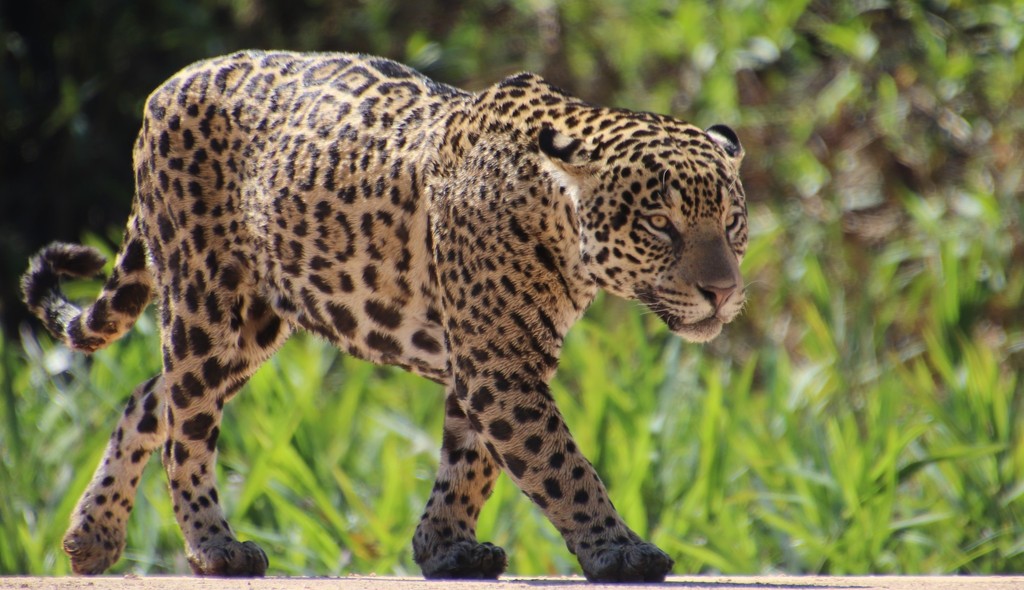
Jaguar
Photo © Millie Basden
Photo © Millie Basden — CC BY 4.0 — Source: iNaturalist photo #48880320Identification
The jaguar is the largest cat species in the Americas and the third largest in the world. Its distinctive coat features pale yellow to tan fur covered with spots that transition to rosettes on the sides. Some individuals display a rare melanistic black coat. Adults reach a body length of up to 1.85 metres (6 feet 1 inch) and can weigh up to 158 kilograms (348 pounds). The jaguar's most formidable feature is its extraordinarily powerful bite, which allows it to pierce the carapaces of turtles and tortoises. It even employs a unique killing method among big cats: biting directly through the skull of mammalian prey between the ears to deliver a fatal blow to the brain.
Range & Habitat
Jaguars are found throughout a vast range extending from the Southwestern United States across Mexico and much of Central America, through the Amazon rainforest, and south to Paraguay and northern Argentina. Their ancestors probably entered the Americas from Eurasia during the Early Pleistocene via the Bering Strait land bridge, with the oldest jaguar fossils in North America dating to between 0.85 to 0.82 million years ago.
The jaguar inhabits a variety of forested and open terrains, though its preferred habitat is tropical and subtropical moist broadleaf forest, wetlands, and wooded regions. These cats are adept swimmers and have adapted well to diverse ecosystems across their range. As an apex predator and keystone species, the jaguar plays an important role in stabilizing ecosystems and regulating prey populations.
Behaviour & Diet
Jaguars are largely solitary animals and opportunistic stalk-and-ambush predators. Their hunting prowess is legendary, enabled by their combination of size, power, and intelligence. The species is threatened by habitat loss, habitat fragmentation, poaching for trade in body parts, and killings by ranchers in human–wildlife conflict situations, particularly in Central and South America. The wild population is thought to have declined since the late 1990s, and the jaguar has been listed as Near Threatened on the IUCN Red List since 2002.
Best Time & Places to See It
Priority areas for jaguar conservation comprise 51 large areas inhabited by at least 50 breeding individuals, called Jaguar Conservation Units, located in 36 geographic regions from Mexico to Argentina. These protected regions offer the best opportunities for encountering jaguars in their natural habitat. However, spotting these elusive solitary predators remains challenging, as they are adept at avoiding human detection and require vast territories.
Photography Tips
Photographing jaguars demands patience and access to protected conservation areas where populations are stable. Position yourself in their preferred habitats—tropical and subtropical moist broadleaf forests and wetlands—where you're most likely to encounter them. Early morning and dusk are prime times for apex predator activity. The jaguar's distinctive spotted-to-rosette coat pattern and robust build make for striking images; capture their powerful presence and the detail of their striking facial markings. Be prepared for long waits, as their solitary nature and low population densities mean sightings remain rare and unpredictable rewards for dedicated wildlife photographers.
Tortuguero National Park
Roxana, Costa Rica
+420 birds+23 mammals
Canals and lagoons thread through a labyrinth of lowland rainforest where the Caribbean coast of Costa Rica meets the wetland frontier. This is terrain shaped by…
VIEW NATIONAL PARKSanta Rosa National Park
Santa Elena, Costa Rica
+359 birds+30 mammals
Where Pacific-facing slopes descend from volcanic uplands toward the Guanacaste lowlands, Santa Rosa National Park unfolds across a mosaic of tropical dry forest, gallery woodland, and…
VIEW NATIONAL PARKGuanacaste National Park
Santa Elena, Costa Rica
+461 birds+17 mammals
Where the Pacific slopes of northwestern Costa Rica rise toward the Continental Divide, dry tropical forest gives way to cloud-laden peaks and misty ridges—a landscape that…
VIEW NATIONAL PARKYasuní National Park
Aguarico, Ecuador
+601 birds+43 mammals
Where the western Amazon basin converges with Ecuador's Orellana Province, lowland rainforest reaches toward the horizon in an unbroken canopy of staggering botanical density. Yasuní National…
VIEW NATIONAL PARKSangay National Park
Cebadas, Ecuador
+320 birds+10 mammals
High in Ecuador's Andean spine, where the Western Cordillera rises to touch perpetual snow, a landscape of volcanic drama and ecological intensity unfolds across Sangay National…
VIEW NATIONAL PARKSumaco Napo-Galeras National Park
Loreto, Ecuador
+563 birds+4 mammals
Where Ecuador's Amazon transitions into cloud forest, a massive shield volcano rises from the emerald lowlands of Orellana Province, anchoring one of the continent's most biodiverse…
VIEW NATIONAL PARKAntisana National Park
Quijos, Ecuador
+432 birds+21 mammals
Where the eastern Andean slopes descend into the Amazon basin, Antisana National Park sprawls across roughly 2,500 square kilometers of some of South America's most dramatic…
VIEW NATIONAL PARKIguaçu National Park
Brazil
+387 birds+17 mammals
Where the Paraná Plateau plunges toward the Atlantic watershed, six thousand square kilometers of subtropical rainforest cling to steep gorges and river valleys in this corner…
VIEW NATIONAL PARKPantanal Matogrossense National Park
Brazil
+322 birds+17 mammals
Where the flooded forests of central Brazil meet vast seasonally inundated grasslands, Pantanal Matogrossense National Park sprawls across nearly 2,900 square kilometers of one of the…
VIEW NATIONAL PARKAnavilhanas National Park
Brazil
+468 birds+8 mammals
Across the Rio Negro in central Amazonas, an archipelago of over a thousand islands rises from the world's largest rainforest river system, creating a labyrinth of…
VIEW NATIONAL PARKManu National Park
Manu, Peru
+892 birds+26 mammals
Across the eastern slopes of the Peruvian Andes, tropical rainforest descends into the Amazon basin with a complexity that few terrestrial ecosystems match. Manu National Park…
VIEW NATIONAL PARKBahuaja Sonene National Park
San Pedro de Putina Punco, Peru
+602 birds+8 mammals
Where the Madre de Dios and Heath rivers converge in southeastern Peru rises one of South America's most biodiverse wilderness regions: a vast protected realm of…
VIEW NATIONAL PARKChagres National Park
Caimitillo, Panama
+486 birds+19 mammals
Where the Chagres River carves through the humid tropics of central Panama, a vast montane and lowland forest sprawls across more than 2,300 square kilometers, anchoring…
VIEW NATIONAL PARKIguazú National Park
Puerto Iguazú, Argentina
+346 birds+15 mammals
Where the Paraná Plateau plunges toward the Atlantic watershed, nearly 800 square kilometers of subtropical rainforest drape across Misiones Province in a landscape carved by millennia…
VIEW NATIONAL PARKCalilegua National Park
Municipio de Calilegua, Argentina
+288 birds+8 mammals
Where the eastern Andean slopes plunge into northwestern Argentina's humid subtropics, nearly 2,645 square kilometers of steep terrain and luxuriant forest compose one of South America's…
VIEW NATIONAL PARKMontes Azules
Candelaria, Mexico
+395 birds+47 mammals
Where jungle-clad limestone plateaus plunge into canyon systems carved by the Usumacinta River, Mexico's most pristine rainforest reserve unfolds across the Lacandón region of Chiapas. Montes…
VIEW BIOSPHERE RESERVETikal National Park
Tikal, Guatemala
+399 birds+16 mammals
Dense rainforest canopy rises above the limestone plateau of Petén, where archaeological wonder and ecological richness merge seamlessly across one of Central America's most biodiverse landscapes.…
VIEW NATIONAL PARKLaguna del Tigre National Park
Petén, Guatemala
+399 birds+29 mammals
Where the Petén lowlands dissolve into wetland and forest, Laguna del Tigre National Park protects one of Guatemala's most ecologically vital landscapes. This sprawling reserve encompasses…
VIEW NATIONAL PARKSierra del Lacandón National Park
Petén, Guatemala
+348 birds+7 mammals
Where the Petén rainforest rises into limestone ridges and deep ravines, Sierra del Lacandón National Park protects one of Central America's most intact tropical wilderness zones.…
VIEW NATIONAL PARKCaño Negro National Wildlife Refuge
Caño Negro District, Costa Rica
+486 birds+16 mammals
Where the San Juan River's seasonal floodplain opens into expansive wetlands, Caño Negro Wildlife Sanctuary sprawls across one of Central America's most productive freshwater ecosystems. This…
VIEW WILDLIFE SANCTUARYBarra del Colorado National Wildlife Refuge
Tortuguero, Costa Rica
+462 birds+36 mammals
Where the Caribbean's restless waters meet the Limón Province coastline, Barra del Colorado National Wildlife Sanctuary unfolds across a landscape of extraordinary ecological complexity. This equatorial…
VIEW WILDLIFE SANCTUARYNo community photos yet. Log in to add the first one.
No community observations of this species yet.