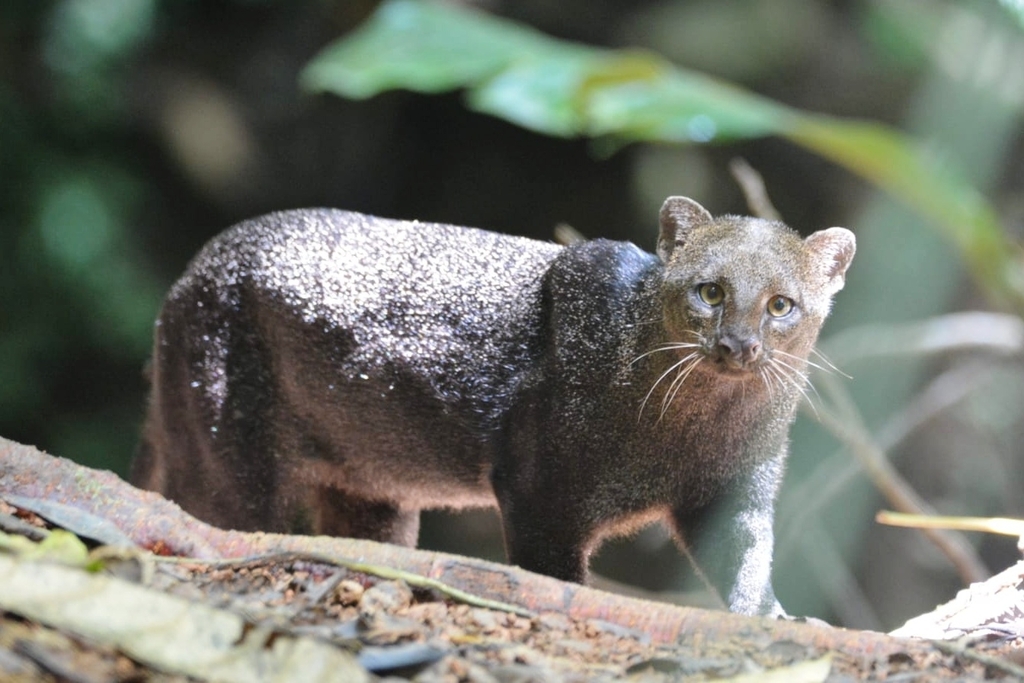
Jaguarundi
Photo © Ben Jobson
Photo © Ben Jobson — CC BY 4.0 — Source: iNaturalist photo #310267736Identification
The jaguarundi is a distinctly slender, medium-sized wild cat with an elongated body and relatively short legs that give it a mustelid-like appearance. About twice the size of a domestic cat, it reaches nearly 360 mm (14 inches) at the shoulder and weighs between 3.5 and 7 kg (7.7 to 15.4 pounds). Its most striking feature is its uniform coloration, which exists in two color morphs: gray and red. The cat has a small, narrow head with small, round ears, a short snout, and a notably long tail—characteristics that set it apart from other neotropical cats such as the spotted species in the genus Leopardus.
Range & Habitat
The jaguarundi is native to the Americas, ranging from central Argentina in the south through much of South America east of the Andes, Central America, and into northern Mexico. It historically occurred in the Lower Rio Grande Valley in south Texas as recently as the early 1990s but is now believed to be extirpated from the United States. The species inhabits a remarkably broad array of both closed and open habitats, from tropical rainforests and deciduous forests to deserts and thorn scrubs.
The jaguarundi is fairly common in Brazil, Peru, and Venezuela. However, populations are in decline across much of its range due to habitat loss and fragmentation, as well as persecution for killing poultry, though it remains listed as least concern on the IUCN Red List.
Behaviour & Diet
Secretive and alert, the jaguarundi is typically solitary or forms pairs in the wild, living in large home ranges where individuals are sparsely distributed. Unlike other sympatric cats such as the ocelot, the jaguarundi is notably more active during the day, hunting mainly during daytime and evening hours. Though an efficient climber, it typically prefers hunting on the ground, feeding on various kinds of prey including ground-feeding birds, reptiles, rodents, and small mammals.
Mating occurs throughout the year with peaks at different times across the species' range. After a gestation period of 70 to 75 days, females give birth to litters of one to four kittens. In captivity, jaguarundis have been recorded living up to 15 years, and captive individuals are notably more gregarious than their wild counterparts.
Best Time & Places to See It
Travellers seeking the jaguarundi should focus on Brazil, Peru, and Venezuela, where the species is fairly common. The cat's preference for daytime and evening hunting makes it more likely to be spotted than other felids active primarily at night. However, its secretive nature, sparse distribution, and large home ranges mean sightings remain challenging. The species' broad habitat tolerance means it may be encountered in diverse environments, from rainforests to more open scrublands.
Photography Tips
Photographing a jaguarundi requires patience and an understanding of its diurnal hunting habits. Position yourself during daytime and evening hours when the cat is most active. The uniform coloration of either gray or red morphs, combined with the animal's slender build and distinctive long tail, provides striking photographic subjects. The cat's small round ears and elongated body shape are key identifying features worth capturing. Given the species' preference for ground hunting and relatively open habitats within its range, ground-level or low-angle shots may prove most effective for wildlife photographers.
Río Pilcomayo National Park
Argentina
+271 birds+13 mammals
Where the Río Pilcomayo cuts through northeastern Argentina's subtropical lowlands, a sprawling mosaic of wetlands, grasslands, and seasonally flooded forests creates one of South America's most…
VIEW NATIONAL PARKIguazú National Park
Puerto Iguazú, Argentina
+346 birds+15 mammals
Where the Paraná Plateau plunges toward the Atlantic watershed, nearly 800 square kilometers of subtropical rainforest drape across Misiones Province in a landscape carved by millennia…
VIEW NATIONAL PARKMontes Azules
Candelaria, Mexico
+395 birds+47 mammals
Where jungle-clad limestone plateaus plunge into canyon systems carved by the Usumacinta River, Mexico's most pristine rainforest reserve unfolds across the Lacandón region of Chiapas. Montes…
VIEW BIOSPHERE RESERVENo community photos yet. Log in to add the first one.
No community observations of this species yet.