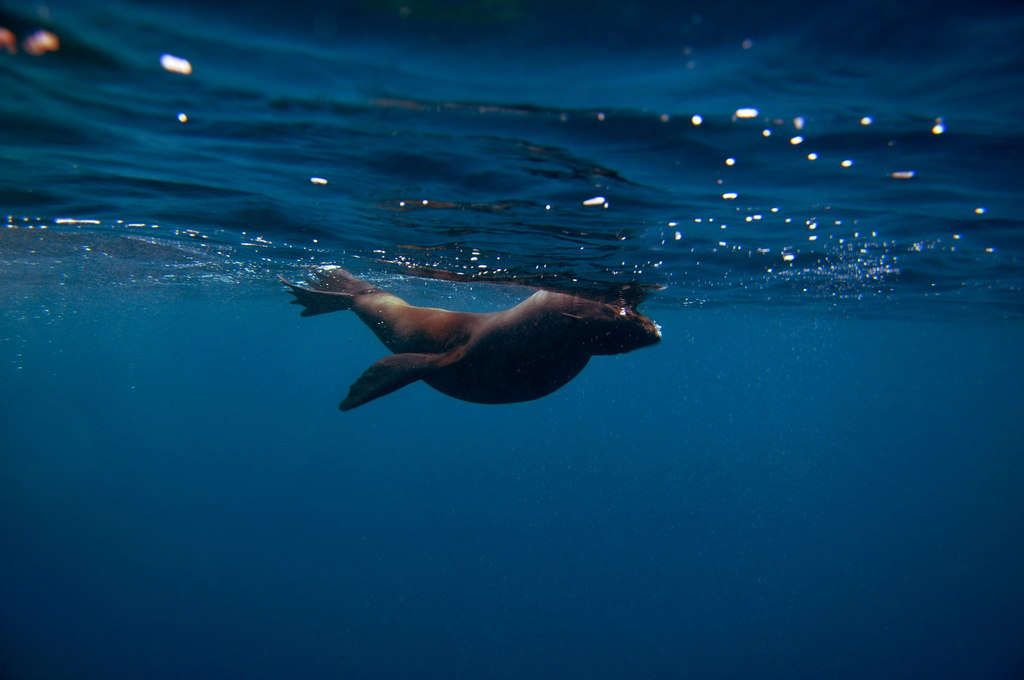
Juan Fernandez Fur Seal
Photo © Erasmo Macaya Horta
Photo © Erasmo Macaya Horta — CC BY 4.0 — Source: iNaturalist photo #85829247Identification
The Juan Fernández fur seal is the second smallest of all fur seals, distinguished by its short, robust body and brown pelage. Like all fur seals, it possesses small external ear flaps, thick insulating fur, and relatively short front and hind flippers with fleshy-tipped digits that enable it to walk on land—a key difference from true seals. Sexual dimorphism is pronounced in this species: females average 100 pounds and 4 feet 6 inches in length with lighter brown fur, while males are substantially larger at around 300 pounds and 6 feet 6 inches long, with darker brown coats and distinctive golden-tipped guard hairs on the head, neck, and shoulders. Males also possess noticeably thicker necks than females.
Range & Habitat
This species is found exclusively on the Pacific Coast of South America, occurring only on the Juan Fernández Islands and the Desventuradas Islands. The Juan Fernández fur seal was hunted to near extinction for the fur trade following its discovery in the mid-1500s and was believed extinct until a population of approximately 200 individuals was rediscovered on the Juan Fernández Islands in the 1960s. Today, the population has recovered to an estimated 12,000 individuals.
Behaviour & Diet
These seals are largely solitary, spending time foraging at sea and hauling out on rocky shores to rest. Females show strong site fidelity, preferring tide pools and rocky caves for daytime rest and maintaining spacing of several feet from one another. Much remains unknown about this species, including the diet and behavior of males outside the breeding season. Breeding is highly territorial, with males aggressively competing for access to female resting sites in a polygynous system. Pups are born between November and December and are weaned at ten months of age; mothers remain with pups for about a week before departing to forage and mate again.
Observations have been limited primarily to lactating females, which forage at sea—sometimes as far as 300 miles offshore—diving to depths between 30 and 300 feet to hunt lanternfish and squid, typically at night when prey moves to shallower waters. Lactating females may remain at sea for up to 25 days before returning to shore for five days with their pups, whose high-fat maternal milk sustains them during prolonged maternal absences.
Best Time & Places to See It
The Juan Fernández Islands and Desventuradas Islands are the only locations where this species can be encountered. Breeding activity occurs during the November to December pupping season, when territorial males gather and females congregate in resting areas, offering the best opportunity to observe their behavior and the marked sexual dimorphism of the species. Rocky shores, tide pools, and coastal caves are prime habitats to search.
Photography Tips
Photograph males during the breeding season to capture the dramatic size difference and the striking golden-tipped guard hairs on their heads, necks, and shoulders. The species' preference for rocky shores and tide pools provides natural compositional opportunities. Since females favor specific resting sites and maintain consistent spacing, patient observation of these areas may yield multiple subjects. The contrast between the darker males and lighter-brown females makes for compelling wildlife imagery, particularly when documenting the polygynous breeding system and territorial interactions.
Chile: Fuegian Snipe & Juan Fernandez
No community photos yet. Log in to add the first one.
No community observations of this species yet.