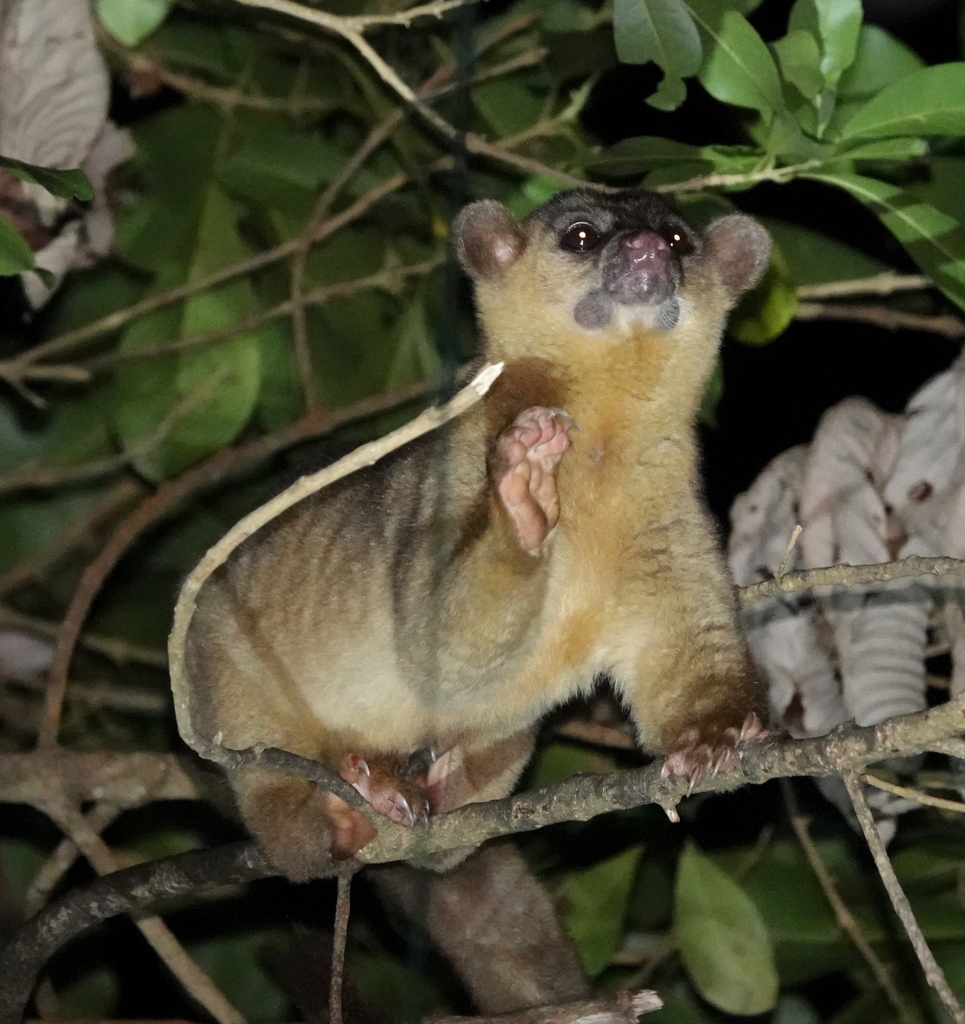
Kinkajou
Photo © desertnaturalist
Photo © desertnaturalist — CC BY 4.0 — Source: iNaturalist #108091839Identification
The kinkajou is a distinctive small mammal belonging to the Procyonidae family, which also includes raccoons, coatis, and olingos. It has a round head, large eyes, a short pointed snout, and short limbs. Most notably, it possesses a long prehensile tail that it uses for balance and movement through the treetops. The total head-and-body length, including the tail, ranges from 82 to 133 cm (32 to 52 inches), with the tail alone measuring 39 to 57 cm (15 to 22 inches). Adults typically weigh between 1.4 and 4.6 kg (3.1 to 10.1 pounds), with females generally smaller than males. The short, rounded ears measure between 3.6 and 5.4 cm (1.4 to 2.1 inches).
Range & Habitat
The kinkajou is native to the tropical rainforests of Mexico, Central America, and South America. Eight subspecies have been documented across this vast range, from Mexico through the Amazon Basin and into Brazil, with populations also found in countries including Panama, Colombia, Ecuador, Peru, Venezuela, and the Guianas. Recent genetic studies have identified five distinct geographical clades, suggesting that some populations may warrant separate species status.
Behaviour & Diet
Kinkajous are strictly nocturnal animals, which explains why they are seldom observed by people despite their wide range. This mostly frugivorous mammal feeds primarily on fruits, though its diet may include other forest foods. The species is arboreal, spending its life among the trees where its prehensile tail provides essential balance and support. Kinkajous are not closely related to other tree-dwelling mammal groups such as primates or mustelids, making them a unique component of rainforest ecosystems.
Best Time & Places to See It
Because kinkajous are strictly nocturnal, night-time forest expeditions offer the best chance of encounters. Tropical rainforest habitats throughout Mexico, Central America, and South America provide suitable habitat, though spotting them remains challenging due to their elusive nature and dense forest environment. Patient observers with good lighting equipment will have the best opportunities during nocturnal rainforest walks.
Photography Tips
Photographing kinkajous requires night-time equipment and techniques, as these are exclusively nocturnal animals. A headlamp or red-light flashlight will help locate them while minimizing disturbance, and a camera capable of low-light performance is essential. Their small size, arboreal habits, and tendency to remain high in the canopy make them challenging subjects, so patience and a telephoto lens are recommended for successful wildlife photography.
Manuel Antonio National Park
Quepos, Costa Rica
+426 birds+22 mammals
Where tropical rainforest descends steeply to a rocky Pacific coastline, Manuel Antonio National Park distills Central American biodiversity into one of Costa Rica's most compressed and…
VIEW NATIONAL PARKArenal Volcano National Park
Peñas Blancas, Costa Rica
+551 birds+21 mammals
Straddling the border between Alajuela and Guanacaste in northwestern Costa Rica, this national park rises dramatically around one of Central America's most active volcanic systems. The…
VIEW NATIONAL PARKBraulio Carrillo National Park
Las Horquetas, Costa Rica
+547 birds+18 mammals
Where the Caribbean slope descends from the central volcanic cordillera toward the humid lowlands of Heredia, Braulio Carrillo National Park preserves one of Costa Rica's most…
VIEW NATIONAL PARKYasuní National Park
Aguarico, Ecuador
+601 birds+43 mammals
Where the western Amazon basin converges with Ecuador's Orellana Province, lowland rainforest reaches toward the horizon in an unbroken canopy of staggering botanical density. Yasuní National…
VIEW NATIONAL PARKSumaco Napo-Galeras National Park
Loreto, Ecuador
+563 birds+4 mammals
Where Ecuador's Amazon transitions into cloud forest, a massive shield volcano rises from the emerald lowlands of Orellana Province, anchoring one of the continent's most biodiverse…
VIEW NATIONAL PARKNatural Farallones de Cali National Park
Buenaventura, Colombia
+733 birds+27 mammals
Where the Pacific coastal plain meets the western slopes of the Andes, Farallones de Cali National Park sprawls across nearly 3,500 square kilometers of dramatic topography…
VIEW NATIONAL PARKSoberanía National Park
Cristóbal, Panama
+495 birds+34 mammals
Rainforest and riverine woodland blanket the rolling terrain of this 714-square-kilometre national park in Colón Province, where the Caribbean watershed feeds a maze of streams and…
VIEW NATIONAL PARKChagres National Park
Caimitillo, Panama
+486 birds+19 mammals
Where the Chagres River carves through the humid tropics of central Panama, a vast montane and lowland forest sprawls across more than 2,300 square kilometers, anchoring…
VIEW NATIONAL PARKMontes Azules
Candelaria, Mexico
+395 birds+47 mammals
Where jungle-clad limestone plateaus plunge into canyon systems carved by the Usumacinta River, Mexico's most pristine rainforest reserve unfolds across the Lacandón region of Chiapas. Montes…
VIEW BIOSPHERE RESERVETikal National Park
Tikal, Guatemala
+399 birds+16 mammals
Dense rainforest canopy rises above the limestone plateau of Petén, where archaeological wonder and ecological richness merge seamlessly across one of Central America's most biodiverse landscapes.…
VIEW NATIONAL PARKLaguna del Tigre National Park
Petén, Guatemala
+399 birds+29 mammals
Where the Petén lowlands dissolve into wetland and forest, Laguna del Tigre National Park protects one of Guatemala's most ecologically vital landscapes. This sprawling reserve encompasses…
VIEW NATIONAL PARKRincón de la Vieja National Park
Liberia, Costa Rica
+451 birds+30 mammals
Where volcanic slopes rise abruptly from the Guanacaste lowlands, Rincón de la Vieja National Park sprawls across a landscape shaped by geothermal drama and seasonal extremes.…
VIEW NATIONAL PARKLa Amistad International Park
Crorina, Costa Rica
+532 birds+20 mammals
Where the Caribbean slopes of Costa Rica's Talamanca Mountains rise steeply inland from Limón, the boundary between two nations dissolves into an unbroken expanse of rainforest.…
VIEW NATIONAL PARKGandoca-Manzanillo National Wildlife Refuge
Manzanillo, Costa Rica
+394 birds+18 mammals
Where the Caribbean coastal plain surrenders to water-logged forest and mangrove tangles, Gandoca-Manzanillo Wildlife Sanctuary shelters one of Costa Rica's most biodiverse lowland wetland ecosystems. The…
VIEW WILDLIFE SANCTUARYNo community photos yet. Log in to add the first one.
No community observations of this species yet.