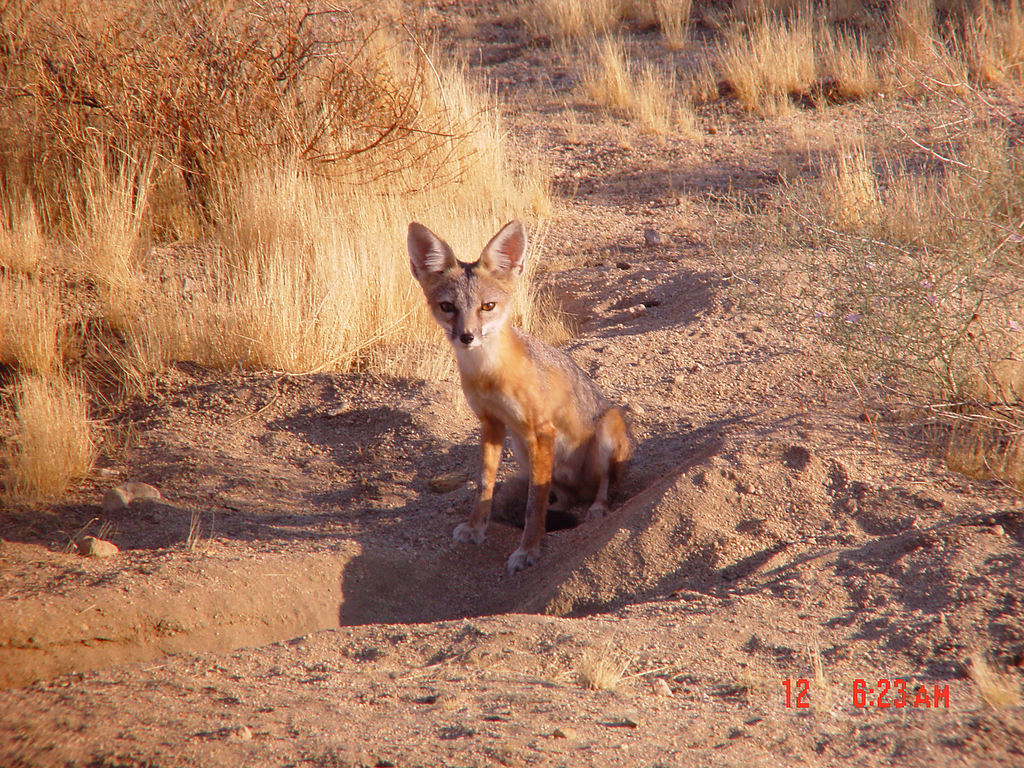
Kit Fox
Photo © Gordon C. Snelling
Photo © Gordon C. Snelling — CC BY 4.0 — Source: iNaturalist photo #2746008Identification
The kit fox is among the smallest foxes in North America and worldwide, weighing between 1.6 and 2.7 kg (3.5 to 6.0 lb). Its most striking feature is a pair of exceptionally large ears—measuring 71 to 95 mm—that serve dual purposes: dissipating heat in the desert environment and providing exceptional hearing. This resemblance to the fennec fox of Africa has earned it recognition as a North American counterpart. The body is compact, measuring 455 to 535 mm in length, with a notably long, bushy tail comprising about 40% of total body length, tipped with black and bearing a pronounced dark spot on the caudal gland.
The coat color varies geographically but generally displays a grizzled or yellowish-gray dorsal surface created by black-tipped guard hairs or hairs with alternating black and white bands. The tail is gray with a black tip, distinguishing it from the striped tail of the gray fox. Distinctive dark patches frame the nose, while the belly and inner ears are lighter in color. The shoulders, flanks, and a strip across the chest range from buffy to orange. The soles are protected by stiff hair tufts that provide traction on sandy terrain and insulation against extreme temperatures. Males are slightly larger than females, but sexual dimorphism is minimal.
Range & habitat
Kit foxes inhabit arid and semi-arid regions across the Southwestern United States and into northern and central Mexico. Their range extends from the arid interior of Oregon in the north to southwestern Colorado in the east, and south through Nevada, Utah, southeastern California, Arizona, New Mexico, and western Texas. They occupy elevations between 400 and 1,900 meters (1,300 to 6,200 ft) above sea level.
These foxes favor desert scrub, chaparral, halophytic regions, and grasslands—particularly areas with sparse ground cover. Common vegetation includes sagebrush and saltbrush, though specific habitats vary regionally. Kit foxes prefer loose-textured soils for denning. While primarily desert dwellers, they occasionally inhabit agricultural areas including orchards and can even adapt to urban environments.
Behaviour & diet
Kit foxes are primarily nocturnal and sometimes crepuscular, spending daylight hours resting in underground dens to escape heat stress. They typically forage alone and are not strongly territorial, preferring to live in pairs or small family groups. These foxes are prolific den users, employing more than 11 different dens across their home range in a given year. While they dig their own burrows, they readily modify and occupy dens abandoned by badgers, ground squirrels, prairie dogs, and kangaroo rats. Dens serve multiple purposes: daytime shelter, predator avoidance, thermal regulation, moisture conservation, and breeding and rearing of young.
Physiologically adapted to desert life, kit foxes regulate water conservation by panting at rates proportional to ambient temperature rather than at their thorax's resonant frequency—an economical strategy that prioritizes water retention. Their agility is remarkable; they can reach speeds around 40 km/h and possess an incredible ability to evade predators through rapid directional changes. Their small size and cryptic coloration further enhance their survival in open desert environments.
Best time & places to see it
Kit foxes are nocturnal, making them challenging subjects for wildlife observation. Your best chance of encountering one is during early dawn or dusk hours when they emerge from dens to forage. The San Joaquin Valley of California, though hosting an endangered subspecies with a depleted population, remains a historically significant location. More broadly, desert regions across Arizona, Nevada, New Mexico, and southeastern California offer the greatest likelihood of sightings, particularly in areas with sparse vegetation and loose sandy soils where dens are prevalent.
Patience and timing are essential. Visit during cooler months when kit foxes may be more active during daylight hours. Scanning open desert scrub and grassland habitats at dawn, when foxes return to their dens after nighttime foraging, offers the best chance of observation. Listen for their vocalizations and watch for movement in areas with multiple burrow systems.
Photography tips
Kit foxes present a challenging but rewarding photography subject due to their nocturnal habits and small size. Wide-angle lenses are generally impractical; instead, use telephoto lenses to maintain distance and avoid disturbing these elusive animals. Fast film or high ISO settings are essential for capturing images during low-light conditions at dawn and dusk. Their large ears and delicate features merit close-up photography when possible—frame the distinctive facial markings and ear structure to emphasize their fennec fox-like appearance.
Positioning yourself near active den sites during early morning or late evening increases encounter probability. The kit fox's remarkable cryptic coloration—grizzled gray and tan—blends seamlessly with desert scrub, so watch carefully for movement rather than shape. Capture their characteristic agility and directional changes if possible, and photograph their distinctive long tail with its black tip, a useful identifying feature. Always maintain respectful distance to avoid stress, particularly during denning and pup-rearing seasons.
Joshua Tree National Park
Riverside County, United States
+221 birds+23 mammals
Across 5,610 square kilometers of Riverside County's high desert, a landscape of geological drama unfolds where granite monoliths pierce through bajadas of creosote scrub and Joshua…
VIEW NATIONAL PARKGreat Basin National Park
White Pine County, United States
+170 birds+19 mammals
Where the Great Basin's high desert plateaus rise above 10,000 feet, ancient bristlecone pines endure on moonscape ridges of limestone and quartzite, creating one of North…
VIEW NATIONAL PARKArches National Park
Grand County, United States
+185 birds+20 mammals
Where rust-red sandstone fins rise abruptly from high desert scrubland, Arches National Park spans 548 square kilometers of one of North America's most sculptural landscapes. The…
VIEW NATIONAL PARKDeath Valley National Park
Inyo County, United States
+339 birds+25 mammals
Across nearly 3.5 million acres of southeastern California's Inyo County, vast salt flats meet sculpted badlands and alluvial fans in a landscape so extreme it defines…
VIEW NATIONAL PARKEl Vizcaíno
Laguna San Ignacio, Mexico
+317 birds+29 mammals
Where the Baja California peninsula thins into a tapestry of salt lagoons and coastal desert, one of Mexico's most biodiverse reserves sprawls across half a million…
VIEW BIOSPHERE RESERVEPetrified Forest National Park
Apache County, United States
+206 birds+23 mammals
Across the high desert plateau of northeastern Arizona, where the climate swings between scorching summer days and frost-laden winters, badlands of raw earth and timber-turned-to-stone dominate…
VIEW NATIONAL PARKWhite Sands National Park
Otero County, United States
+178 birds+6 mammals
Across the Tularosa Basin in south-central New Mexico sprawls an otherworldly landscape of gypsum dunes—the largest gypsum field on Earth and a stark desert playground shaped…
VIEW NATIONAL PARKKofa National Wildlife Refuge
Yuma County, United States
+142 birds+10 mammals
Desert mountains rise in sculptured ridges across northwestern Arizona, where the Colorado River's distant influence fades into some of the most austere terrain in the American…
VIEW WILDLIFE SANCTUARYNo community photos yet. Log in to add the first one.
No community observations of this species yet.