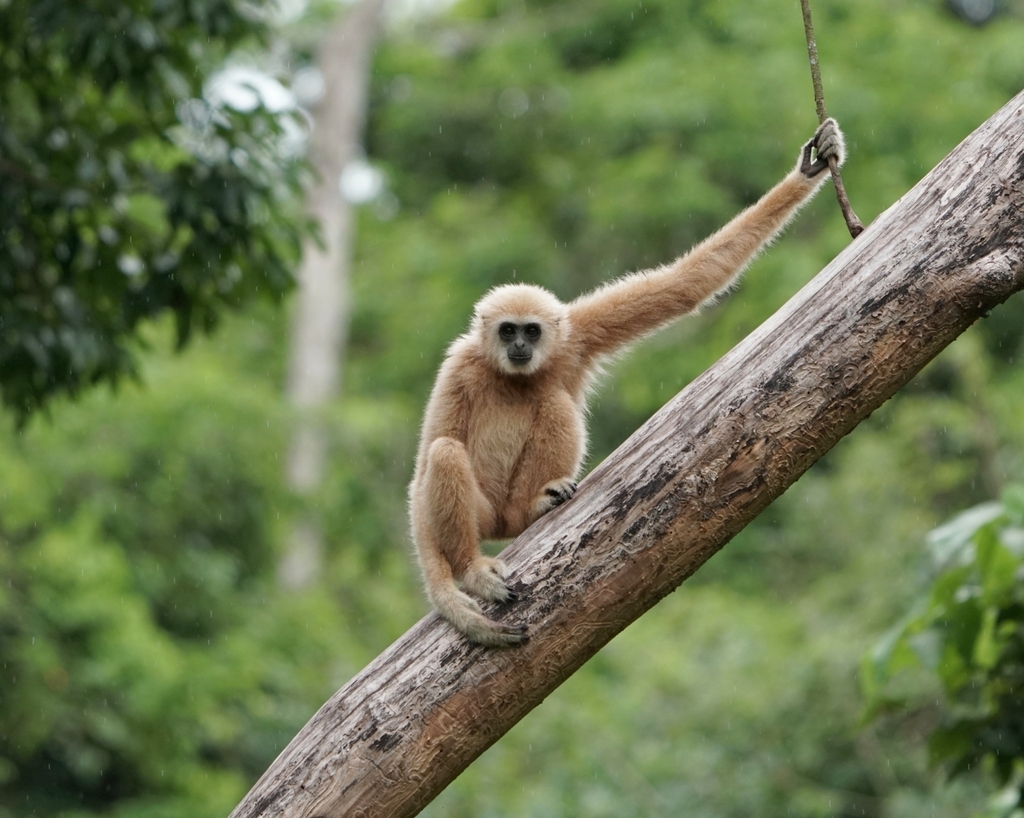
Lar Gibbon
Photo © Focus Saranpat Ouilapan
Photo © Focus Saranpat Ouilapan — CC BY 4.0 — Source: iNaturalist #219681667Identification
The lar gibbon, also known as the white-handed gibbon, is one of the more recognizable members of the gibbon family. Its most distinctive feature is the striking contrast between its dark face, encircled by white hair, and its white hands and feet. The body fur varies considerably across individuals and populations, ranging from jet black and dark brown to light brown and sandy colours, with both males and females displaying the full range of these colour variants and differing little in size.
Built for life in the trees, the lar gibbon possesses the physical adaptations of a true brachiator: extremely long arms, curved fingers, elongated hands, and relatively short legs that give it an intermembral index of 129.7—among the highest of all primates. Like all apes, it lacks a functional tail. Its buttocks are padded with tough, bony tissue called ischial callosities, which serve as sitting pads.
Range & Habitat
The lar gibbon has the greatest north-south range of any gibbon species, historically extending from southwest China through Thailand and Myanmar to the entire Malay Peninsula, with populations also present in the northwest region of Sumatra, Indonesia, Laos, and Malaysia. In recent decades, the continental range has been severely reduced and fragmented, and the species is likely extinct in China, where only the remotest populations in southwest Yunnan may possibly persist.
These gibbons inhabit lowland dipterocarp forests, hill dipterocarp forests, and upper dipterocarp forests, as well as primary lowland and submontane rainforests, mixed deciduous bamboo forests, and seasonal evergreen forests. They are rarely found above 1,200 metres in elevation. Large rivers naturally separate gibbon populations, and in Thailand alone, the remaining population is estimated between 15,000 and 20,000 individuals.
Behaviour & Diet
Lar gibbons are diurnal and arboreal, typically active for an average of 8.7 hours per day, departing sleeping sites near sunrise and returning several hours before sunset. Their time is spent feeding (32.6%), resting (26.2%), traveling (24.2%), engaging in social activities (11.3%), vocalizing (4.0%), and in intergroup encounters (1.9%). They are primary fruit-eaters, with fruit comprising 50% of their diet, supplemented by leaves (29%), insects (13%), and flowers (9%). Their diet includes figs, liana fruits, berries, young leaves, buds, shoots, and various insects; insect consumption increases dramatically during summer months when preferred plant foods are less available.
Lar gibbons are traditionally described as monogamous family pairs with one breeding male, one female, and their juvenile offspring defending a firm territory through vocalizations. However, long-term field studies reveal a more complex social system, with evidence of extra-pair copulations, partner changes, and polyandrous groupings. This flexibility in mating may enhance reproductive success and reduce infanticide risk.
Best Time & Places to See It
Thailand offers the most accessible opportunities for seeing lar gibbons, with Khao Yai National Park being a particularly productive location for observation and study. Early morning is the best time to locate these gibbons, as they are most active and vocal shortly after sunrise, when families gather at territorial boundaries. Myanmar, Malaysia, and the Sumatran regions of Indonesia also support populations, though habitat loss has made encounters increasingly challenging across much of the range.
Photography Tips
Early morning visits offer the best light and behaviour for photography. Focus on capturing the distinctive white hands and feet against the dark body, and the characteristic white facial ring. Wide-angle lenses may be useful for capturing gibbons in their arboreal environment, though telephoto lenses will be necessary to photograph individuals high in the canopy. The swift, fluid brachiating movements demand fast shutter speeds. Early morning light filtering through the rainforest canopy can create dramatic backlighting opportunities that emphasize their silhouettes and the texture of their fur.
Khao Yai National Park
Prachantakham District, Thailand
+377 birds+46 mammals
Evergreen dipterocarp forest blankets the rolling terrain of this national park in eastern Thailand, where limestone hills rise abruptly from the forest floor and seasonal streams…
VIEW NATIONAL PARKTaman Negara National Park
Kampong Samas, Malaysia
+393 birds+48 mammals
Where ancient rainforest meets limestone peaks, one of Southeast Asia's oldest protected wilderness preserves sprawls across 4,343 square kilometers of primordial landscape. Dipterocarp giants tower overhead,…
VIEW NATIONAL PARKNo community photos yet. Log in to add the first one.