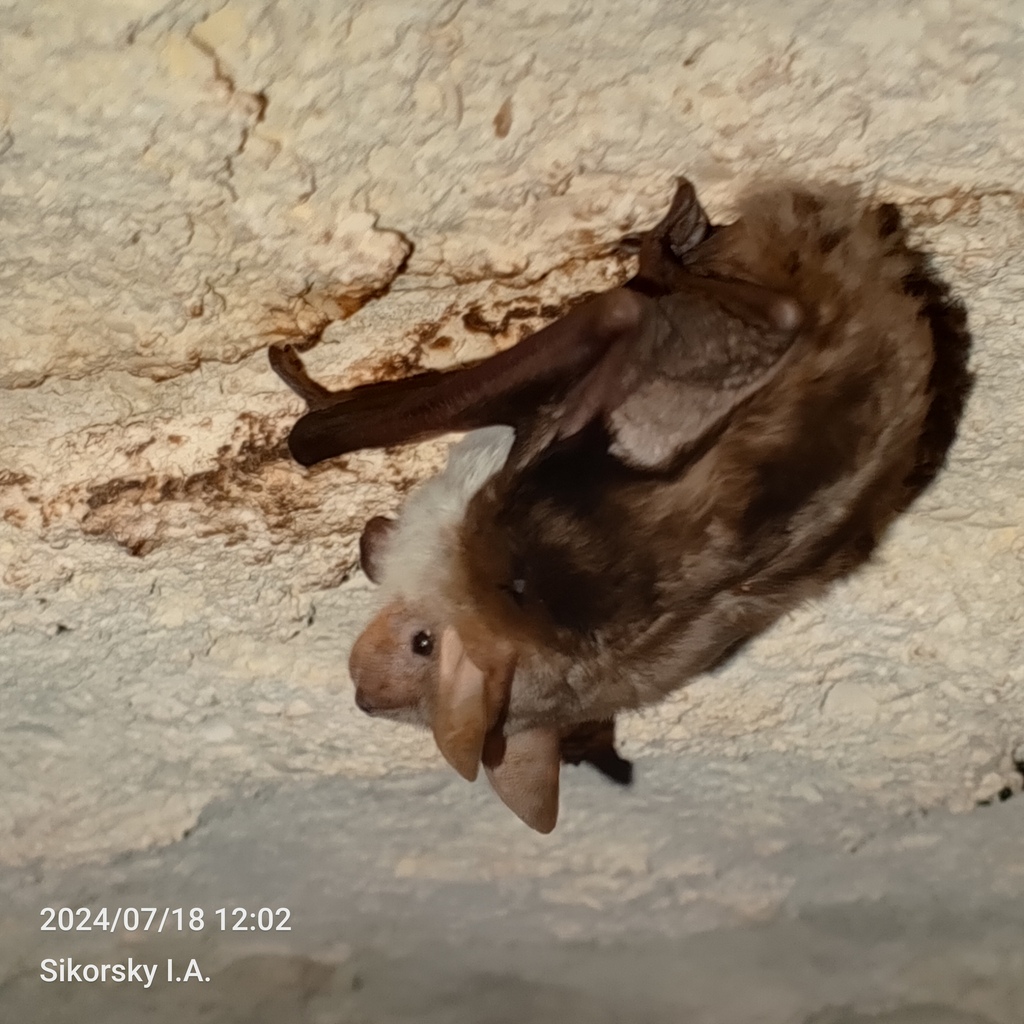
The lesser mouse-eared bat or lesser mouse-eared myotis (Myotis blythii) is a species of insectivorous bat in the family Vespertilionidae. This species has a wide distribution from the Iberian Peninsula to China. == Taxonomy == The lesser mouse-eared bat has a complex taxonomic history. The oldest name is Vespertilio blythii which was given to a single specimen in the British Museum (Natural History) which was labelled "India" by Robert F. Tomes in 1857. In 1885 Francesco Saverio Monticelli described Vespertilio oxygnathus from Italy. Subsequent studies found very little morphological difference between Tomes's taxon in India and the European bats described by Moniticelli and so they were synonymised. Further studies found that the populations found between Europe and India, in Asia Minor, were larger, approaching the greater mouse-eard bat in size and these were named as the subspecies M. blythii omari with a fourth, isolated subspecies being described from southern Siberia and northern China, M. blythii ancilla. == Distribution == Lesser mouse-eared bats can be found in the following countries: Afghanistan, Albania, Austria, Bangladesh, Bulgaria, China, Croatia, France, Georgia, Germany, Greece, Hungary, India, Iran, Iraq, Israel, Italy, Jordan, Kazakhstan, Lebanon, Mongolia, Pakistan, Portugal, Romania, Russia, Slovenia, Cyprus, Spain, Switzerland, Syria, Turkmenistan…
Cévennes National Park
Vebron, France
+187 birds+63 mammals
Where granite gorges slice through the limestone plateaux of southern France, the Cévennes Cœur National Park unfolds across nearly 3,500 square kilometres of one of Europe's…
VIEW NATIONAL PARKVanoise National Park
Val-Cenis, France
+107 birds+29 mammals
Where the French Alps rise in serrated ranks above the Maurienne valley, Vanoise National Park sprawls across more than 1,700 square kilometres of high-altitude wilderness—a realm…
VIEW NATIONAL PARKForêts National Park
Lucey, France
+140 birds+50 mammals
Across the rolling plateaux of central Burgundy, where limestone uplands give way to deep valleys carved by time and water, lies a landscape of profound ecological…
VIEW NATIONAL PARKSierra de Andújar Natural Park
Our Lady of Cabeza, Spain
+198 birds+19 mammals
Where granite gorges slice through Mediterranean scrubland and cork forests cascade down Andalusian hillsides, one of Spain's most pristine wilderness areas unfolds across 74,000 hectares of…
VIEW NATURAL PARKRegional Park of the Catalan Pyrenees
Olette, France
+244 birds+63 mammals
Where granite peaks thrust skyward above cloud-laden valleys, a wild tapestry of Mediterranean and alpine ecosystems interweaves across the Franco-Spanish frontier. These Pyrenean slopes harbour extraordinary…
VIEW NATURE RESERVEPirin National Park
Bansko, Bulgaria
+124 birds+10 mammals
Where jagged limestone peaks pierce the Macedonian sky, ancient glacial valleys cradle some of Bulgaria's most pristine wilderness. This southwestern corner of the Balkans rises to…
VIEW NATIONAL PARKCentral Balkan National Park
Zhidov dol, Bulgaria
+135 birds+16 mammals
Where granite peaks pierce the Bulgarian highlands, ancient beech and conifer forests blanket mountains that rise dramatically from the Balkan range's heart. This wilderness encompasses three…
VIEW NATIONAL PARKVratsa Balkan
Zgorigrad, Bulgaria
+128 birds+10 mammals
Where limestone cliffs plunge into deep river canyons and beech forests give way to rocky karst plateaus, one of Bulgaria's most dramatic mountain landscapes unfolds across…
VIEW NATURE RESERVECalanques National Park
Bouches-du-Rhône, France
+233 birds+42 mammals
Where limestone cliffs plunge dramatically into crystalline Mediterranean waters, Calanques National Park preserves one of Europe's most striking coastal landscapes. These steep-sided inlets, carved by erosion…
VIEW NATIONAL PARKNo community photos yet. Log in to add the first one.
No community observations of this species yet.