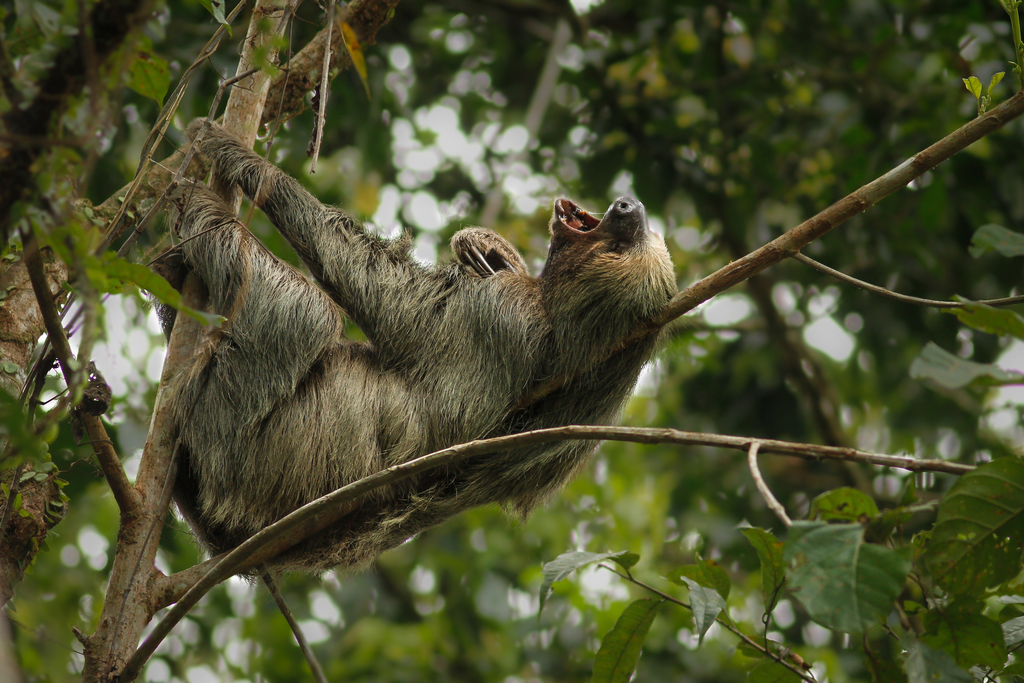
Linnaeus’s Two-toed Sloth
Photo © Julien Renoult
Photo © Julien Renoult — CC BY 4.0 — Source: iNaturalist photo #11095533Identification
Linnaeus's two-toed sloth is the largest extant sloth species, with a body length of approximately 53 to 89 cm (21 to 35 inches), weighing between 4 to 11 kg (9 to 24 pounds). Males and females are identical in size. The species is distinguished by its two claws on the front feet, longer hair, and notably larger eyes compared to three-toed sloths. Their back and front legs are more equal in length than those of their three-toed relatives, and their arms are notably longer, as indicated by their greater shoulder height. The fur ranges from brownish-yellow to pale brown, though in the wild it often takes on a greenish hue from algae growth during the rainy season. The belly fur is slightly lighter than the body fur and flows in the opposite direction from most mammals—towards the spine rather than away from it. Young sloths display softer and darker fur than adults.
Range & Habitat
Linnaeus's two-toed sloth is found throughout northern South America, inhabiting Venezuela, Suriname, Guyana, French Guiana, Colombia, Ecuador, Peru, and Brazil north of the Amazon River, with recent evidence suggesting its range may extend into Bolivia. The species is strictly arboreal and solitary, thriving exclusively in ever-wet tropical rainforests characterized by hot, humid conditions. They favour areas with abundant vine growth, which allows them to move easily through the forest canopy without descending to the ground.
Behaviour & Diet
As a nocturnal and solitary animal, Linnaeus's two-toed sloth is primarily folivorous, feeding mainly on leaves, though detailed dietary information remains limited due to their night-time activity and effective camouflage. The species possesses an exceptionally low metabolic rate, with correspondingly low food intake and defecation rates despite their relatively large body mass. Their extremely long digestion period—caused by low defecation rates and large digestive systems—results in notably high methane production, exceeding that of most similar herbivores.
Two-toed sloths are notably good swimmers, capable of crossing rivers and creeks. However, this ability may expose them to predation by green anacondas. On the ground, where they descend primarily to defecate or change trees, they fall prey to wild cats such as ocelots and jaguars, as well as large birds of prey including harpy and crested eagles.
Best Time & Places to See It
Observing Linnaeus's two-toed sloth presents a significant challenge due to their nocturnal habits and excellent camouflage within rainforest canopies. The species is distributed across Venezuela, Suriname, Guyana, French Guiana, Colombia, Ecuador, Peru, and northern Brazil, offering multiple geographic opportunities for wildlife travellers. Night excursions in rainforest reserves and protected areas within these countries offer the best chance of encounters, particularly in regions with abundant vine growth where sloths concentrate their foraging activities.
Photography Tips
Photographing Linnaeus's two-toed sloth demands patience and specialized night-time equipment. A reliable headlamp or red-light torch will help locate sloths without causing excessive disturbance, as they are less sensitive to red wavelengths. A telephoto lens is essential, as approaching too closely may stress the animal. Their greenish hue during rainy seasons, caused by algae colonization, can provide striking photographic subjects with unusual coloration. Given their slow movements and nocturnal nature, a camera capable of high ISO performance and fast autofocus in low light will prove invaluable for capturing sharp images in the dim rainforest understory.
Manuel Antonio National Park
Quepos, Costa Rica
+426 birds+22 mammals
Where tropical rainforest descends steeply to a rocky Pacific coastline, Manuel Antonio National Park distills Central American biodiversity into one of Costa Rica's most compressed and…
VIEW NATIONAL PARKYasuní National Park
Aguarico, Ecuador
+601 birds+43 mammals
Where the western Amazon basin converges with Ecuador's Orellana Province, lowland rainforest reaches toward the horizon in an unbroken canopy of staggering botanical density. Yasuní National…
VIEW NATIONAL PARKPodocarpus National Park
Zamora, Ecuador
+496 birds+6 mammals
Where the Andes descend toward the Amazon basin, Podocarpus National Park sprawls across nearly 2,800 square kilometres of the most biodiverse terrain in Ecuador's southern highlands.…
VIEW NATIONAL PARKNo community photos yet. Log in to add the first one.
No community observations of this species yet.