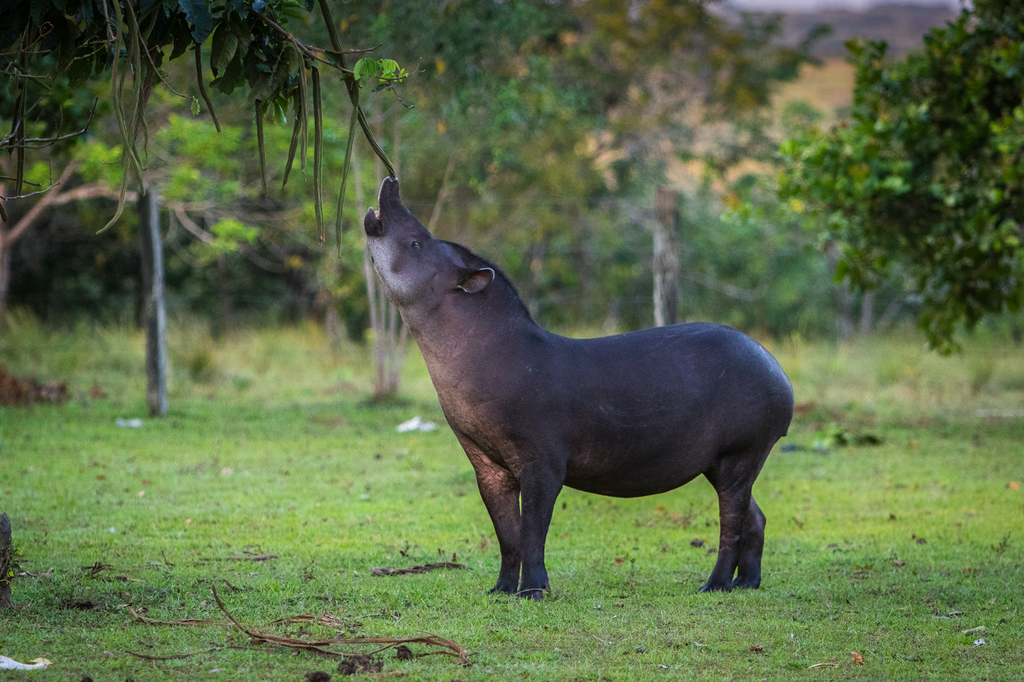
Lowland Tapir
Photo © Diego Lizcano
Photo © Diego Lizcano — CC BY 4.0 — Source: iNaturalist photo #128647291Identification
The lowland tapir is the largest surviving native terrestrial mammal in the Amazon. Adults are dark brown with a paler face and display a distinctive low, erect crest running from the crown down the back of the neck. Their round, dark ears have characteristic white edges. Body length ranges from 1.8 to 2.5 meters, with a short stubby tail of only 5 to 10 centimeters. Adults typically weigh around 225 kilograms, though weights range from 150 to 320 kilograms, and stand between 77 and 108 centimeters at the shoulder. Newborn tapirs are distinctly different, displaying a dark brown coat with small white spots and stripes along their body.
A smaller variant, provisionally called Tapirus kabomani, may exist in Amazonian regions. This potential subspecies weighs only around 110 kilograms, making it the smallest tapir, and exhibits darker coloration than typical lowland tapirs. Females of this form show a characteristic patch of light throat hair extending from chin to ear.
Range & Habitat
Lowland tapirs are found near water throughout the Amazon rainforest and river basin in South America, east of the Andes. Their range extends from Venezuela, Colombia, and the Guianas in the north southward through Brazil, Argentina, and Paraguay, and westward into Bolivia, Peru, and Ecuador. Rare individuals occasionally cross to Trinidad, though no breeding population exists there. Notably, the species was observed in Rio de Janeiro state in 2024 for the first time since 1914, indicating forest recovery in the region.
The smaller Tapirus kabomani variant inhabits mosaics of forest and savanna, with confirmed records from southern Amazonas, Rondônia, and Mato Grosso in Brazil, and suspected presence in Colombian Amazonas, northern Bolivia, Amapá, and French Guiana.
Behaviour & Diet
Lowland tapirs are excellent swimmers and divers yet move with surprising speed on land, even traversing rugged mountainous terrain. They are semi-aquatic, spending considerable time in water and often sleeping on riverbanks. In the wild, these tapirs face predation from black caimans, Orinoco crocodiles, jaguars, and cougars, which frequently hunt them at night when they leave the water. Green anacondas also prey on tapirs. Despite their herbivorous diet, lowland tapirs are capable of fierce self-defense, possessing an extremely powerful bite.
These animals have a lifespan of approximately 25 to 30 years in the wild.
Best Time & Places to See It
Look for lowland tapirs near water sources throughout the Amazon basin—along rivers, streams, and wetland areas where they spend much of their time swimming and foraging. Dawn and dusk are prime observation times, as these are periods of greatest activity. The species is most reliably seen during wetter seasons when water levels are higher and tapirs congregate near reliable water sources. Protected rainforest areas and national parks within the Amazon basin offer the best chances for encounters.
Photography Tips
Position yourself near water sources and riverbanks during early morning or late afternoon light for optimal photography. The tapir's distinctive pale face, white-edged ears, and prominent neck crest are key features to capture. Since tapirs are primarily crepuscular and semi-aquatic, be prepared for low-light conditions and potentially wet environments. Patience and stillness are essential—allow the tapir to approach rather than pursuing. Capture behavioral shots of them swimming or wading, as these showcase their aquatic adaptations. A telephoto lens is recommended to maintain safe distance while achieving detailed frame-filling compositions.
Bahuaja Sonene National Park
Baritú National Park
Brasília National Park
Calilegua National Park
Campos Amazónicos National Park
Carlos Botelho State Park
Chapada dos Guimarães National Park
Chapada dos Veadeiros National Park
El Rey National Park
Nothing matches these filters.
No community photos yet. Log in to add the first one.
No community observations of this species yet.