Maned Serow
Photo © Focus Saranpat Ouilapan
Photo © Focus Saranpat Ouilapan — CC BY 4.0 — Source: iNaturalist #204556398Identification
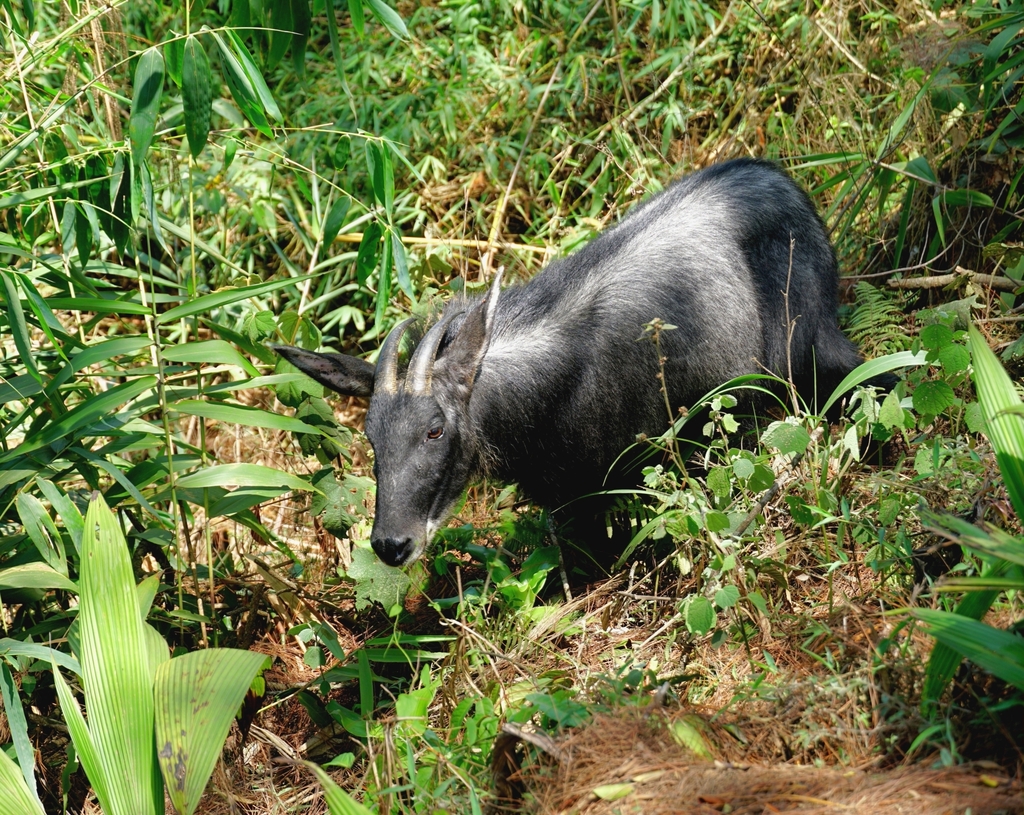
The maned serow is a compact, goat-like ungulate standing around 91 cm (3 ft) at the shoulder and weighing approximately 91 kg (200 lb). Its most distinctive feature is the prominent mane that runs from the horns down the middle of the back between the scapulae, giving the animal its common name. The coat consists of coarse, bristly guard hairs overlaying a dense fur layer. Males possess light-colored horns measuring approximately 150 mm (6 in) in length that curve slightly backward; females lack horns. Both sexes share the same compact build and robust appearance, making them instantly recognizable in their montane forest habitat.
Range & Habitat
The maned serow has a broad distribution across Asia, occurring in central and southern China, India, Vietnam, Cambodia, Laos, Myanmar, Thailand, and the Indonesian island of Sumatra. This species shows considerable elevation flexibility depending on geography and season. In Assam, it inhabits hilly forests above 300 m (980 ft), descending to 100 m (330 ft) during winter months. In the Nepal Himalayas, it strongly prefers higher elevations between 2,500–3,500 m (8,200–11,500 ft), while in Tibet its distribution closely follows forested mountain ranges. The species is fundamentally a forest dweller, as evidenced by fossil evidence from northeastern Thailand, and appears well-adapted to steep, wooded terrain across its extensive range.
Behaviour & Diet
Maned serows are territorial animals that typically live alone or in small groups. Unlike many ungulates that follow strict diurnal or nocturnal patterns, this species demonstrates flexible activity rhythms with peaks of both daytime and nighttime activity, likely an adaptation to their varied environments. Females produce a single young after approximately eight months of gestation. Dietary analysis using dental microwear texture reveals that maned serows are primarily browsing herbivores with a diet dominated by folivory—the consumption of leaves and other plant foliage. This browsing specialization suits their forest habitat perfectly, allowing them to exploit food sources unavailable to grazing species.
Best Time & Places to See It
Observing maned serows requires patience and access to suitable montane forest habitat. The Himalayan regions of Nepal and India offer excellent opportunities, particularly at elevations between 2,500–3,500 m where the species is most predictably found. In Southeast Asia, forested mountains in Myanmar, Thailand, Laos, and Cambodia provide habitat, though sightings are less common. Winter months in lower-elevation regions like Assam may offer better chances as animals descend to more accessible elevations. Early mornings and late afternoons may yield better results given the species' flexible activity patterns, though encounters require both timing and considerable luck in remote forest terrain.
Photography Tips
Photographing maned serows presents considerable challenges due to their shy, territorial nature and preference for dense forest. A telephoto lens of at least 200–400 mm is essential for capturing details from a safe distance that respects the animal's wariness. The distinctive mane is the key identifying feature—positioning yourself to capture it in profile or from slightly above will showcase this characteristic best. Early morning light filtering through forest canopy can create atmospheric images, though the dense vegetation typical of serow habitat often limits opportunities. Patience, stillness, and high ISO settings to compensate for low forest light are essential. Capturing the animal's horns (in males) and coarse coat texture requires close focus and good shutter speed to overcome subject movement in challenging lighting conditions.
Langtang National Park
Helambu, Nepal
+364 birds+14 mammals
Where the southern slopes of the Himalayan highlands descend toward the subtropical valleys of central Nepal, Langtang National Park sprawls across one of the subcontinent's most…
VIEW NATIONAL PARKKhao Yai National Park
Prachantakham District, Thailand
+377 birds+46 mammals
Evergreen dipterocarp forest blankets the rolling terrain of this national park in eastern Thailand, where limestone hills rise abruptly from the forest floor and seasonal streams…
VIEW NATIONAL PARKGiant Panda National Park
Mianyang, China
+447 birds+47 mammals
Where the eastern slopes of China's Sichuan plateau descend into cloud-wrapped valleys, one of Asia's most biodiverse landscapes unfolds across more than 350,000 square kilometres. This…
VIEW NATIONAL PARKSanjiangyuan National Park
Nagqu, China
+187 birds+25 mammals
Where the headwaters of three great Asian rivers emerge from a high alpine plateau, the landscape unfolds in tundra and dwarf shrubland—a world of austere beauty…
VIEW NATIONAL PARKWolong National Nature Reserve
Wenchuan County, China
+333 birds+17 mammals
Where the Qingyi River cuts through the eastern flanks of the Minshan Range, a temperate montane forest cloaks steep valleys in dense canopy that thins dramatically…
VIEW NATURE RESERVENo community photos yet. Log in to add the first one.
No community observations of this species yet.