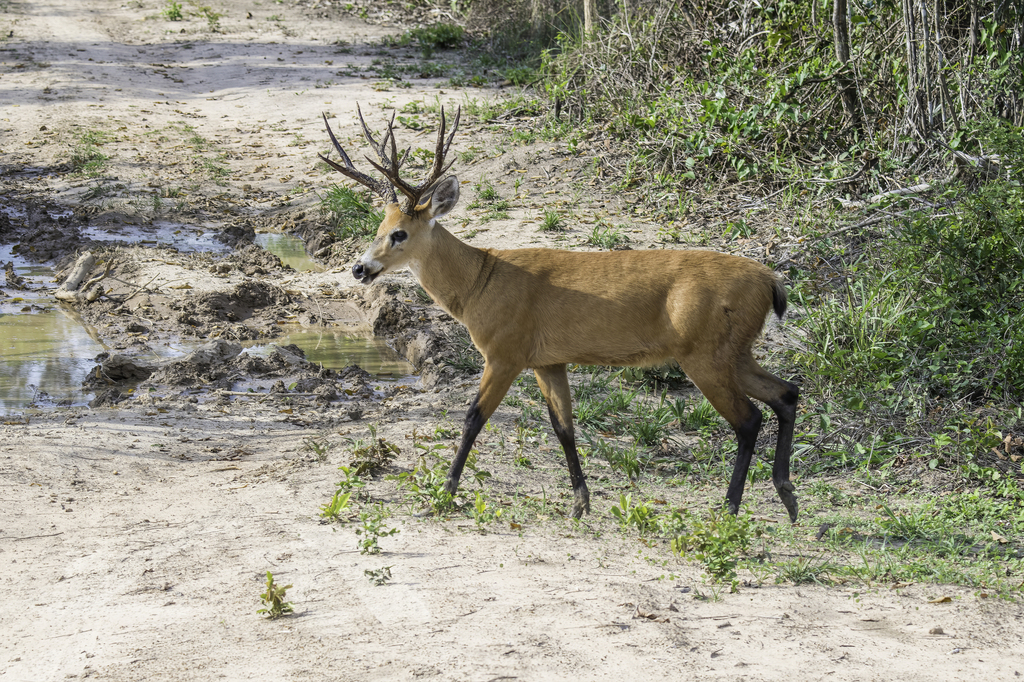
Marsh Deer
Photo © Emily Turteltaub Nelson
Photo © Emily Turteltaub Nelson — CC BY 4.0 — Source: iNaturalist photo #618693113Identification
The marsh deer is South America's largest living deer species, resembling the North American mule deer with distinctively large ears lined with white hairs. Adults display red-gold to tawny brown fur that darkens in winter, with white marks around the eyes and hips. The legs are black below the tarsal joint, as is the muzzle, while the short tail is reddish above and black underneath. Males stand 100–127 cm at the shoulder with head-and-body length of 153–200 cm, weighing 80–125 kg on average, occasionally reaching 150 kg. Only males bear antlers—heavy, irregular, amber-colored structures reaching 60 cm in length. Females are noticeably lighter at around 70 kg. A key adaptation is the large hoof with elastic interdigital membranes, essential for swimming and traversing marshy terrain.
Range & Habitat
Once widespread across tropical and subtropical South America east of the Andes, marsh deer are now found in fragmented populations across Argentina, Bolivia, Peru, Brazil, Uruguay, and Paraguay. They inhabit the Paraná, Paraguay, Araguaia, and Guapore river basins, with smaller populations in the southern Amazon, including Peru's Bahuaja-Sonene National Park. The species is strictly confined to marsh and lagoon zones where water depth remains below 70 cm. The Pantanal and Chaco wetlands represent crucial strongholds. Listed as vulnerable by the IUCN and protected under CITES Appendix I, habitat destruction from dam construction and agricultural drainage poses the greatest modern threat.
Behaviour & Diet
Marsh deer are typically solitary or occur in small groups of fewer than six individuals, led by an adult male. They are swift swimmers adapted to wetland life, with jaguars and pumas as their primary natural predators. These animals exhibit a migratory pattern following seasonal water-level fluctuations, allowing them to exploit newly exposed food sources during dry seasons and track flooded areas in wet seasons. Diet comprises over 40 plant species, predominantly grasses (Graminae, 22% of diet), Pontederiaceae (12%), and Leguminosae (11%), supplemented by aquatic flowers and shrubs. They function as grazer-browsers, with dietary composition shifting seasonally.
Best Time & Places to See It
The dry season concentrates marsh deer in higher densities at marsh boundaries, particularly around the Rio Negro marshland, making this the optimal viewing period. The Pantanal Wetland in Brazil and protected areas within Argentina and Paraguay offer the best opportunities. Argentina's newly established Ciervo de los Pantanos National Park provides dedicated protection. Peru's Bahuaja-Sonene National Park harbors small but genuine populations. Success requires patience and early-morning or late-afternoon visits to marsh edges, as these elusive cervids remain vigilant and mobile.
Photography Tips
Photograph marsh deer during the dry season when populations concentrate at predictable locations. The large ears and white eye-rings offer striking compositional elements; shoot early or late in the day to capture warm golden light that complements their reddish-brown coats. Male antlers are distinctive and photograph well in profile. Patient stalking along marsh boundaries is essential—these are wary animals despite the absence of large predators in most areas. Wide-angle environmental shots showing the deer in their marshy habitat convey their ecological specialization effectively. The contrast between their dark legs and paler body creates pleasing visual composition.
Emas National Park
Encontro das Águas State Park
Guirá State Park
Pantanal Matogrossense National Park
Rio Negro Pantanal State Park
Nothing matches these filters.
No community photos yet. Log in to add the first one.
No community observations of this species yet.