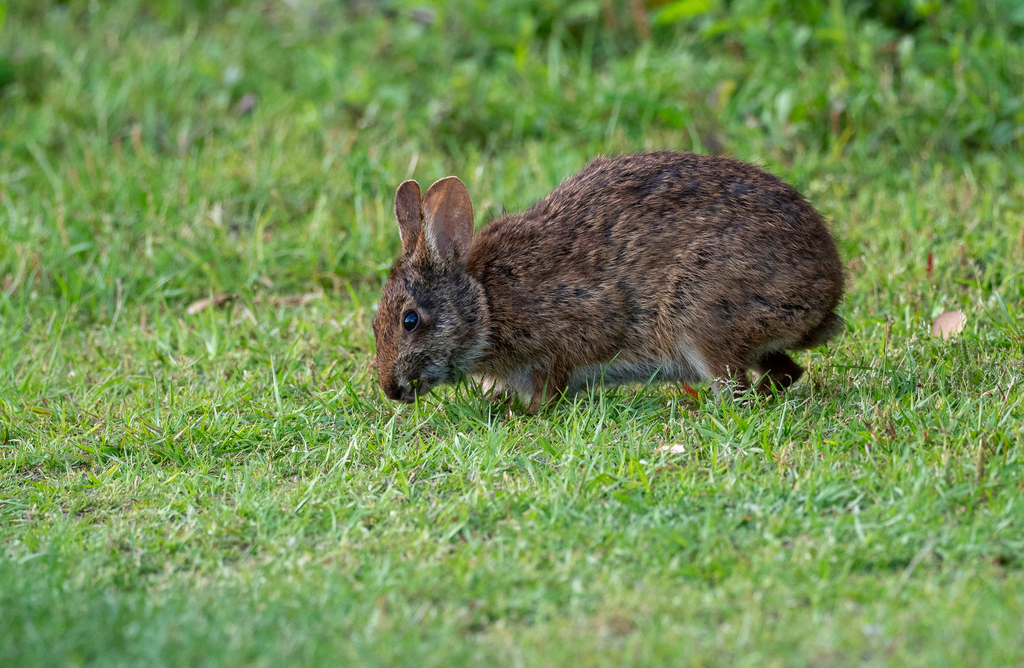
Marsh Rabbit
Photo © Forest Botial-Jarvis
Photo © Forest Botial-Jarvis — CC BY 4.0 — Source: iNaturalist photo #128545327The marsh rabbit (Sylvilagus palustris) is a small cottontail rabbit found in marshes and swamps of coastal regions of the Eastern and Southern United States, from Virginia to the lower Florida Keys. Being a small brown rabbit, it is similar in appearance to the widespread eastern cottontail (Sylvilagus floridanus), but is characterized by its smaller ears, legs, and tail, as well as its grayish-brown underparts. Marsh rabbits are common throughout their range, except for in the Everglades, where the invasive Burmese python has reduced their numbers, and the lower Florida Keys, where the subspecies known as the Lower Keys marsh rabbit (Sylvilagus palustris hefneri) is threatened by rising sea levels and human development of the land. They prefer to live in marshes, swamps, and alongside coastal waters and rivers, as they are excellent swimmers. The marsh rabbit is often compared to the aquatic swamp rabbit (Sylvilagus aquaticus), which is found along the Gulf coast and further inland in the southeastern United States, though the swamp rabbit has larger ears, tail and legs, as well as a distinctly white underside of its tail. Like other rabbits, the marsh rabbit is a herbivore, and will eat the leaves and bulbs of various…
Everglades National Park
Monroe County, United States
+345 birds+22 mammals
Where freshwater marsh meets subtropical sky, the Everglades sprawls across southwestern Florida as one of North America's most expansive wetland ecosystems. Spanning over 13,000 square kilometers,…
VIEW NATIONAL PARKCongaree National Park
Richland County, United States
+205 birds+12 mammals
Where the Congaree River winds through the lowlands of South Carolina, an old-growth bottomland forest of extraordinary character rises from a landscape shaped by seasonal floods…
VIEW NATIONAL PARKJ.N. “Ding” Darling National Wildlife Refuge
Sanibel, United States
+277 birds+6 mammals
Mangrove channels and coastal marshlands dominate this 6,400-acre sanctuary on Florida's Gulf coast, where brackish waterways weave between dense stands of red, black, and white mangrove…
VIEW WILDLIFE SANCTUARYMerritt Island National Wildlife Refuge
Brevard County, United States
+341 birds+19 mammals
Brackish marshes and palmetto scrub define this wildlife sanctuary spanning the coastal lowlands of central Florida, where the Atlantic tide meets freshwater systems in a dynamic…
VIEW WILDLIFE SANCTUARYOkefenokee National Wildlife Refuge
Charlton County, United States
+206 birds+14 mammals
Vast wetlands of cypress and blackwater creeks define this wildlife sanctuary straddling the Georgia–Florida border, where the landscape shifts between open marsh, dense swamp forest, and…
VIEW WILDLIFE SANCTUARYAlligator River National Wildlife Refuge
Dare County, United States
+288 birds+17 mammals
Where the coastal plain of North Carolina meets the Albemarle Peninsula, a sprawling mosaic of freshwater marshes, pocosins, and swamp forest creates one of the Atlantic…
VIEW WILDLIFE SANCTUARYPelican Island National Wildlife Refuge
Windsor, United States
+265 birds+4 mammals
Where Florida's Indian River widens into a brackish estuary, a small island sanctuary commands the attention of waterbirds across the Atlantic Flyway. Pelican Island National Wildlife…
VIEW WILDLIFE SANCTUARYSt. Marks National Wildlife Refuge
Saint Marks, United States
+324 birds+16 mammals
Where the Apalachee Bay begins to define the Florida coastline, salt marshes and freshwater impoundments merge into one of the southeastern United States' most productive wildlife…
VIEW WILDLIFE SANCTUARYNo community photos yet. Log in to add the first one.
No community observations of this species yet.