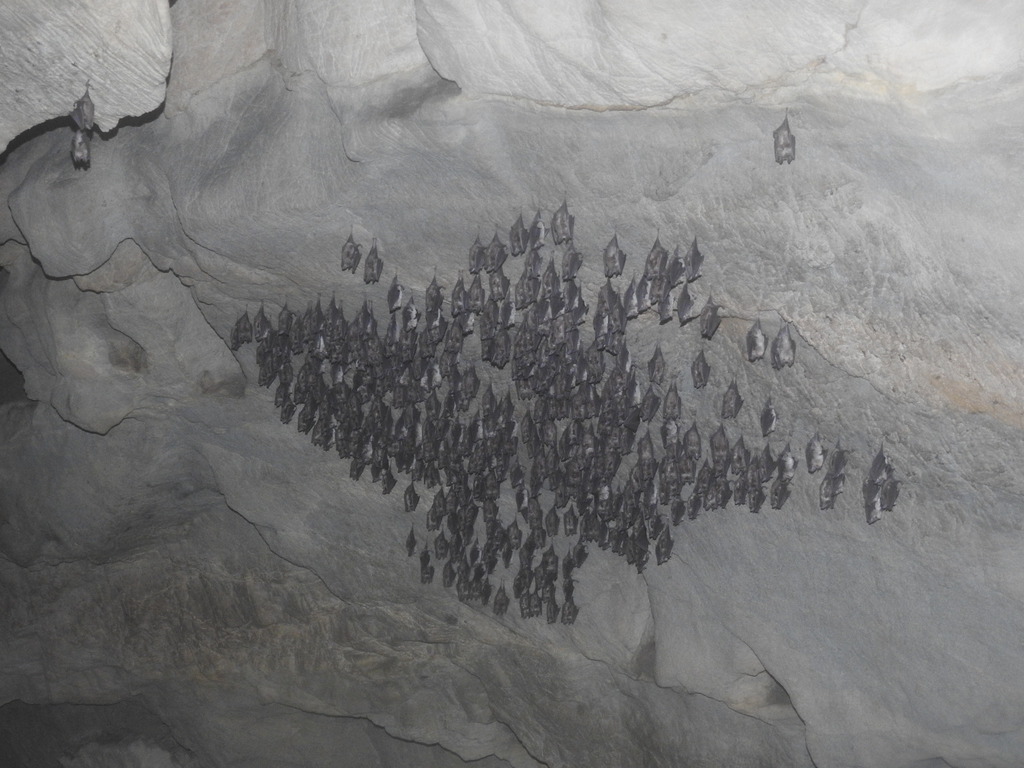
Mediterranean Horseshoe Bat
Photo © Yves Bas
Photo © Yves Bas — CC BY 4.0 — Source: iNaturalist #105375250Identification
The Mediterranean horseshoe bat is a small insectivore with a head and body length of 43–58 millimetres and a relatively short tail of 22–30 millimetres. It has a wingspan of 30–32 centimetres and weighs between 8 and 17.5 grams, making it one of the more diminutive horseshoe bats. The species is distinguished by its characteristic horseshoe-shaped nose leaf, with a pointed upper connecting process that is noticeably longer than the broadly rounded lower process. Its fluffy fur has a light grey base, with the back displaying grey-brown colouration that may have a slight reddish tinge, while the underside is grey-white to yellow-white.
Range & Habitat
This species is endemic to the Mediterranean region and the Balkan peninsula, with populations also found in parts of Italy. The Mediterranean horseshoe bat favours areas with suitable vegetation for foraging and relies heavily on caves and underground shelters for roosting. Unfortunately, the species has experienced general population decline over the past 27 years, largely due to agricultural expansion and urbanization that destroy the insect-rich vegetation on which it depends for survival.
Behaviour & Diet
As an insectivorous species, the Mediterranean horseshoe bat hunts small flying insects in flight. It is highly social, forming exceptionally large colonies in caves that can exceed 5,000 individuals, surrounded by smaller satellite colonies of dozens to hundreds of animals. Summer colonies are often mixed with other bat species, such as Blasius's horseshoe bat and Mehely's horseshoe bat. Females establish nurseries housing 50–400 individuals, sometimes accompanied by males. Young bats become independent at four weeks of age, and females reach reproductive maturity at 2–3 years old. Mating occurs primarily in autumn within caves, though it may continue into winter roosts. The species is extremely sensitive to disturbance.
Best Time & Places to See It
Young are born from mid-June through July, making summer an excellent season to observe maternal colonies and juvenile bats. Cave systems throughout the Mediterranean region and Balkans, particularly in Bulgaria and Italy, are prime locations for encounters. Visit established cave roosts during dawn or dusk when bats emerge to forage. However, visitors must approach these sites with caution and respect, as the species is highly sensitive to disturbance.
Photography Tips
Photographing this delicate bat requires patience and minimal disturbance. Use high-speed film or digital sensors capable of capturing rapid movement in low light conditions. Position yourself at cave entrances during emergence times at dusk, when bats are most active and light levels are still workable. Infrared or night-vision equipment can be valuable for observing roosting behaviour without disturbing the colonies. Always prioritize the bats' welfare over obtaining the shot, maintaining respectful distance and avoiding flash photography within cave systems.
Causses du Quercy Regional Nature Park
Cévennes National Park
Corse Regional Nature Park
Forêts National Park
Grands Causses Regional Nature Park
Haut-Jura Regional Nature Park
Landes de Gascogne Regional Nature Park
Loire-Anjou-Touraine Regional Nature Park
Monts d’Ardèche Regional Nature Park
Nothing matches these filters.
No community photos yet. Log in to add the first one.
No community observations of this species yet.