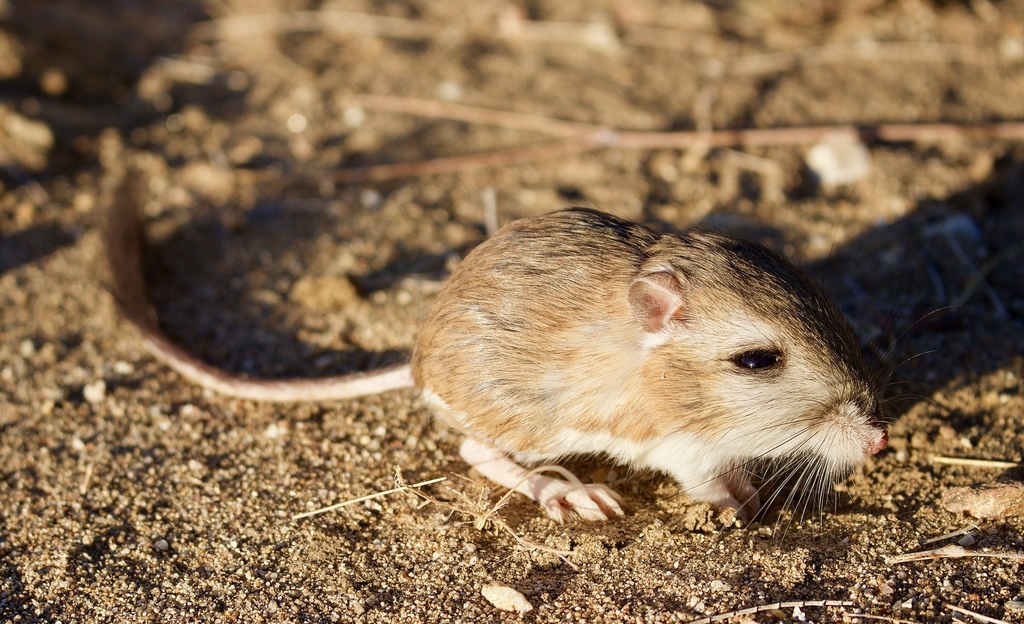
Merriam’s Kangaroo Rat
Photo © Bill Levine
Photo © Bill Levine — CC BY 4.0 — Source: iNaturalist photo #11725211Identification
Merriam's kangaroo rat is the smallest of the southwestern kangaroo rats, averaging about 14 inches in total length. Like all kangaroo rats, it is instantly recognizable by its extremely long, powerful hind feet and almost entirely bipedal posture—it hops and jumps rather than runs or scurries. The species has light brown or tan fur on its back, with coloration varying slightly between populations. A distinctive feature is the relatively long tail with a prominent tuft of hair at the tip, which acts like arrow fletching to stabilize the animal during its hopping locomotion. Merriam's kangaroo rats possess four toes on each hind foot, distinguishing them from some related species. Like other members of the family Heteromyidae, they have distinctive fur-lined cheek pouches used as portable food caches.
Range & Habitat
Merriam's kangaroo rat inhabits the Upper and Lower Sonoran life zones across the southwestern United States, Baja California, and northern Mexico. The species thrives in diverse arid and semi-arid environments, including desert scrub, alkali scrub, sagebrush steppe, pinyon-juniper woodland, and Joshua tree habitat. These rodents are highly adapted to harsh desert conditions and are found throughout much of the region's most challenging terrain.
Behaviour & Diet
Merriam's kangaroo rats are strictly nocturnal and solitary, with males and females each maintaining separate territories that they vigorously defend against intruders of either sex. They construct complex burrow systems with multiple entrances positioned at the base of shrubs, providing escape routes from predators. Remarkably, these animals reduce their above-ground activity during bright moonlit nights, retreating underground to minimize predation risk—in some areas, foraging is limited to just two hours or less per night. During the day, they remain in their cool burrows, often sealing entrances with soil to prevent heat exposure.
The diet consists almost exclusively of plant seeds from desert and grassland plants. Kangaroo rats have evolved a remarkable water-conservation strategy: they rarely drink water, instead obtaining moisture through metabolic processes and the water content of seeds. Their cheek pouches allow them to collect and transport large quantities of seeds to their burrows, where the humid burrow environment causes seeds to absorb moisture—water the animal later regains when consuming the stored seeds.
Best Time & Places to See It
Merriam's kangaroo rat is nocturnal and elusive, making observation challenging. The best opportunity to encounter them is during night surveys in suitable desert habitat within their southwestern range, particularly during darker lunar phases when they are most active. New moon periods offer the highest likelihood of observing this species above ground. Their presence is often detected through burrow systems and tracks rather than direct sightings.
Photography Tips
Photographing Merriam's kangaroo rat requires specialized night photography techniques, including infrared or thermal imaging equipment, as the species is exclusively nocturnal. Patient observers may set up camera traps near active burrow systems in appropriate habitat. Focus on capturing the distinctive hopping posture, elongated hind feet, and characteristic tail tuft. Early evening or just after dark, during the new moon phase, offers the best window for field observation and photography of this cryptic desert rodent.
Big Bend National Park
Cave Creek Canyon
Chiricahua Mountains
Death Valley National Park
El Vizcaíno
Joshua Tree National Park
Kofa National Wildlife Refuge
Saguaro National Park
Santa Rita Mountains
Nothing matches these filters.
No community photos yet. Log in to add the first one.
No community observations of this species yet.