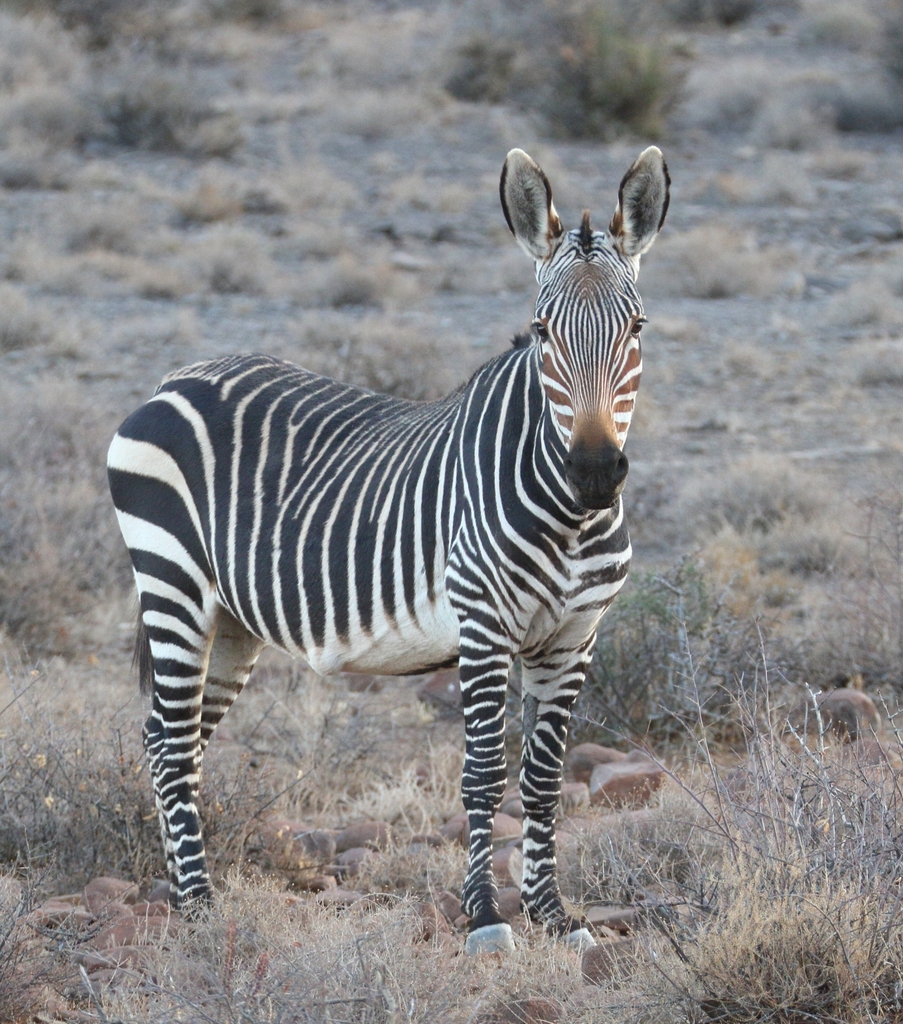
Mountain Zebra
Photo © Alan Manson
Photo © Alan Manson — CC BY 4.0 — Source: iNaturalist #206391398Identification
The mountain zebra is a striking equid instantly recognizable by its bold black or dark brown stripes set against a white or buff ground colour, with the distinctive pattern varying from individual to individual. A key identifying feature is the dewlap—a fold of skin beneath the neck—which is particularly conspicuous in the Cape mountain zebra subspecies. Unlike plains zebras, mountain zebras have stripes covering their entire body except for the belly. Adults measure 2.1 to 2.6 metres in head-and-body length with a shoulder height of 1.16 to 1.5 metres, weighing between 204 and 372 kilograms. The Cape mountain zebra typically has a whiter ground colour, while Hartmann's mountain zebra displays a slightly buff tone and is generally larger overall.
Range & Habitat
Two subspecies of mountain zebra occupy distinct regions of southwestern Africa. The Cape mountain zebra inhabits South Africa, while Hartmann's mountain zebra is found in southwestern Angola and Namibia. These ranges do not overlap, preventing interbreeding between the subspecies. Historically, mountain zebras ranged across the entire length of escarpments along the west coast of southern Africa, though hunting fragmented their populations dramatically.
Mountain zebras prefer mountainous terrain and escarpments with diverse grass species, typically inhabiting slopes and plateaus up to 2,000 metres above sea level. They adapt to hot, dry, rocky environments and migrate to lower elevations during winter. The species occupies mountain slopes, open grasslands, and woodlands where sufficient vegetation exists to sustain them.
Behaviour & Diet
Unlike the gregarious plains zebra, mountain zebras form small family units consisting of a single stallion with one to five mares and their recent offspring. Bachelor males occupy separate groups and compete with harem stallions for young females. Mares produce one foal at a time, nursing for approximately three years. Young zebras disperse from their maternal groups at different ages depending on subspecies: Cape mountain zebra foals leave between 13 and 37 months, while Hartmann's mothers expel foals around 14 to 16 months. Young males may roam solitarily before joining bachelor groups, whereas females either join established herds or form new breeding units with bachelor males.
Mountain zebras are specialized grazers favouring tufted grasses, particularly Themeda triandra, but readily browse bark, twigs, leaves, buds, fruit, and roots when grass is scarce. They drink daily and possess a remarkable adaptation for survival in arid regions: when surface water disappears during droughts, they dig for groundwater in dry riverbeds.
Best Time & Places to See It
The Cape mountain zebra population has recovered dramatically through dedicated conservation efforts and can be viewed in South African national parks and provincial nature reserves that protect approximately 1,030 individuals. Hartmann's mountain zebra populations are safeguarded in protected areas across southwestern Angola and Namibia. Both subspecies are best observed in their mountainous habitats during seasons when water availability is reliable, though the species' daily drinking requirement makes them predictable near water sources. Spring and early summer offer optimal viewing when vegetation is lush and foal numbers are visible.
Photography Tips
The mountain zebra's striking stripe pattern and distinctive dewlap make compelling photographic subjects. The contrast between the bold black markings and white or buff ground colour produces dramatic images, particularly in golden hour light. Photographing family groups reveals behavioural interactions between stallions and mares. The species' preference for mountainous terrain offers spectacular landscape photography opportunities—capture zebras against dramatic escarpment backdrops or silhouetted on plateaus. Their smaller herd size compared to plains zebras allows for more intimate portraiture and detailed documentation of individual markings. Early morning or late afternoon light enhances stripe definition and brings out the subtle colour differences between the two subspecies.
Agulhas National Park
Cape Agulhas Local Municipality, South Africa
+224 birds+13 mammals
Where the Atlantic and Indian Oceans meet at Africa's southernmost tip, Agulhas National Park stretches across 892 square kilometres of windswept coastal landscape and rugged limestone…
VIEW NATIONAL PARKTankwa-Karoo National Park
Hantam Local Municipality, South Africa
+201 birds+20 mammals
Across the semi-arid heartland of the Northern Cape, where winter rains carve ephemeral watercourses through endless ochre plains, Tankwa-Karoo National Park sprawls across more than 3,100…
VIEW NATIONAL PARKMountain Zebra National Park
Inxuba Yethemba Local Municipality, South Africa
+265 birds+35 mammals
Across the windswept plateaus and deeply incised valleys of the Eastern Cape's interior, Mountain Zebra National Park unfolds as a landscape of geological drama and ecological…
VIEW NATIONAL PARKBontebok National Park
Swellendam Local Municipality, South Africa
+204 birds+11 mammals
Where the Cape Fold Mountains give way to coastal lowlands, a landscape of rolling sandstone hills and fynbos heathland creates one of South Africa's most compact…
VIEW NATIONAL PARKAugrabies Falls National Park
Kai !Garib Local Municipality, South Africa
+176 birds+20 mammals
Where the Orange River cuts a dramatic scar through the Northern Cape's arid interior, Augrabies Falls National Park sprawls across nearly 1,200 square kilometers of raw,…
VIEW NATIONAL PARKAddo Elephant National Park
Sundays River Valley Local Municipality, South Africa
+388 birds+55 mammals
Where the Eastern Cape's semi-arid scrublands meet transitional woodland, Addo sprawls across 13,478 square kilometres of one of southern Africa's most biodiverse landscapes. The terrain rises…
VIEW NATIONAL PARKCamdeboo National Park
Camdeboo Local Municipality, South Africa
+272 birds+24 mammals
Granite ridges and weathered sandstone cliffs rise across a semi-arid landscape where the Karoo transitions into the eastern escarpment of South Africa, creating Camdeboo National Park's…
VIEW NATIONAL PARKNamib-Naukluft National Park
Namibia
+217 birds+33 mammals
Across nearly 94,000 square kilometers of southwestern Namibia, a landscape of extremes unfolds where towering sand dunes meet rugged mountain ranges, and ancient riverbeds carve through…
VIEW NATIONAL PARKEtosha National Park
Namibia
+356 birds+58 mammals
Across northern Namibia's stark semi-arid plateau, a vast shallow depression transforms seasonally into one of Africa's most dramatic wildlife theaters. Etosha National Park, encompassing more than…
VIEW NATIONAL PARKNamibRand Nature Reserve
Hammerstein, Namibia
+107 birds+12 mammals
Where rust-coloured dunes surrender to sculpted granite outcrops and vast plains stretch toward an endless horizon, one of southern Africa's most pristine wilderness areas unfolds. The…
VIEW NATURE RESERVENo community photos yet. Log in to add the first one.
No community observations of this species yet.