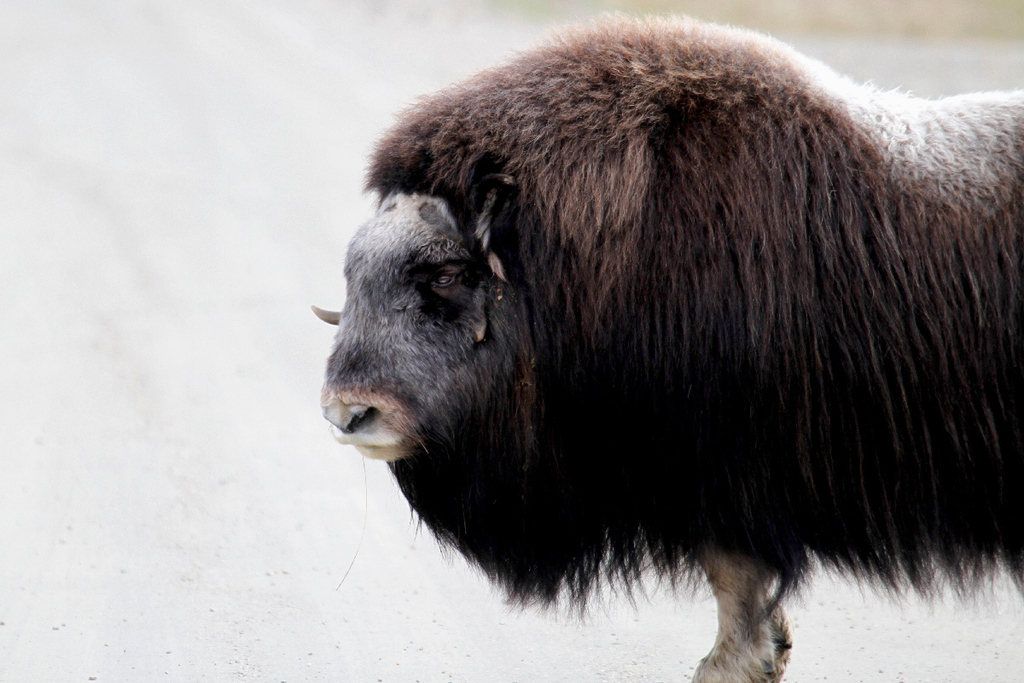
Muskox
Photo © steve b
Photo © steve b — CC0 1.0 — Source: iNaturalist photo #230366459Identification
The muskox is a stocky, heavily built hoofed mammal belonging to the family Bovidae. Despite its name, it is more closely related to sheep and goats than to true oxen, belonging to its own genus Ovibos (Latin for "sheep-ox"). The species is instantly recognizable by its exceptionally thick, long coat that nearly reaches the ground, providing insulation against Arctic conditions. Both males and females bear horns that curve downward and inward.
The most distinctive feature of male muskoxen is the pungent musky odor they emit during the seasonal rut, or mating season—the source of the animal's common name. This strong scent serves to attract females during breeding. The Inuktitut name umingmak, meaning "the bearded one," refers to the shaggy appearance created by their dense coat.
Range & Habitat
Muskoxen are native to the Arctic and are found primarily in Greenland, the Canadian Arctic territories of the Northwest Territories and Nunavut, and Alaska. These animals thrive in tundra and cold grassland environments. Historically, they inhabited Eurasia, though their natural presence in that region ended approximately 2,700 years ago. Today, reintroduced populations exist in Alaska, Canada's Yukon territory, and Siberia, while an introduced population in Norway has partially emigrated to Sweden, where a small but established group now resides.
Behaviour & Diet
Muskoxen are adapted to survive in extreme Arctic conditions through their thick coat and robust build. They are one of the two largest extant members of the caprines (the subfamily that includes sheep and goats), alongside the similarly sized takin. Like other Arctic ungulates, they are herbivorous, grazing on the sparse vegetation available in their harsh habitat. During the breeding season, males produce their characteristic musky odor to attract mates—a behavior unique among their relatives.
Best Time & Places to See It
For travelers seeking muskoxen in their natural habitat, the Canadian Arctic—particularly Nunavut and the Northwest Territories—offers the most reliable opportunities. Greenland is another prime destination. Those interested in reintroduced populations might consider Alaska or the Yukon. The animals are year-round residents of the Arctic, though accessibility varies seasonally due to weather conditions. Summer months typically offer the most practical window for Arctic travel and wildlife observation.
Photography Tips
Muskoxen's thick, shaggy coat and low profile make them visually striking subjects, especially in Arctic landscapes. Their dense pelage creates interesting texture and contrast, particularly during overcast Arctic conditions. Capturing the impressive downward-curving horns and the animal's stocky silhouette against tundra backdrops will convey their adaptation to harsh environments. Patience and distance are essential, as approaching these wild animals should be done with appropriate caution and respect for their space.
Arctic National Wildlife Refuge
Dovrefjell-Sunndalsfjella National Park
Gates of the Arctic National Park
Kangerlussuaq
Northeast Greenland National Park
Quttinirpaaq National Park
Scoresby Sund
Wrangel Island Nature Reserve
Nothing matches these filters.
No community photos yet. Log in to add the first one.
No community observations of this species yet.